The 6 AM class gets training done before work. The evening class might have the coach and partners you want. Then there's the part neither timetable shows: when you'll eat, get home and actually fall asleep.
That's where the morning-versus-evening decision usually gets made. A class can look ideal on paper and still leave you rushing through drills, missing dinner or setting an alarm after another short night.
Neither morning nor evening is universally better for MMA. Choose a well-coached session you can attend consistently while getting enough sleep and food. Later-day power advantages found in exercise tests don't prove that evening classes produce better fighters.
If both classes are genuinely workable, your response to the time of day becomes useful to consider. This guide explains how to make that comparison, including the research, sparring, lifting and a simple diary for trying a schedule without guessing from one good session.
Morning vs evening MMA: the practical comparison
| Your situation | Morning may fit when… | Evening may fit when… |
|---|---|---|
| Work keeps running late | You can train before work without cutting sleep | Your finish time is dependable enough to reach class |
| The class you need | The right coach and suitable partners attend early | The instruction or supervised rounds you need happen later |
| Sleep | You can move bedtime early enough for the alarm | You have time to get home and settle before sleeping |
| Food | You can arrange tolerable food around an early start | You can eat during the day and avoid arriving after a long gap without food |
| Lifting as well | The other session fits without making the day unmanageable | The combined workload still leaves you able to train usefully |
| You have no strong preference | Try the option with fewer practical obstacles | Compare it against the same criteria, not just how energetic one workout feels |
These are planning considerations, not measured advantages of every morning or evening class. An evening session isn't automatically crowded or advanced, and a morning class isn't automatically quieter or more beginner-friendly. Ask about the actual batch.
If you need local options, our morning MMA and boxing classes in Delhi NCR guide separates published class times from general gym opening hours.
What the research can tell you
There are two different questions here: when you can perform best today, and when training will help you improve most over time. Evidence for one does not settle the other.
Some power tests favour later in the day
A systematic review of daily performance variation included 63 articles, with 29 contributing to its meta-analysis. Anaerobic power and jump performance tended to peak later in the day; endurance findings were less clear. The authors also identified a moderately high risk of bias in individual studies.
That is relevant to a sport with explosive actions, but a jump or cycling-power test doesn't measure your ability to read an opponent, learn a takedown or complete an MMA round. It cannot establish an ideal sparring time or a higher win rate.
Use this as a possible explanation for why you feel more powerful later, rather than a reason to abandon a useful morning class. Your coach's feedback and the work you actually complete still matter.
Better performance today doesn't guarantee better long-term gains
A 2023 review of timed strength and endurance training found little evidence that one training time consistently produced greater improvements than another. It included 26 articles, with seven contributing to meta-analyses, and most studies had a high risk of bias.
There was some evidence that training and testing at similar times helped performance. That is more specific than saying everybody should train in the evening. It also concerns strength and endurance interventions, not a trial comparing complete morning and evening MMA programmes.
If you improve at a movement because you practise it regularly with good instruction, a small difference in how powerful you feel at the start needn't decide your entire timetable.
Your body clock may change your response
Chronotype describes differences in people's preferred sleep and activity timing. It is one reason the same clock time may feel different to two people.
A 2025 study of 24 male boxers tested visual reaction time at 9 AM, 1 PM and 5 PM. Results differed between morning-type and evening-type participants, with evening types performing better later and morning types performing worse in the evening than earlier.
It was a small study of a specific reaction test. It doesn't show that a “night owl” should always spar at night, or that a tired beginner has identified their chronotype after two early classes.
Before blaming your body clock, check whether the early slot simply means less sleep, a rushed arrival or missing food. Those are different problems and require different changes.
Sleep is the first constraint to check
An early session needs an early-enough night. A late session needs room after it for the rest of your evening. Count both sides of the timetable.
The 2021 athlete sleep consensus recommends an individual approach rather than treating one sleep-duration range as ideal for every athlete. Training, travel and other demands can interfere with sleep. Your own needs belong in the plan, not just the class start time.
For example, 10:15 PM to 5:30 AM gives you 7 hours 15 minutes in bed. That is an opportunity to sleep, not proof that you slept for that long or that it meets your needs. If you cannot realistically move bedtime, adding an early alarm changes the amount of sleep available.
Does evening MMA ruin sleep?
Not automatically. A 2019 systematic review did not support a blanket claim that evening exercise worsens sleep in healthy participants, though vigorous exercise finishing within an hour of bedtime could be disruptive.
A 2026 review comparing morning and evening exercise likewise found no clear overall morning advantage for most sleep outcomes. It did find a signal for more wakefulness after initially falling asleep with evening exercise, while warning about possible small-study effects. Intensity and proximity to sleep remain relevant.
A technical class ending at 7:30 PM and demanding rounds ending at 10 PM are therefore different scheduling questions. Write down what you trained, when it ended and when you went to bed; “evening MMA” alone leaves out too much.
Is a four-hour gap a rule?
A 2025 wearable-data study followed 14,689 active people. Later, more strenuous exercise was associated with poorer subsequent sleep, while sessions ending at least four hours before sleep onset were not associated with those changes.
This was observational, used wearable measurements and included WHOOP-affiliated authors. It wasn't an MMA trial establishing that four hours is necessary or sufficient for you. Nor does it prove that an evening session causes poor sleep whenever the gap is shorter.
If late hard sessions repeatedly leave you awake, try an earlier finish or discuss reducing the late-session demand with your coach. If sleep problems persist or daytime sleepiness affects your safety, seek appropriate clinical advice rather than trying to solve them with a training timetable alone.
Morning MMA: make the whole morning work
The main practical attraction is getting a class into a part of the day that work or family commitments may otherwise leave free. But the morning still needs preparation.
Ask the gym which coach teaches the early batch, what the class covers and whether suitable partners attend. A 6 AM “MMA” slot might rotate between striking, wrestling and grappling across the week. It may not teach the same material as the evening class.
Then plan the departure time, getting changed and the journey afterwards. If you need a shower before work, confirm one is available. Avoid building the plan around a facility you haven't checked.
Arrive with enough time to follow the coach's warm-up and build into the session. Getting there late and rushing straight into live work isn't a useful way to judge whether morning training suits you.
Do you have to train fasted?
No. Morning training and fasted training are separate choices.
A review of fasted versus fed exercise found a benefit from pre-exercise feeding for prolonged aerobic performance, but not shorter aerobic exercise. That doesn't answer every question about intermittent striking and grappling, and it doesn't establish a universal breakfast rule for MMA.
Arrange food you tolerate around the session. A banana or toast before class may be a practical option for some people; others need a different amount or more time. Those are examples to discuss or try during ordinary training, not a prescribed menu or an instruction to force food immediately before rounds.
If a medical condition, medication, persistent dizziness or dietary restriction affects training without food, get individual guidance. Don't use hard sparring to test whether you can push through feeling unwell.
Evening MMA: protect the hours after class
Evening training can fit well when you have enough time after work to get to the gym, and when the class has the instruction you need. It becomes less workable if every session depends on leaving work early or skipping the rest of the evening.
Check the actual finish time. A listed hour-long class, extra rounds, changing and travelling home can become a much longer commitment. Decide beforehand which extras you can realistically stay for.
Plan food during the day and afterwards rather than arriving after a long gap and hoping to sort everything out at bedtime. The sports-nutrition position statement supports tailoring food, fluids and timing to the training situation; it doesn't prescribe the same meal for everyone at 6 PM.
For more detailed food planning, use our protein guide for MMA and lifting. You don't need to turn this scheduling decision into a separate restrictive diet.
Check the caffeine as well as the class
A 2023 caffeine-and-sleep meta-analysis found that caffeine can reduce sleep duration and disrupt sleep. Dose, timing and individual response matter; “I can fall asleep after coffee” isn't a complete assessment of its effect.
If you need a late coffee or pre-workout to get through class and then struggle at night, record that pattern. Changing the stimulant may be part of the answer. There is no universal caffeine cutoff supplied by this article, and no reason to treat more stimulation as proof that the training slot works.
For beginners, compare the teaching before the clock
Ask both batches the same questions: Who teaches? How are new members introduced? What happens during partner drills? Can you watch or book an appropriate trial?
If the morning class gives you patient instruction and suitable practice while the evening option is a session you're not ready for, the morning has a practical advantage. The reverse can be true at another gym. Neither conclusion comes from a general rule about the time of day.
Use our guide to choosing an MMA gym to assess the class itself. Our first-class walkthrough explains what to ask before joining, including contact and equipment expectations.
What about sparring or preparing for a fight?
Put suitable supervision, partner matching and the purpose of the session ahead of a presumed afternoon performance peak. A later time doesn't make hard contact appropriate, and a morning slot doesn't make it inappropriate.
If you compete, talk to your coach about the likely competition timetable. The training-time research above gives a reason to consider some familiarity with performing near the expected event time. It doesn't justify rearranging every session, losing sleep or guaranteeing an advantage on fight day.
Event schedules can change. A local morning class should not be presented as a way to “reset” your body clock for an uncertain evening bout. Travel and fight-week planning need their own discussion with the people preparing you.
How to fit lifting around MMA
Morning lifting followed by evening MMA is one possible arrangement. So is early MMA with lifting on another day. The useful question is what the combination lets you do well, not whether you have filled both available slots.
Look at the hardest sessions first. If an early lift leaves you unable to do useful work in an important later class, review the lifting load, exercise choices or day with your coach. Moving the lift to another clock time while keeping an excessive week may leave the same problem in place.
Two sessions in a day are not automatically better, and several hours between them do not guarantee recovery. Food, sleep, session demands and your training background all belong in the decision.
Use the weekly MMA and weightlifting plan for scheduling examples and the workload troubleshooting guide when fatigue keeps accumulating. Those articles answer different questions from choosing a morning or evening class.
Does morning MMA burn more fat?
An early start doesn't establish a fat-loss advantage. Neither does turning up without breakfast.
A small 2017 review of overnight-fasted exercise found no advantage for weight loss or body composition over fed exercise, with limited studies and data. It concerned aerobic exercise, not a long-term comparison of morning and evening MMA.
Choose the session that supports useful training and a workable eating pattern. If you're managing a weight class, get appropriate sports-nutrition advice; don't turn an article about class times into a dehydration or rapid-weight-loss plan.
Choose your slot in four steps
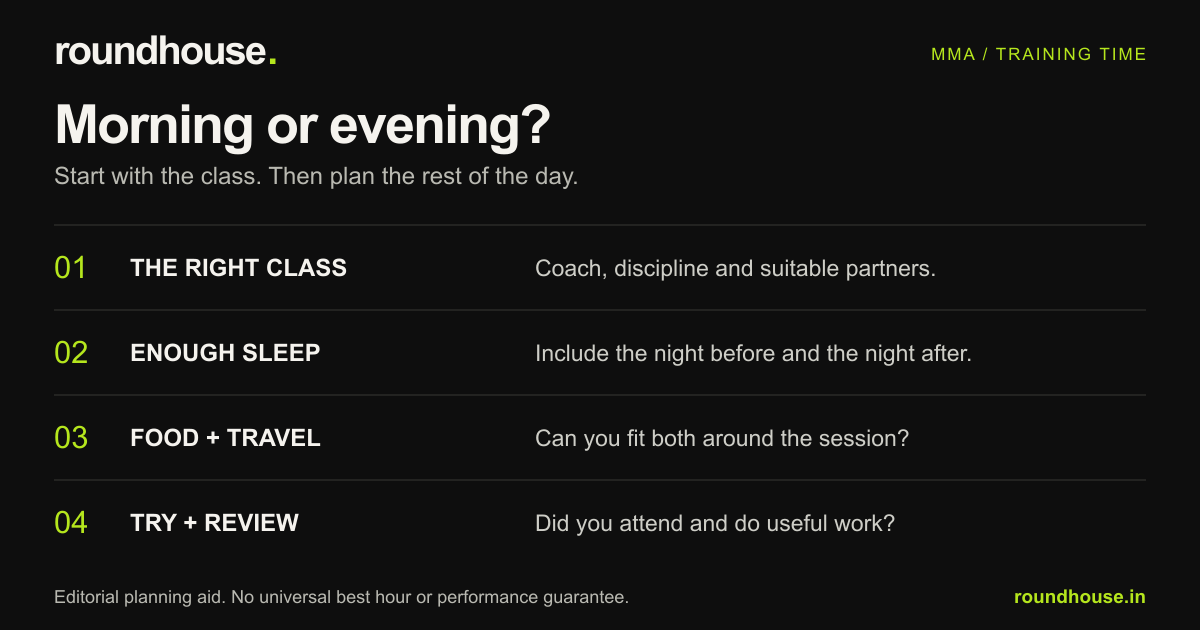
- Find the class you need. Compare the actual instruction, discipline and partners. Remove a slot that doesn't offer appropriate training.
- Write down the night around it. For mornings, include the previous bedtime. For evenings, include the journey home and realistic bedtime afterwards.
- Fit food and travel into the remaining time. Use your own route and working hours. If the plan only works when everything is on time, allow more room or choose another slot.
- Review what happens over ordinary weeks. Keep notes instead of deciding from the first energetic evening or difficult early morning.
If both slots still look workable, start with your preference. You can change the plan after seeing how it affects attendance and the rest of the week.
Three example decisions
| Situation | A reasonable starting choice | What would make you reconsider? |
|---|---|---|
| Work frequently overruns; you can sleep earlier | Try an appropriate morning class | The alarm shortens sleep or the early class doesn't cover your needs |
| Bedtime is late and difficult to move; evenings are free | Try an appropriate evening class | Late finishes repeatedly interfere with sleep or meals |
| The required coached session is only available at one time | Plan around that session first | The rest of the week becomes unsustainable; discuss alternatives |
These are editorial examples. They aren't tested schedules or a claim that one arrangement will work for everyone with that job or sleep pattern.
Keep a short diary before changing the whole week
A couple of weeks of notes can expose practical problems: missed classes, rushed food, delayed bedtime or a journey that takes longer than expected. This is a convenient review window, not enough evidence to prove which time improves your physiology or MMA ability.
Download the two-week training-time diary (CSV). It has room for planned and actual training times, session type, sleep, food/travel fit and comments. Fill it in yourself; there is no recovery score or automatic diagnosis.
Keep the other demands reasonably similar when comparing slots, and record differences you can't control. If the early class teaches technique and the evening class is hard rounds, you are comparing different training as well as different times.
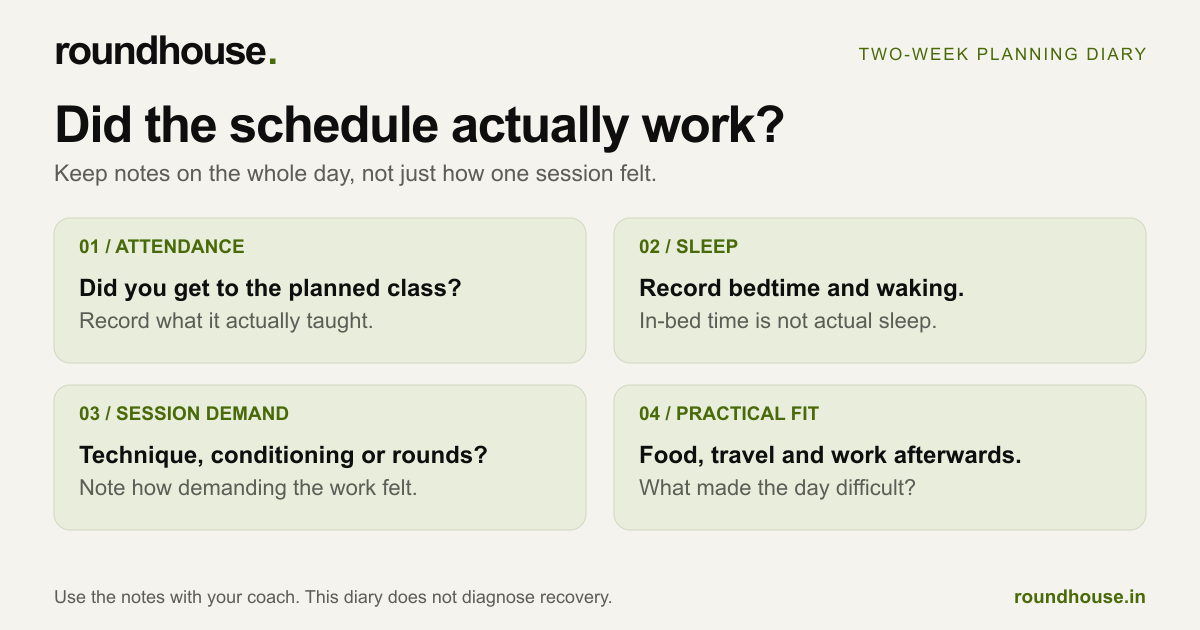
At the end, ask whether you attended, did useful work and had a manageable day afterwards. Discuss repeated difficulties with your coach. One bad session or a wearable's readiness number shouldn't be the sole reason to declare an entire part of the day unsuitable.
To find options, use Find My Gym, then ask the shortlisted gym for its current branch-specific timetable. In Delhi NCR, the early-batches guide gives you published morning leads to start with.
Frequently asked questions
Is morning or evening better for MMA training?
Neither is universally better. Start with appropriate coaching, adequate sleep and a schedule you can attend. Some later-day advantages appear in general power tests, but that doesn't prove evening classes produce better MMA progress or fight outcomes.
Will evening MMA affect my sleep?
It can, particularly if demanding work finishes close to bedtime, but evening exercise isn't automatically disruptive. Record the actual finish time, session demand, caffeine and subsequent sleep. Repeated problems justify adjusting the schedule; persistent sleep difficulties need appropriate professional advice.
Can I do MMA in the morning without breakfast?
Morning training doesn't require fasting. Plan food you tolerate around the session and consider the demands of the class. General exercise findings don't establish one breakfast rule for MMA. Seek individual advice if a medical condition or medication makes exercising without food an issue.
Is morning MMA better for weight loss?
An early or fasted session doesn't establish better long-term fat loss. The fasted-exercise evidence discussed above isn't proof about MMA scheduling. Choose a sustainable training and eating arrangement, and get sports-nutrition support for weight-class goals.
Can I lift in the morning and train MMA in the evening?
Possibly, if the combined workload suits your experience, food, sleep and recovery. The gap between sessions isn't a guarantee. Protect the important training and review lifting that repeatedly leaves you unable to work well in MMA.
Can I mix morning and evening classes?
Yes, if the combination works around sleep and the class content you need. Check the transition between a late session and an early alarm in particular. A mixed timetable isn't automatically a problem, but fitting every available class into the week isn't a goal by itself.
Should a beginner choose the quieter batch?
Only if it also has suitable instruction and partners. We haven't established that mornings or evenings are generally quieter. Ask the gym about the actual batch and try an appropriate session before committing.
Should I train at the same time as my next fight?
Discuss some practice near the likely event time with your coach, especially if it differs substantially from your usual routine. Evidence about matching training and testing times isn't a guarantee about fight outcomes, and uncertain event timing doesn't justify sacrificing sleep.