Your first MMA class can be the hardest one to walk into. You don’t know the rules, the people, or what’s expected of you.
Here’s how to prepare, what an introductory class might involve, and what to check afterwards. Ask your gym about its actual format: the minute-by-minute walkthrough below is an editorial example, not a class we observed or a promise about every gym.
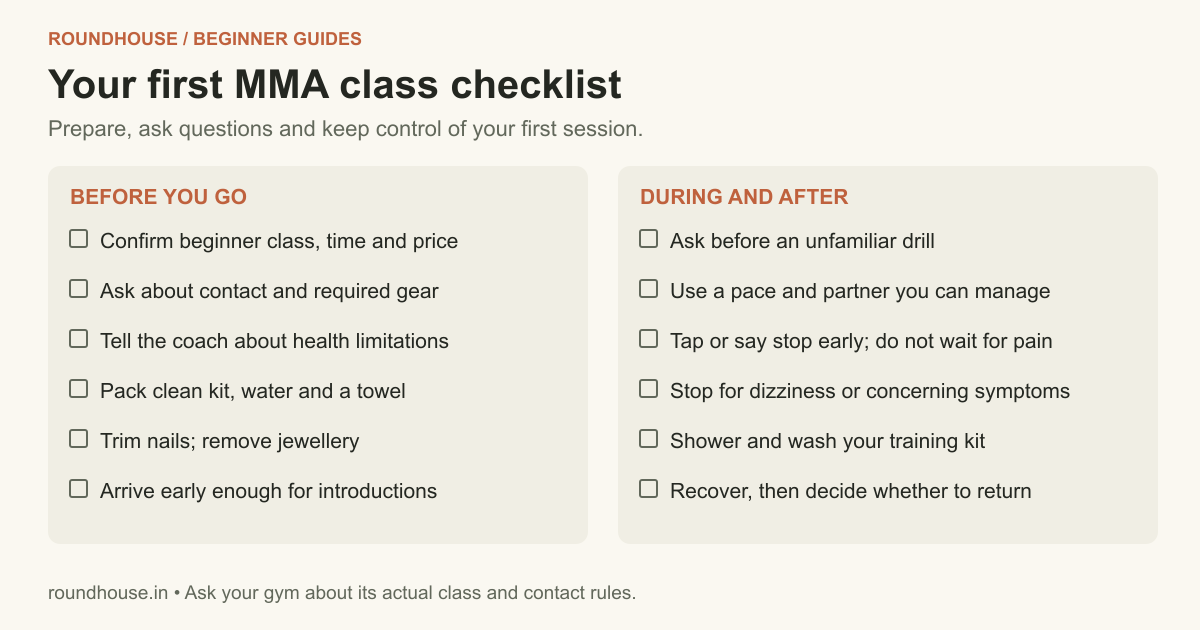
The short answer: what happens on day one?
You may feel tired or awkward, and a beginner-friendly coach should explain the class without expecting prior knowledge. Expect basic movement, demonstrations and controlled practice. You should not be pressured into hard sparring or a drill you do not understand or agree to.
A useful first-session goal is to learn a few basics and assess the coaching, partners and atmosphere. Some sessions are striking-only, others focus on grappling, and some mix both. Read our beginner’s guide to MMA training in India for the broader starting plan.
Before you go: message the gym
A little preparation can make the day easier.
Send a short message or call before you turn up. Ask these questions:
- Which class should a complete beginner join?
- Is the trial class free, and what does it cost if not?
- Do I need to bring gear, or can I borrow some?
- What time should I arrive?
- Does the trial include partner contact, submissions or sparring, and can I opt out?
Tell the coach about any injury, health problem, or past head injury. Ask what adaptations are possible; a coach may need you to get individual medical advice before participating. Our MMA training cost guide explains what to ask about fees.
What to wear and pack
Confirm the gym’s equipment requirements before buying or borrowing anything.
- Shorts with no pockets or zips, and a t-shirt or rash guard
- A water bottle
- A towel
- A change of clothes for after
- Hand wraps, if you have them
Skip jewellery, rings, and watches. Trim your nails short, because long nails cut training partners. Loaner gloves or pads are not guaranteed. Ask about their availability, size and cleaning. If the class requires a mouthguard, bring your own properly fitted one rather than sharing one. Delay non-essential purchases until you know what the class needs.
Food, water and arrival time
Choose a familiar meal or snack that you tolerate before exercise. Around 1.5–2 hours may be a comfortable gap for a light meal, but appetite and digestion vary. A banana with dahi, poha or oats are possible choices, not a prescribed pre-training meal.
Bring water and check ventilation and water-break arrangements, especially in a hot room. Hydration needs depend on the conditions, session and person. Do not force large amounts or automatically add salt because the gym lacks air-conditioning. The National Athletic Trainers’ Association fluid-replacement guidance emphasises individual needs and the risks of both too little and too much fluid.
Ask how early the gym wants you there; 10–15 minutes can allow time for introductions, paperwork and changing. Avoid rushing if you can.
Wear clean training clothes and bring a spare shirt if useful. Follow the gym’s hygiene rules and keep outdoor footwear off the mats.
When you arrive
Someone should welcome you and explain what happens. If nobody does, that’s a small warning about the gym.
Expect to do the following:
- Complete any registration form and discuss relevant health limitations privately with the coach
- Read any terms, consent forms or waiver the gym provides
- Meet the coach and tell them about injuries and your goals
- Remove your shoes and leave them at the entrance
- Change into your training clothes
Read the waiver before you sign it, and ask about anything you don’t understand.
Mat etiquette: ask rather than guess
Rules vary, but these are useful questions to clarify.
- Shoes stay off the mat, and you wear slides to the bathroom
- Follow any entry etiquette the coach explains; not every gym uses a bow or nod
- Tell the coach if you need a break or must leave; do not wait for permission to stop an unsafe drill
- Don’t walk across the mat while people are drilling
- Keep your phone in your bag
- Tell your partner if something hurts
If you’re unsure, watch what the others do. A beginner-friendly coach should make questions welcome.
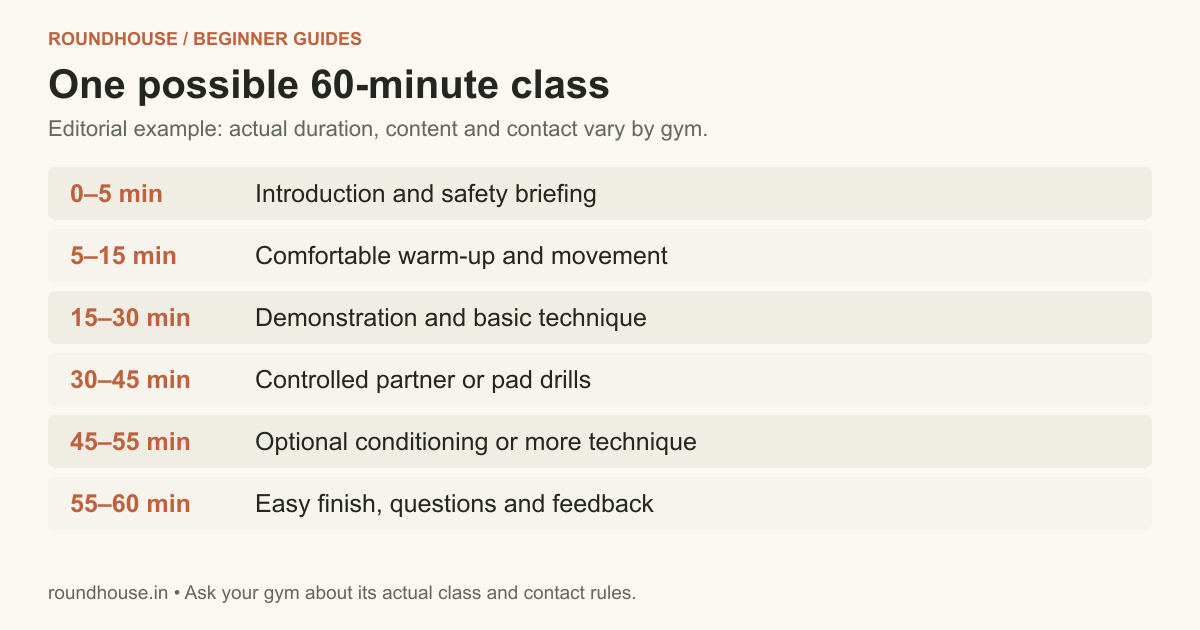
A minute-by-minute example of a 60-minute class
Class lengths and content vary. This is one illustrative hour, not a verified timetable for any listed gym. A beginner trial may be shorter or longer, and it need not contain every stage.
| Minutes | Example activity | What to look for |
|---|---|---|
| 0–5 | Introduction and safety briefing | Explain the plan, contact limits, tapping and breaks |
| 5–15 | Comfortable warm-up and movement practice | Scale the pace and learn unfamiliar movements |
| 15–30 | Coach demonstration and basic technique | A clear explanation and individual corrections |
| 30–45 | Controlled partner or pad drills | Suitable pairing, agreed intensity and immediate stopping |
| 45–55 | Optional conditioning or more technique | Adjust or omit it if the workload is too much |
| 55–60 | Easy finish, questions and feedback | Check how you feel and clarify what you learned |
The blocks total 60 minutes. More time does not automatically mean sparring or rolling; ask what the session actually includes.
Warm-up: move at a manageable pace
The warm-up gets your body moving. It may include skipping, jogging, shadow boxing or dynamic stretches, adapted to your ability.
You may breathe harder than usual. Keep the pace manageable and ask for an easier movement when needed. Do not treat severe breathlessness, dizziness or other concerning symptoms as something to push through.
Technique: learn one or two basics
The coach demonstrates a move, breaks it into steps, and then you try it. In a striking class, this might be a jab and cross or a basic stance. In a grappling class, it might be a sprawl or an escape from a bad position.
Don’t worry if you get it wrong. A beginner-friendly coach expects to explain and repeat the basics.
Partner drills: control comes first
You may pair up and repeat the move. One person attacks slowly while the other defends, then you swap. Ask how much resistance is intended. In a beginner drill, the task should be cooperative and controlled rather than a contest to win.
A good partner goes slowly and helps you. If yours doesn’t, tell the coach.
Conditioning: optional and adjustable
Some classes include pad rounds, bodyweight work or short intervals. Other introductory sessions focus entirely on technique.
Scale it to your level. Take a break when needed and discuss whether to rejoin or finish for the day. Symptoms such as dizziness require assessment, not a quick break followed automatically by more exercise.
How striking, grappling and MMA fundamentals differ
| Class | Possible beginner activities | Ask before joining |
|---|---|---|
| MMA fundamentals | Basic stance, movement and an introduction to striking or ground positions | Whether the session combines disciplines and what contact is included |
| Boxing | Footwork, simple punches, pads or a bag | Whether partner drills involve contact; a fitness class may differ from a boxing class |
| Muay Thai | Stance, basic punches or kicks, pads | Required protection and whether clinch work is included |
| BJJ or grappling | Positions, movement, escapes and tapping rules | Gi or no-gi clothing, submission drills and whether live rolling is optional |
These are examples, not a curriculum shared by all gyms.
If you want to explore the combined sport, ask whether an MMA fundamentals class is suitable for you. Our comparison of MMA, boxing, Muay Thai and BJJ covers the choice.
Training with a partner and learning to tap
Ask for an appropriate partner. Experience alone does not guarantee care; look for someone who listens, controls the pace and stops immediately when asked.
Grappling can involve close body contact. Striking drills may use pads, bags or an agreed partner drill. Ask what will happen before starting, explain your boundaries and decline a drill if you are not comfortable. You do not have to tolerate unwanted contact.
Tapping is how you tell your partner to stop. You tap their body or the mat two or three times, or say “stop” out loud.
Your partner must release or stop immediately. Tap early if you feel uncomfortable, trapped or unsure; do not wait for pain, particularly during a submission. Tapping is a communication tool, not a guarantee against injury. A partner who ignores it needs the coach’s immediate attention.
Will you get hit, choked or have to spar?
Ask before booking. A suitable introductory class should prioritise controlled learning and respect your choice to decline contact. You should not be pressured into hard sparring. We cannot promise what an unfamiliar gym will do, so confirm the format and watch how the coach manages it.
You might feel light contact on pads or a partner’s gloves. Grappling may involve positional control or submission demonstrations; ask what is expected and how the coach will supervise stopping.
A small 2019 study involved 20 amateur boxing and Muay Thai athletes and 20 controls. Researchers found short-term changes in brain-function, memory and motor-control measures after sparring. It does not establish a safe amount of head contact or a timetable for beginners. Readiness should be assessed by skills and control rather than a fixed number of weeks.
If a coach asks you to spar hard in your first class, that’s a red flag. You can say no.
What a beginner-friendly session should offer
- An explanation of the task before partner contact.
- Basic techniques rather than pressure to perform advanced skills.
- A pace you can adjust and permission to decline a drill.
- Supervision and a suitable partner.
- Clear answers about assessments, equipment and contact.
You might be the only newcomer that day. That does not make the class unsuitable if the coach can support you properly.
How tiring will the first class feel?
It varies with the class, your fitness and the movements. New footwork, drills and partner work can be demanding even if you already lift or run.
Unfamiliar movements and unnecessary tension can make drills feel harder. Ask the coach to help with relaxed movement and breathing.
Here’s how to manage it:
- Breathe out as you move, and don’t hold your breath
- Take water breaks between drills
- Use an easy-to-moderate effort you can control; a fixed percentage is difficult to judge on day one
- Rest when needed; resume only if comfortable and without concerning symptoms
If you feel dizzy or unwell
Stop the activity and tell the coach. If heat may be involved, move to a cooler place. Do not assume dizziness is simply dehydration or that it will pass after water. The CDC’s heat-illness guidance treats worsening symptoms, confusion and loss of consciousness seriously.
Chest pain, fainting, confusion or severe breathing difficulty require urgent medical help. If symptoms follow a head impact, stop contact and seek medical assessment; do not return to contact that day. The Association of Ringside Physicians’ concussion guidance supports removal, assessment and a medically managed return. Feeling better alone is not clearance.
Soreness afterwards: what to watch
You may have delayed-onset muscle soreness after unfamiliar exercise; some people have little. The Leicestershire Partnership NHS Trust’s soreness guidance describes DOMS as usually experienced 24–72 hours after activity. Persistent or worsening soreness should be assessed. Soreness is not a measure of whether the class was effective.
Familiarity and gradually increasing the workload can make subsequent sessions easier to tolerate. Do not assume every pain after class is ordinary muscle soreness.
For ordinary mild muscle soreness, keep recovery simple:
- Try gentle movement if comfortable; avoid painful exercise
- Eat enough protein and carbs
- Drink water
- Allow enough time for your usual sleep needs
Seek prompt assessment for sharp joint pain, significant swelling or pain that concerns you. Severe muscle pain or weakness, especially with tea- or cola-coloured urine, needs immediate medical attention. The CDC’s rhabdomyolysis guidance explains why these symptoms should not be ignored; they cannot be diagnosed from appearance alone.
Nerves, awkwardness and learning a new language
The unfamiliar setting can feel as demanding as the movements.
Embarrassment. You’ll feel clumsy, and you’ll forget what the coach just showed you. It is fine to ask the coach to demonstrate it again.
Intimidation. Some people look very fit and move well. Their experience may differ from yours. Ask the coach to pair you with someone patient.
Confusion. There’s a lot of new language, from “sprawl” to “guard.” Ask what unfamiliar terms mean; learning them takes practice.
A little excitement. You may enjoy learning something new, but mixed feelings after an unfamiliar session are fine too.
Eight habits for a useful first class
These habits can help you learn and assess the experience.
- Tell the coach about injuries and goals. It helps them look after you.
- Ask questions. Good coaches like it.
- Pace yourself. Choose a pace you can sustain instead of trying to impress anyone.
- Focus on one or two things. Don’t try to remember everything.
- Thank your partners. It builds goodwill, and you’ll see them again.
- Don’t compare yourself to others. You’re only measuring against your next class.
- Use the easy finish to ask questions and check how you feel; it does not guarantee less soreness.
- Write down what you learned. Do it as soon as you leave.
Signs the gym is a good fit
Look for these as you go.
- Someone welcomes you and explains the plan
- The coach corrects you with patience
- The class scales to your level
- You’re paired with someone careful
- Nobody pushes you into hard sparring
- The mats look clean
- People talk to you afterwards
These are useful observations, not proof that a gym is safe. Our guide to choosing a good MMA gym has a fuller comparison scorecard; serious safety concerns override positive points.
Reasons to stop or try another gym
- You’re pressured into hard sparring or contact you declined
- The coach ignores beginners
- Mats are visibly dirty and the gym cannot explain cleaning; smell alone is not a reliable test
- Someone makes fun of your mistakes
- The coach pushes you to pay for a long plan right away
- An injured student is told to toughen up
You don’t have to explain yourself. Leave, and try another gym.
After class: wash, eat and review
Give yourself time to recover and decide what you thought of the session.
Shower after training and wash your kit. The CDC’s athlete hygiene guidance explains that close contact, shared items and contaminated surfaces can spread MRSA. Avoid sharing towels and report suspected skin infections; this is general prevention advice, not an infection-rate estimate for Indian MMA gyms.
Check your skin over the next few days. If you see a red, ring-shaped, or itchy patch, see a doctor and stay off the mats.
Have a normal meal when comfortable. Eggs and roti, dal and rice, or a paneer wrap are possible choices, according to your needs and tolerance. Continue meeting your fluid needs without forcing a fixed volume.
Go to bed on time. Then write down three things: what you learned, what was hard, and how you felt.
If the class suited you and you are recovered, plan another session. Do not book through an injury, concerning symptoms or unresolved safety doubts just to keep momentum.
Your first-class checklist
Print or screenshot it before you go.
The day before
- Message the gym and confirm the time and class
- Tell the coach about any injury
- Pack your bag: shorts, t-shirt, towel, water, spare clothes
- Trim your nails
- Sleep well
On the day
- Choose familiar food and a comfortable gap before exercise
- Drink water through the day
- Arrive 10 to 15 minutes early
- Remove jewellery and watches
In the class
- Use a manageable pace and ask for adjustments
- Ask questions
- Tap or say stop early; do not wait for pain
- Stop if you feel dizzy
Afterwards
- Shower and wash your clothes
- Eat protein and carbs
- Write down what you learned
- Decide about another class once recovered and comfortable with the gym
Frequently asked questions
Do I need to be fit before my first class?
You do not need advanced fitness to ask about a beginner class. Confirm that it can be scaled to you, and get individual advice if a medical condition or injury may affect participation.
What if I can’t keep up?
Slow down and rest. Ask for an adjustment, and resume only if comfortable without concerning symptoms. You can finish for the day.
Will I have to spar?
Ask before booking and explain your boundaries. You should not be pressured into sparring. Readiness depends on skills and control rather than a fixed waiting period; contact should be explained and supervised.
What should I wear?
Shorts with no pockets or zips and a t-shirt or rash guard. Skip jewellery.
Do I need to buy gear first?
Ask the gym what is required and whether suitable, clean loaner gear is available. Bring your own mouthguard if required. Avoid assuming every trial includes equipment.
Is it normal to feel nervous?
It is understandable to feel nervous in an unfamiliar class, even with experience in another sport. Tell the coach what concerns you.
How many classes should I try before deciding?
If the first session is suitable, a few visits can help you judge consistency. There is no need to commit to a month, and you can leave immediately over unsafe contact or ignored boundaries.
What if I have an old injury?
Tell the coach before class. Ask what adaptations are possible. Some injuries need medical assessment before training; a coach’s adjustment does not replace that advice.
Should I tell the coach if I’m worried about getting hit?
Yes. Ask exactly what contact is included, how it is supervised and how to decline. An answer alone is not a guarantee; check whether your limits are respected.
Is the first class free?
It may be free or paid. Confirm the amount, equipment costs and cancellation terms before attending.
What if I hate it?
You can try another gym or a different discipline if you want to. You do not need to continue a class that feels unsuitable or unsafe.
Decide whether you want to return
A useful first class leaves you with a few basics learned and a clearer idea of the coaching, people and pace. Eat a light meal, pace yourself, tap early, and ask questions.
Wash afterwards, recover and decide whether the gym respected your needs. You can return, ask further questions or try somewhere else. The first class is information, not a commitment.
This is general information, not medical advice. See a doctor before you start if you have an injury, a health condition, or a history of head injury.