Combine weightlifting and MMA by planning them as one workload. Decide which sessions matter most, keep the lifting volume manageable and change the plan when your recovery or performance starts slipping. Adding a strength programme to an MMA timetable without removing anything is how a reasonable plan becomes a week you cannot sustain.
The difficult part is often deciding what to leave out. You want stronger lifts, better conditioning and more time on the mats. Your calendar may have room for all three. That does not establish that you can recover from the way you have arranged them.
This guide is about managing that problem. For exercises and a sample timetable, use our weekly MMA and weightlifting plan. Here, we will look at what to adjust when the plan meets an actual week of work, training and missed sleep.
First, be precise about “overtraining”
Feeling tired after a hard session is not enough to diagnose overtraining syndrome.
The joint ECSS/ACSM consensus statement distinguishes short-term performance changes from prolonged maladaptation. Diagnosing overtraining syndrome involves clinical assessment and excluding other explanations. It is not something a soreness score or one bad workout can establish.
That distinction matters because the response to an overloaded week is not to label yourself broken. It is to take the change seriously, review what you are doing and get appropriate help when the problem persists.
You also do not need a diagnosis before making an obviously excessive schedule smaller. If you keep turning up to important sessions unable to do useful work, the plan needs attention.
No article can promise that a particular split will prevent overtraining. The practical aim is a workload you can monitor and adjust, rather than a schedule you are determined to finish regardless of the result.
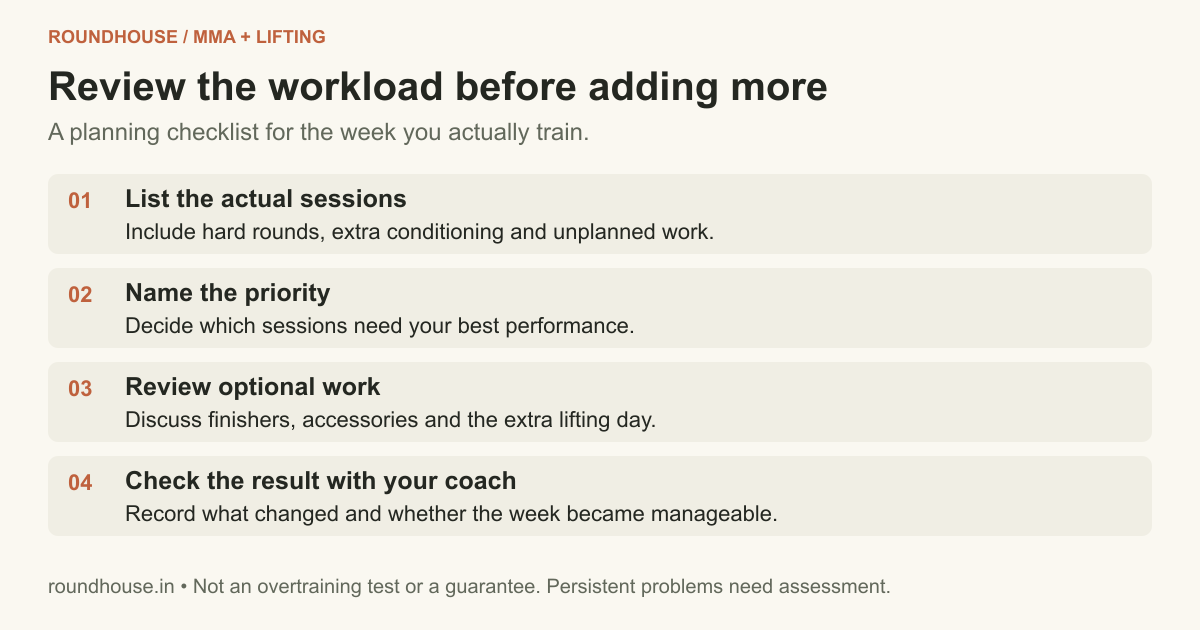
Put every demanding session on the same page
Your lifting app may show a sensible programme. Your MMA timetable may show three classes a week. Look at them together before deciding the week is sensible.
Include hard rounds, extra conditioning, private sessions and the finishers you have started adding because the main workout did not feel like enough. If it takes effort and time, it belongs in the record.
Then write down what actually happened. “MMA, 60 minutes” could mean technical drilling with breaks or a demanding session with repeated hard rounds. The class name alone does not describe what you did.
Work and travel belong in the discussion too. They are not interchangeable with training sets, but a late commute or an early flight changes when you can eat and sleep. The programme has to fit those constraints.
Choose what you are trying to improve right now
You can care about both sports without giving every goal equal priority in every session.
If improving MMA is the main goal for this training block, identify the classes your coach considers important. Then fit the strength work around those commitments. A lifting session that repeatedly leaves you unable to practise well is worth changing, even if the numbers in the gym look good.
If strength is the main goal, be honest about that too. Discuss how much demanding MMA work fits alongside it. Calling every class “just skill work” does not make the hard rounds disappear.
For a recreational trainee, the answer may be less dramatic: learn MMA, get stronger gradually and keep the routine compatible with work. That is a clear enough goal to build a week around.
Write the priority in a sentence. It makes decisions easier when an extra session appears or a week becomes busier than expected.
Start with the lifting work you can repeat
Our three-day MMA strength programme includes a two-day option. The third day is optional for a reason: the rest of your training still counts.
For someone already attending MMA regularly, discussing two manageable strength sessions with a coach is a reasonable starting point. It is an editorial starting option, not a universal maximum or a minimum everyone must reach.
Keep the purpose of each exercise clear. You need to know what it contributes and whether it is worth its place in the week. A long accessory list is harder to defend when you are already struggling to recover from the main work.
Do not judge the session by how exhausted you feel afterwards. Judge whether you completed the intended work with appropriate technique and can continue the wider programme.
Adding work is easy. Establishing that the extra work is useful takes more patience.
What should you cut first when the week is too much?
Start by identifying what is optional and what has actually changed. You do not need to redesign every exercise after one difficult day.
| What is happening | A change to discuss | What to check afterwards |
|---|---|---|
| Extra finishers keep appearing after lifting | Remove the unplanned conditioning | Whether you can complete the intended sessions more consistently |
| The optional third lifting day keeps compromising MMA | Remove that day before trying to rescue every exercise | Whether the two remaining strength sessions fit the week |
| Accessories keep turning a short session into a long one | Reduce or remove lower-priority work | Whether the main work and useful skill practice improve |
| Hard rounds are added without the lifting plan changing | Tell the strength coach what changed in MMA | Whether both coaches understand the actual workload |
| Work travel or late finishes shrink the recovery window | Plan a smaller week in advance | Whether the revised schedule is realistic without borrowing from sleep |
These are examples of workload decisions, not a treatment plan for diagnosed overtraining syndrome.
Suppose a trainee has three MMA classes and three lifting sessions, then adds a conditioning finisher after each lift. Removing the finishers and the optional lifting day is a concrete proposal to discuss. It is easier to assess than keeping all six sessions and hoping a supplement makes them work.
That smaller plan is not automatically the right dose. Record what changes, discuss it with the coach and reassess rather than treating the reduction as a guaranteed fix.
Reduce volume without making every set a test
Volume means the amount of work you do. In the weights room, sets and repetitions are useful parts of that record. How demanding those sets are also matters.
If you remove a session but turn every remaining set into an attempt to prove you have not lost strength, the week may not become much easier. Be clear whether you are reducing work, reducing effort or changing both.
For a simple arithmetic example, reducing four sets to two on one exercise removes two sets from that exercise. It does not establish that the whole session is half as demanding. Other exercises, load, repetitions and effort can all differ.
Keep those details in the log. “Light session” is a poor description if you changed the exercise list but still pushed every movement hard.
A coach can help decide which lifts to retain and what effort is appropriate. You do not need a fresh personal record to show that a reduced session was worthwhile.
Can you lift and train MMA on the same day?
Sometimes that is the timetable you have. Decide which session needs your best performance, then discuss how the other one should fit.
A 2022 concurrent-training meta-analysis found no overall disadvantage for maximal strength or whole-muscle growth compared with strength training alone. Explosive-strength gains were more vulnerable, particularly when aerobic and strength work occurred in the same session. Its findings came from structured aerobic training, not a test of your sparring class.
A 2025 study in 96 recreationally active adults reported no impairment of the measured strength or muscle-size adaptations in its concurrent-training comparisons. It used a specific 12-week programme. Together, these findings give you reasons to look at the details rather than assume that combining training must fail—or that every combination works equally well.
If you can separate sessions, the gap can give you time to eat, travel and reassess how you feel. It is not a magic recovery interval. A finding about sessions separated by several hours does not guarantee readiness for contact work that evening.
Tell the MMA coach if the earlier lift was unusually demanding. Tell the strength coach when the MMA class changes. They cannot adjust for a session they do not know happened.
Keep a short record you will actually use
You do not need to turn a recreational training week into a research project. A few consistent notes are more useful than a detailed spreadsheet you abandon after three days.
| Record | Example of a useful note | Why it helps the conversation |
|---|---|---|
| Planned and completed work | Intended technique class; additional hard rounds took place | Shows how the actual week differed from the plan |
| Lifting details | Exercise, load, repetitions, sets and how demanding they felt | Makes performance comparisons less vague |
| Sleep opportunity | Late finish followed by an early start | Identifies a practical schedule constraint |
| Food and routine changes | Missed lunch before two sessions | Adds context before blaming the training format |
| Changes you noticed | Several comparable sessions felt harder; discussed with coach | Helps describe a pattern without claiming a diagnosis |
Use comparable sessions when you can. A difficult lift after a demanding class is not directly comparable with the same lift after a restful weekend.
You can use the log linked from our weekly-plan article, or keep simple notes on your phone. The important part is looking back before making the next decision.
What should you do after one bad session?
Start with the facts. Was the workout unfamiliar? Did the class become harder than planned? Have you been unwell, missed meals or had little opportunity to sleep?
Do not force the original target just to protect the spreadsheet. Adjust the session with the coach, or stop if continuing is inappropriate. A single poor performance does not need a dramatic explanation.
Then look at the next few planned sessions. If the same practical problem is still there, address it rather than assuming tomorrow will sort it out. An early start after another late finish is a schedule issue you can already see.
This is different from explaining away a continuing decline. When the problem keeps recurring or feels out of proportion, take the record to someone qualified to assess it.
When a wearable says you are recovered
Use the number as one piece of information. It should not overrule pain, illness or a clear deterioration you and your coach can observe.
The overtraining consensus above does not identify a single generally accepted marker that settles the diagnosis. A consumer score cannot establish that you have overtraining syndrome, and it cannot clear you for every session either.
If you find the device useful for noticing changes in your routine, keep that use specific. “My score changed after a week of late nights” is an observation you can discuss. “The app is green, so the extra rounds must be fine” is a bigger claim.
Protect the time you have to recover
If class timing keeps interfering with sleep or work, our morning vs evening MMA guide helps you compare the whole day around each slot.
The 2021 athlete-sleep consensus describes how training, travel and other demands affect sleep. Its recommendations favour an individual approach rather than assuming a single sleep rule answers every athlete's needs.
Look at the clock around your sessions. A late class includes the journey home, food and getting ready for bed. An early lifting session includes the alarm and travel. Count the whole arrangement before saying you have plenty of time between workouts.
If the week repeatedly leaves you too little opportunity to sleep, change the schedule. Buying recovery equipment does not create the missing hours.
Food deserves the same practical attention. Repeatedly missing meals or combining a demanding cut with increasing training needs a review of the whole plan. Do not assume another serving of protein addresses every reason a session might feel poor.
When should you get assessed?
Persistent fatigue or an unexplained performance decline deserves proper assessment, especially if you also feel unwell or have ongoing pain. Do not keep increasing training while trying to prove that it is only a motivation problem.
The ECSS/ACSM statement explains why other illnesses and nutrition-related factors need consideration. The label “overtraining” should not hide another cause that needs attention.
Bring your record: the training you planned, what you completed, changes in sleep and food, and when the problem started. Give the clinician and coach something more useful than “I think my recovery is bad”.
Do not use this article to set a return-to-training date. If you have been told to stop or modify training for a health problem, follow that advice and get an individual return plan.
What changes during a fight camp?
A fight camp changes the priority and may change the demands on your time, food and training. It is a good reason to coordinate the programme, not to make every session harder at once.
Give the strength coach the current MMA timetable. Discuss which work is being maintained, what is being reduced and how the plan changes around competition. Any weight-making plan needs appropriate professional oversight as well.
There is no universal taper countdown in this article. The event, athlete and preparation differ. A recreational weekly plan should not silently become a fight-camp prescription because a date has been put on the calendar.
Make the next week easier to judge
Write down the priority. List the actual demanding sessions. Remove work that does not have a clear place, and agree with the coach what you will review afterwards.
Keep the first adjustment concrete. It might be removing the unplanned finisher or dropping the optional lifting day. You should be able to explain what changed and whether the rest of the week became more manageable.
If you need an exercise template, use the two-day option in our MMA strength programme. If you need to arrange the days, use the weekly MMA and lifting plan. Keep this guide for the review: whether that plan is doing its job in your actual week.
Frequently asked questions
How many days should I lift while doing MMA?
Two manageable strength sessions are one starting option to discuss if you already train MMA regularly. That is not a universal prescription. Your goal, experience, class intensity, available time and response to the work determine what fits.
Does being sore mean I am overtraining?
Soreness alone does not diagnose overtraining syndrome. Describe the session and any continuing changes in performance or how you feel. Persistent or concerning symptoms need appropriate assessment rather than a diagnosis from a checklist.
Should I stop all lifting when MMA becomes harder?
You may be able to change optional sessions, accessory work or effort instead. Agree the adjustment with your coach. Illness, injury or persistent unexplained problems can require a different response; do not assume a smaller workout is always the answer.
Will a deload fix overtraining in a week?
There is no guaranteed one-week fix. A planned reduction can be useful for managing workload, but diagnosed overtraining syndrome and other health problems need individual assessment and management. Do not treat a calendar week as automatic clearance to resume everything.