Can you combine weightlifting and MMA? Yes. For a recreational adult already comfortable with both, one or two short full-body lifting sessions are a practical starting point. Put MMA skill quality first, keep lifting sets short of failure, and reduce strength-training volume when hard sparring or recovery demands increase. There is no weekly plan that guarantees you will avoid overtraining.
This guide is for healthy adult recreational trainees. If you are new to lifting, learn the movements with a qualified coach before using the sample sessions. Competition preparation, injury rehabilitation and weight management need individual guidance.
Does lifting interfere with MMA training?
Lifting and MMA can coexist, but accumulated fatigue can reduce the quality of both. Adding a demanding lifting programme to an already demanding fight schedule increases the total workload.
Research on concurrent training examines strength and aerobic exercise performed within the same programme. A 2022 systematic review and meta-analysis of 43 studies found no significant reduction in maximal-strength or muscle-size gains compared with strength training alone, but smaller improvements in explosive strength. That effect was more pronounced when both kinds of training happened within the same session than when separated by at least three hours.
These findings concern aerobic and strength training, not contact or sparring. Their application to MMA is an inference, not validation of this schedule.
The useful question is therefore: can you complete your lifting and still move, concentrate and make decisions well in MMA? If lifting regularly leaves you too fatigued for your most important class, reduce it before adding more conditioning.
How many days should you lift alongside MMA?
Start with one or two lifting days, then adjust to your actual MMA workload. Two sessions are a practical template, with the right amount depending on your experience and class intensity.
| Your MMA week | Lifting starting point | What to watch |
|---|---|---|
| 2–3 mostly technical classes | 1–2 full-body sessions | Learn the lifts and build consistency first |
| 4–5 mixed-intensity classes | 1–2 short full-body sessions | Keep heavy leg fatigue away from demanding sparring |
| 6 sessions, especially with live work | 1 brief session, or 2 reduced sessions if recovery allows | Review whether all six MMA sessions need to be demanding |
| A competition approaching | Individual plan with your coach | Maintain useful strength while managing total fatigue |
An experienced lifter doing three easy MMA sessions might tolerate a third lifting day. A beginner doing three exhausting classes might need only one. Class intensity, sleep, work stress and training history matter more than the session count by itself.
Add work only after you can repeat the schedule without a persistent drop in MMA quality.
A sample weekly plan for MMA and weightlifting
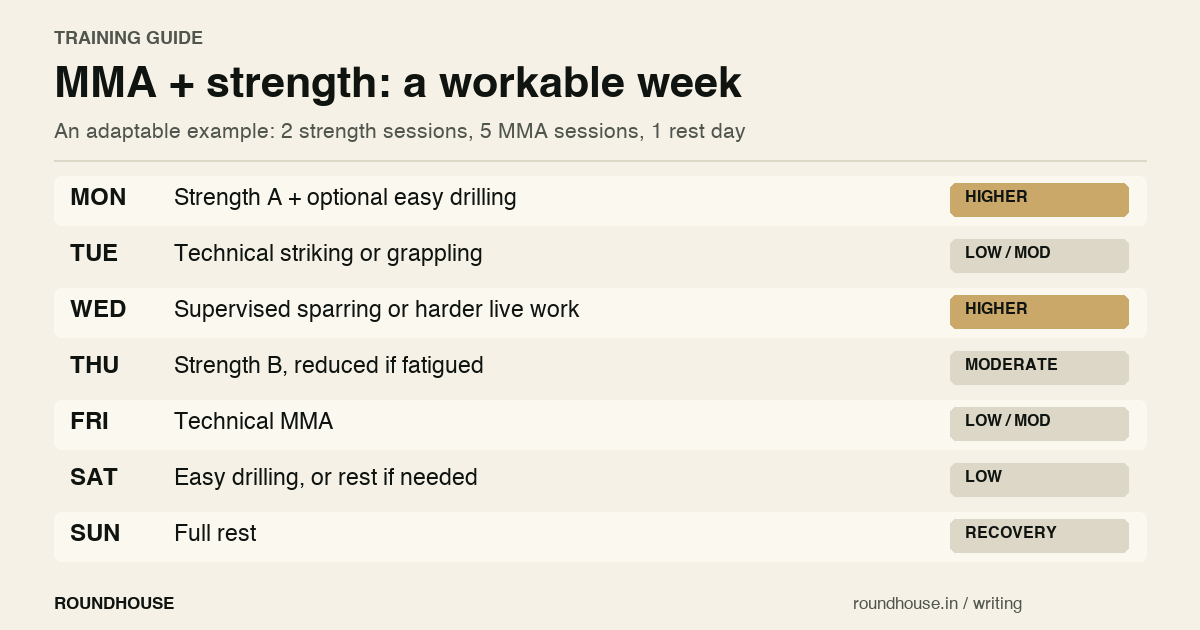
Schedule the most demanding MMA work first, then place strength sessions around it. This example uses five MMA sessions, two lifting sessions and a full rest day. Most of the MMA sessions are deliberately technical or easy.
| Day | Lifting | MMA or recovery | Intended demand |
|---|---|---|---|
| Monday | Strength A | Easy technical drilling later, if recovered | Higher because of lifting |
| Tuesday | None | Technical striking or grappling | Low to moderate |
| Wednesday | None | Coach-supervised sparring or harder live work, if appropriate | Higher |
| Thursday | Strength B, reduced if Wednesday was taxing | No additional hard conditioning | Moderate |
| Friday | None | Technical MMA | Low to moderate |
| Saturday | None | Easy drilling; adjust or rest if fatigued | Low |
| Sunday | None | Full rest | Recovery |
“Technical” describes how the session is actually run. A class that turns into hard live rounds should be counted as a demanding session, even if the timetable calls it technique.
Thursday is flexible: if Wednesday leaves you unusually sore or exhausted, reduce Strength B, move it to a suitable day or skip it. Do not force the calendar to work by training through pain or compromised technique.
If your gym spars on a different day, move the lifting around that class. Ask about class format and intensity before committing; a timetable alone will not tell you the workload.
Should you lift before or after MMA on the same day?
Put the session that matters most first, and separate sessions when practical. For someone learning MMA, arriving fresh enough for technical practice usually takes priority over an extra lifting session.
Treat session spacing as one part of workload management; six hours is not a universal MMA recovery rule. Morning lifting and an evening technical class may be workable, but the combination still depends on intensity, food, sleep and your response.
If you must train back-to-back, shorten the supporting workout. Avoid using a hard sparring session as the second half of a workout when you already feel depleted. Tell your coach about the earlier session rather than hiding fatigue to complete the plan.
Which lifts should you choose for MMA?
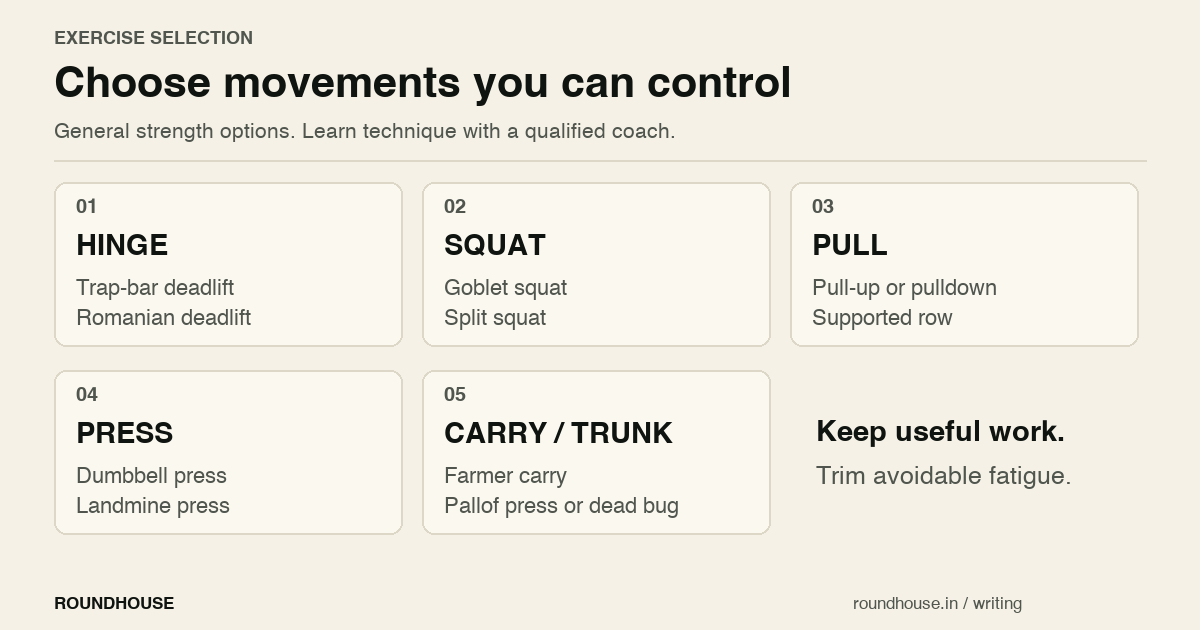
Choose familiar, controllable movements that build general strength without excessive fatigue. No exercise automatically transfers to better takedowns or makes you resistant to strikes. Fighting skills still need fighting practice.
| Movement pattern | Options | Selection rule |
|---|---|---|
| Hinge | Trap-bar deadlift or Romanian deadlift | Choose the variation you can perform comfortably and consistently |
| Squat or single-leg work | Goblet squat, front squat or split squat | Use a tolerable range of motion and controlled repetitions |
| Pull | Pull-up, lat pulldown or supported row | Pick a version you can complete without losing position |
| Press | Dumbbell bench press or landmine press | Use a pain-free option that suits your shoulders |
| Carry or trunk control | Farmer carry, suitcase carry, Pallof press or dead bug | Keep posture and breathing controlled |
Choose your hinge around equipment, technique and injury history. A trap bar is one option; it is not universally safer or faster to recover from.
Trim long leg sessions, repeated failure sets and unfamiliar high-soreness exercises when they interfere with MMA. Back squats and isolation work can still fit if their benefits justify their recovery cost.
Have a qualified coach or clinician select and teach any neck work. Loaded neck exercises are outside these sample sessions and should not be treated as concussion protection.
Two sample full-body strength sessions
Begin with a manageable number of sets, and finish each set with repetitions still available. Use these examples only with movements you already know.
Warm up with easy movement and lighter rehearsal sets of the chosen lifts. Those warm-up sets are separate from the working sets listed below. Allow roughly 40–55 minutes, including preparation and rest; do not rush a lift just to meet a time target.
Strength A: the more demanding session
| Exercise | Working sets and repetitions | Adjustment |
|---|---|---|
| Trap-bar deadlift | 3 × 4–6 | Use a familiar hinge alternative if needed |
| Pull-up or lat pulldown | 3 × 5–8 | Use assistance rather than forcing failed reps |
| Split squat | 2 × 6 per leg | Keep the load modest at first |
| Dumbbell bench press | 2 × 6–8 | Choose a comfortable pressing variation |
| Farmer carry | 2 × 20–30 metres | Optional; omit if grip fatigue affects grappling |
Strength B: the smaller session
| Exercise | Working sets and repetitions | Adjustment |
|---|---|---|
| Romanian deadlift | 2 × 6–8 | Reduce or omit if the previous session left your legs fatigued |
| Supported row | 2 × 8–10 | Keep the movement controlled |
| Goblet squat | 2 × 6–8 | Use a comfortable depth |
| Landmine or dumbbell press | 2 × 6–8 | Use an option you have learned |
| Pallof press or dead bug | 2 controlled sets | Stop before posture or breathing control deteriorates |
For the main lifts, rest about two to three minutes if needed to repeat clean work; accessories may need less. Start with a weight that leaves roughly two or three possible repetitions at the end of a set. This is a practical effort guide, not an exact measurement.
If repetitions slow markedly or technique changes, stop the set. Add a small amount of load only when you can repeat every prescribed set cleanly and your MMA sessions remain productive. Progress can mean better control or the same work feeling easier, not just more weight.
With only one lifting day available, use a shortened Strength A: one hinge, one pull and one press, with optional single-leg or trunk work. With a very busy MMA week, reduce sets before adding another training day.
How do you manage hard days and deloads?
Count demanding sessions across both sports, not just sessions in the weight room. Heavy lifting, hard live rounds and intense conditioning all contribute to the week's workload.
A useful planning heuristic is to begin with roughly two or three demanding days and make the surrounding sessions easier. This is not a validated “three hard days” ceiling or a guarantee against overtraining. You may need fewer, and an experienced athlete's supervised plan may differ.
Log session duration, effort, sleep and next-day fatigue. Watch whether supposedly easy days are becoming demanding.
A deload is a temporary reduction in training demand. If fatigue is accumulating, you could remove optional work and reduce lifting sets by about one-third to one-half for several days or a week. Coordinate changes to live work with your MMA coach.
You can schedule easier weeks in advance, but do not wait for a fixed deload date if training quality is already declining. Restore work gradually when the easier period has helped.
For a closer look at what to reduce and how to track the result, read how to combine lifting and MMA when recovery slips.
What should you eat and how much should you sleep?
Protect regular meals, enough total food and adequate sleep before spending on supplements. Your lifting plan cannot account for a week of skipped lunches and consistently short nights.
The 2021 athlete sleep consensus notes that seven to nine hours is an appropriate range for healthy adults, while athletes' needs vary and may increase with training demands. Treat that as a starting point, and pay attention to persistent daytime sleepiness and disrupted sleep.
For protein, the ISSN position stand on protein and exercise gives 1.4–2.0 grams per kilogram of body weight per day for most exercising individuals. That is approximately 98–140 grams daily for a 70 kg adult. Its general per-meal guidance is about 20–40 grams, adjusted for the person and meal.
For body-weight targets, meal planning and the limits of those ranges, read how much protein you need when training MMA and lifting.
Indian staples can fit a training day without a special “fighter diet”:
| Meal | Example combinations |
|---|---|
| Breakfast | Eggs or tofu, roti and fruit; or paneer with dahi and a carbohydrate source |
| Lunch | Rice, dal, sabzi and chicken, fish, tofu or paneer |
| Before training | A familiar, easy-to-digest snack such as a banana; adjust timing to stomach comfort |
| After training or at dinner | A regular meal with carbohydrates and a protein source; whey is optional |
Portions and recipes determine calorie and protein totals. Dal, chana, rajma, soya, dairy, eggs, meat and fish can all contribute; plan portions deliberately, including for vegetarian and vegan meals.
Rice, roti, oats, poha, potatoes and fruit are practical carbohydrate options. Avoid assuming that adding more protein makes up for too little overall food. Use the Indian macros calculator as an estimate, not a personalized sports-dietitian prescription.
Hydration during hot or sweaty sessions
Start hydrated, keep fluid accessible and plan for the duration and conditions of your session. The NATA fluid-replacement position statement emphasizes individual needs and avoiding both inadequate drinking and excessive intake. Electrolyte needs also vary; there is no universal instruction to add salt whenever you get a headache.
Headache, dizziness or unusual confusion during training should prompt stopping and assessment, not automatically another round or a salty drink. A headache after head contact needs assessment for a possible injury. Follow professional guidance if symptoms are severe, persistent or unusual for you.
Is creatine useful when you train MMA?
Creatine monohydrate is an optional supplement with evidence for repeated high-intensity exercise; it is not a recovery substitute or a requirement for MMA. The ISSN creatine position stand describes a common ongoing intake of 3–5 grams per day. A loading phase is not necessary for a gradual approach.
Creatine can increase body mass through water retention, which matters if you compete in a weight class. It does not guarantee better sparring performance. Discuss its use with an appropriate clinician if you have kidney disease, a relevant medical condition or uncertainty about suitability. Competitive athletes should also consider supplement contamination and suitable independent batch testing.
For the evidence, optional loading and weight-class trade-offs, read Creatine for Combat Sports: Benefits, Evidence and Limitations.
Roundhouse's supplement comparator can help compare products and prices. Verify suitability and independent testing separately.
How can you tell fatigue from overtraining?
A tired week does not by itself diagnose overtraining syndrome. The ECSS/ACSM consensus statement distinguishes short-term functional overreaching, more persistent maladaptation and overtraining syndrome. Diagnosis involves the wider clinical picture and ruling out other explanations.
Pay attention when several changes persist together: declining training performance, disrupted sleep, unusual fatigue, lower mood or motivation, and soreness that is not settling in your usual pattern. None of these is a diagnostic test on its own. A particular resting-heart-rate increase or a fixed number of sore days is not a universal cutoff.
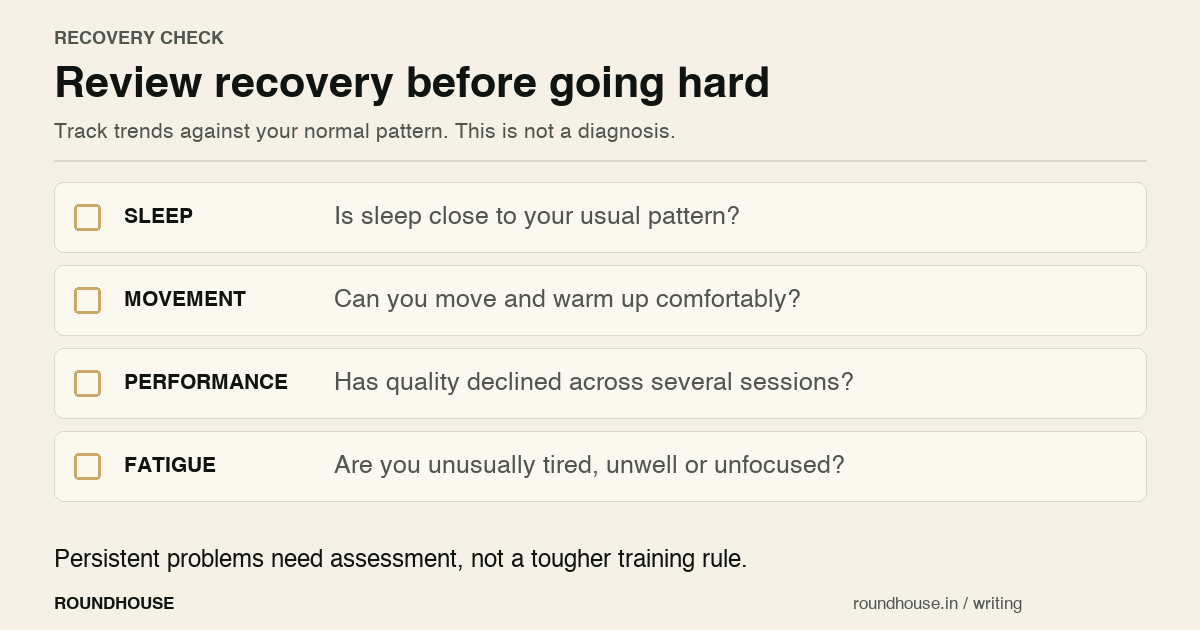
Before the next demanding session, ask:
- Is my sleep close to my normal pattern?
- Can I move and warm up comfortably?
- Has performance been declining across several sessions?
- Am I unusually fatigued, unwell or struggling to concentrate?
If the answers suggest accumulating fatigue, remove optional work and make the next sessions easier. If problems persist despite reduced training, or illness, significant pain or mood changes are involved, get an appropriate clinical assessment. Do not use this checklist to self-diagnose overtraining or clear yourself to spar after an injury.
What changes when you prepare for a fight?
Competition preparation needs an individual plan with your coaches. Keep useful strength work while reducing unnecessary fatigue, avoid introducing unfamiliar exercises near the event, and adjust lifting to the intensity of MMA practice.
The timing and amount of lifting near an event depend on your programme and recovery; there is no universal stop date for lower-body work.
For weight-class decisions, use qualified sports-nutrition and medical support. Rapid dehydration and severe food restriction can create serious problems.
How do you adapt the plan when the week changes?
Keep the MMA sessions you value most, then adjust the supporting work. These worked examples illustrate decisions, not measured results or instructions to train through an injury.
| What changed | A practical adjustment | What to check next |
|---|---|---|
| Wednesday's technical class became hard live rounds | Count it as demanding. Shorten or skip Thursday's Strength B if you are still fatigued | Can you warm up comfortably and keep technique controlled? |
| Work leaves time for only one lifting session | Use the shortened Strength A option: one familiar hinge, one pull and one press | Does the smaller workload let you attend your key MMA classes consistently? |
| You miss a session after a late workday | Resume the schedule without stacking the missed workout onto a sparring day | Was the interruption a one-off, or does the plan need fewer commitments? |
| Grip fatigue makes grappling unproductive | Remove the optional carries and review pulling volume | Is the next class more productive without that extra work? |
For a demanding workweek, reserve time for travel, changing, food and sleep as well as the class itself. A 60-minute class with a long commute is a larger calendar commitment. Treat a rest day as a planned part of the week rather than a debt you have to repay with extra sessions.
Download the weekly planner and training log
Write down the plan, then compare it with the week you actually trained. Roundhouse's worksheet has an illustrative week, a blank planner and a one-week training log. The spreadsheet version provides four blank weeks.
- Printable weekly planner and training log (PDF, 2 pages)
- Four-week training log (CSV, opens in Excel or Google Sheets)
Fill in class intensity and lifting before the week starts. Afterwards, note what you completed, session duration, effort, sleep and how the next warm-up felt. At the weekly review, choose one change to make the next week more repeatable. These worksheets organize observations; they do not calculate an overtraining score or clear you to train after an injury.
Frequently asked questions
Can you build muscle while doing MMA?
Yes, muscle growth and MMA training are compatible. Progress depends on resistance-training stimulus, food and recovery. If classes consistently compromise your lifting progress, review the total workload and your priorities.
Will lifting weights make you slower at MMA?
Not automatically. Fatigue from poorly scheduled lifting may make you feel slower, while strength gains and sport performance are different outcomes. Keep MMA quality as the check on whether your current lifting workload is useful.
Is two days of lifting enough?
Two days can be a practical strength-training starting point alongside MMA. One may suit a busy or demanding week. More sessions are not automatically better, and the quality and amount of work within them matter.
Can beginners start MMA and lifting at the same time?
Yes, but learn both with manageable workloads and suitable instruction. Consider starting with one lifting session rather than immediately copying the full sample week. Increase training when your technique and recovery are consistent.
Should you lift on a sparring day?
If sparring is demanding, prioritize arriving fresh and avoid a fatiguing lifting session beforehand. A qualified coach may arrange a small strength session on the same day, but spacing sessions does not remove the combined workload.
What is the first change to make when recovery slips?
Remove optional conditioning or accessory work, reduce lifting sets and review the intensity of live training with your coach. Check sleep, food and illness too. Persistent deterioration needs assessment rather than progressively stricter self-imposed training rules.
Put the plan around your actual gym schedule
Establish your MMA priorities, add repeatable strength work, and adjust from your training log. A sustainable week beats completing a demanding calendar once and spending the next week exhausted.
If you are looking for training in Delhi NCR, use the MMA gym finder to compare locations, listed disciplines and contact options. Read the sources on each listing and ask the gym about class intensity, current fees and trial availability. A Roundhouse enquiry is a request, not a confirmed booking.
For an existing shortlist, see MMA gyms in Noida or MMA gyms in Gurugram. Choosing a commute and class schedule you can sustain is part of making the programme work.