For a healthy adult combining MMA and lifting, 1.6–2.2 grams of protein per kilogram of body weight per day is a useful planning range. At 80 kg, that works out to 128–176 g a day. You do not automatically need the top end, and you do not add a separate “MMA allowance” to a bodybuilding target.
The harder part is fitting that protein into meals you can repeat while leaving enough food for training. A target that depends on three shakes and a dinner you never get around to cooking needs another look.
This guide explains how to choose a starting number, build meals around it and adjust when your goal changes. It is written for adults training recreationally. Making weight for a fight is a separate job.
Where the protein range comes from
There is no well-established equation that calculates an exact protein requirement from your number of MMA classes and lifting sessions. The available evidence combines broader exercise research with combat-sport guidance.
The ISSN position stand on protein and exercise gives 1.4–2.0 g/kg/day for most exercising people. Our narrower starting range above places a little more emphasis on someone also doing resistance training; it is a planning choice, not a newly discovered MMA threshold.
Morton and colleagues’ resistance-training meta-analysis estimated a breakpoint around 1.6 g/kg/day, with uncertainty extending to about 2.2 g/kg/day. That finding concerns average muscle gains in the studies analysed. It does not mean every gram above 1.6 is wasted, or prove that a fighter in a calorie deficit has the same needs.
Use those numbers to make a workable first decision. Do not treat the second decimal place as a measurement of your body.
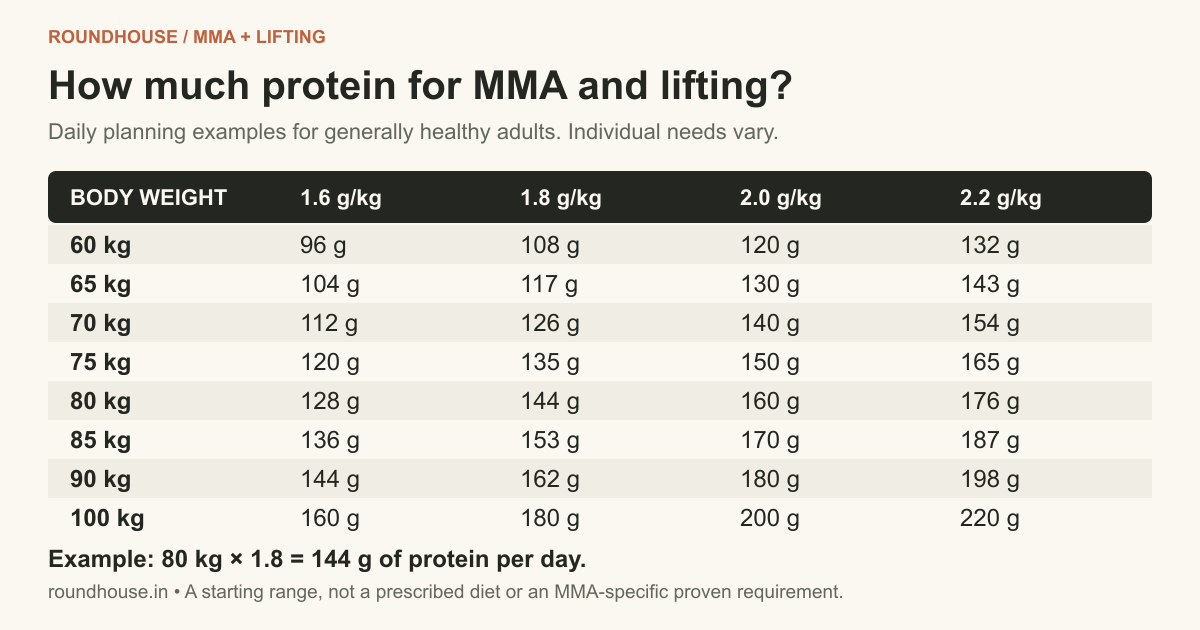
Calculate your daily protein target
Multiply your body weight in kilograms by the number you are considering. Use your ordinary, hydrated training weight—not a deliberately dehydrated weigh-in number.
| Body weight | At 1.6 g/kg/day | At 1.8 g/kg/day | At 2.0 g/kg/day | At 2.2 g/kg/day |
|---|---|---|---|---|
| 60 kg | 96 g | 108 g | 120 g | 132 g |
| 65 kg | 104 g | 117 g | 130 g | 143 g |
| 70 kg | 112 g | 126 g | 140 g | 154 g |
| 75 kg | 120 g | 135 g | 150 g | 165 g |
| 80 kg | 128 g | 144 g | 160 g | 176 g |
| 85 kg | 136 g | 153 g | 170 g | 187 g |
| 90 kg | 144 g | 162 g | 180 g | 198 g |
| 100 kg | 160 g | 180 g | 200 g | 220 g |
For an 80 kg person choosing 1.8 g/kg, the calculation is 80 × 1.8 = 144 g/day. Rounding that to about 145 g makes meal planning easier. There is no need to force dinner to deliver exactly the last gram.
If you have substantially higher body fat, a major weight-change goal or a medical condition, do not keep scaling the table upwards indefinitely. A sports dietitian can help choose an appropriate reference weight and target. This table does not calculate either for you.
Choose a target you can actually eat
Start by recording a few ordinary days of eating, including a busy workday and a training day. Include milk, snacks and cooking ingredients rather than counting only the obvious protein food at dinner.
Then compare what you eat with the target you are considering. If you are far below it, work out which meal needs changing before ordering supplements.
| Situation | A useful first decision | What to avoid |
|---|---|---|
| Maintaining weight while doing MMA and lifting | Pick a manageable point in the planning range and check your usual meals | Assuming more sessions always require a higher protein multiplier |
| Trying to gain muscle | Meet the protein target while planning enough total food for the goal | Replacing needed meals with extra powder |
| Losing body fat gradually | Review protein, total intake and training together; consider professional help as the deficit becomes more demanding | Treating a very high protein number as protection against any size of deficit |
| Preparing to make a competition weight | Work with a qualified sports dietitian and your coaching team | Using this article as a fight-week weight-cut protocol |
An 80 kg trainee eating about 145 g consistently has a usable starting plan. Switching to 176 g because a social-media post says “more is optimal” still leaves the practical question: what problem would those extra 31 g solve?
If the answer is a measured gap in an individual plan, address it. If the answer is simply that the higher number feels more serious, keep the simpler plan while you assess it.
Does MMA mean you need more protein than someone who only lifts?
It means your nutrition has to support a different week. It does not give us a reliable instruction to add another 50 g.
The 2025 ISSN combat-sport position stand stresses matching nutrition to the training phase and keeping protein from displacing carbohydrate and fat. Its practical section gives 1.6–2.2 g/kg/day during a planned, longer-term weight descent. That is different from treating its fight-week discussion as advice for ordinary gym members.
If you lift in the morning and train MMA in the evening, plan the meals between those sessions. Reaching a protein target alone does not establish that you have eaten enough to train twice.
Write down both sessions before planning food. A day with technical drilling, an office lunch and dinner at home is a different logistical problem from a lifting session followed by late sparring and a long commute.
Our weekly MMA and weightlifting plan can help you put those sessions on one calendar. Use that calendar when deciding which meals need to be portable or ready in advance.
What changes when you are losing fat?
A calorie deficit changes the question from “Can I support training?” to “Can I support training while losing weight and limiting muscle loss?” Protein is part of that plan, alongside the size of the deficit and the resistance training you can sustain.
A 2025 review by Refalo, Trexler and Helms analysed 29 studies in non-obese, resistance-trained people under energy restriction. Higher intakes were associated with more favourable fat-free-mass changes, but the authors call the findings exploratory. The studies differed, and this was not a trial establishing one ideal dose for MMA athletes.
Their higher suggested ranges concern particular risks and priorities, including leaner trainees trying to retain muscle during a deficit. They are not a reason for every recreational fighter to jump to 3 g/kg.
Also check the denominator. Grams per kilogram of fat-free mass and grams per kilogram of total body weight are different calculations. A recommendation using one cannot be copied into a calculator using the other.
For example, 2.5 g per kilogram of 60 kg fat-free mass equals 150 g. It does not equal 2.5 multiplied by an 80 kg scale weight, which would be 200 g. These are arithmetic examples, not two competing prescriptions for the same person.
For a demanding cut, take your food record, weight trend and training schedule to a sports dietitian. Raising protein while repeatedly struggling through sessions is not enough information to decide that the diet is working.
Divide the day into meals, not a race to dinner
Once you have a daily target, divide it across the meals you can reasonably eat. Four eating occasions are one option; your work and training schedule may suit another arrangement.
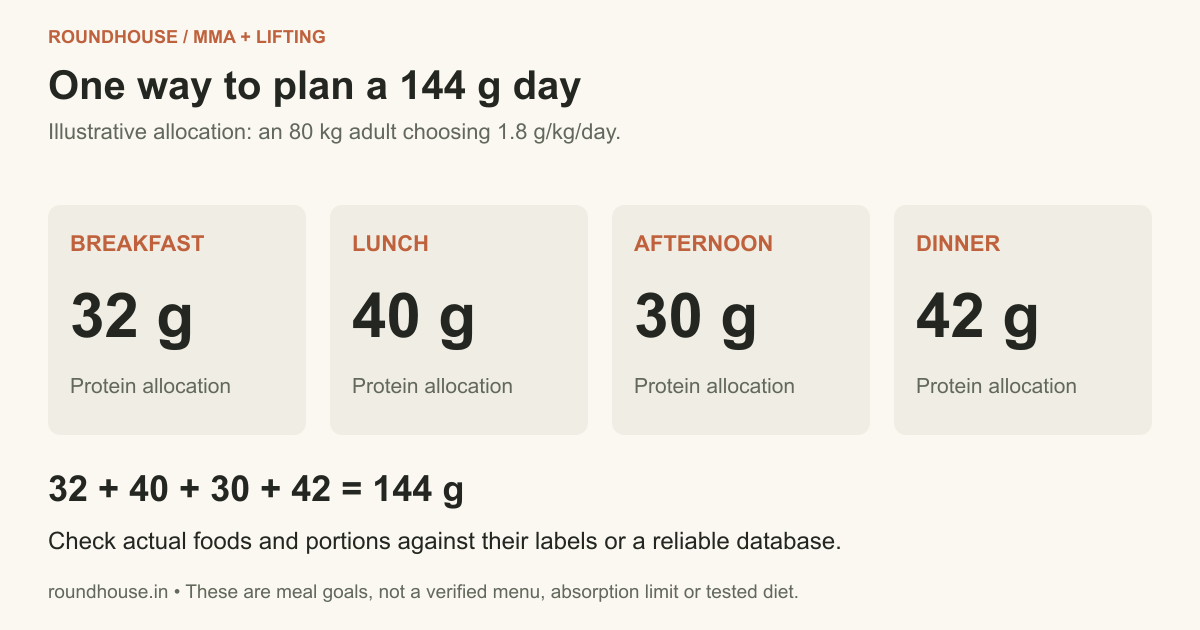
For the illustrative 80 kg trainee targeting 144 g, one allocation looks like this:
| Eating occasion | Protein allocation | Planning job |
|---|---|---|
| Breakfast | 32 g | Choose the main protein food before adding the rest of breakfast |
| Lunch | 40 g | Make it a meal you can obtain or pack on a workday |
| Afternoon meal or snack | 30 g | Put it where it fits comfortably before or between sessions |
| Dinner | 42 g | Have an option ready for a late finish |
| Daily total | 144 g | Include all foods when checking the actual total |
These are meal goals, not a menu with verified nutrients. A plate of “paneer and roti” does not automatically contain the allocation in its row. Work out your portions using the label or a reliable food-composition entry.
If breakfast contains very little protein and dinner has become an enormous catch-up meal, moving some of the planned food earlier may be easier than buying another supplement. Test the arrangement on the kind of day you actually have.
Is there a 30 gram limit per meal?
There is no universal rule that protein above 30 g in a meal is simply discarded.
Trommelen and colleagues’ 2023 experiment compared post-exercise protein doses including 25 g and 100 g, following responses over 12 hours. The larger dose produced a greater, longer anabolic response in that setting. It was an acute experiment, not proof that one huge daily serving produces the best long-term muscle gains or MMA performance.
You can use larger meals when they suit you. You also do not have to turn that study into a challenge to drink 100 g of protein after class.
The four-meal allocation above is a convenient way to organise a day. It is not an absorption limit, and 42 g at dinner does not need to be split into two servings to make it “count”.
How close to training should you eat protein?
The ISSN exercise-protein guidance discusses servings of roughly 20–40 g and distributing protein through the day. Those are broad reference points, not a universal meal ceiling or a requirement to interrupt class for a shake.
Plan your normal meals around the session. If you eat a substantial meal before lifting and can have dinner afterwards, that can be a simpler arrangement than adding another feeding solely to satisfy a timer.
If training ends late and dinner will be delayed, a portable option may help you complete the day. It might be food, a drink or a protein supplement you tolerate. Count it towards the daily total.
For MMA, leave yourself an opportunity to learn what sits comfortably before movement and contact. Do not debut a large shake or unfamiliar meal immediately before a hard session. The best-looking meal schedule on paper is of little use if you cannot follow it at the gym.
Build protein into Indian meals without guessing
You have plenty of possible foods: eggs, fish, chicken, milk, curd, paneer, tofu, soy foods, dals, rajma and chana. The useful question is how much protein your portion contributes—not whether the food has been described as “high protein”.
Start with a main protein food at each meal, then build the rest of the plate around your appetite, overall nutrition needs and training. A vegetarian version and a version containing meat need not look identical.
Avoid treating “one bowl” as a fixed nutrition unit. A small bowl of thick dal and a large bowl of diluted dal can contain different amounts of the ingredient you are trying to count.
Read the label and keep the weight basis consistent
The calculation is straightforward:
Protein in your portion = portion weight ÷ label reference weight × protein on the label.
Two manufacturer examples show how to use it. These are label-based calculations, not independent tests or brand recommendations. Check the packet you actually buy.
| Food and source | Reference value | Example portion | Calculated protein |
|---|---|---|---|
| Amul Fresh Paneer, Dudhsagar Dairy product page | 20 g per 100 g | 150 g of the listed product | 30 g |
| Nutrela soya chunks | Brand states 52% protein | 50 g dry product, before hydration | 26 g |
For the paneer example, the same product page lists 312 kcal per 100 g. A 150 g portion therefore contributes about 468 kcal as well as 30 g protein, before cooking additions. That is why protein grams alone do not describe the meal.
For the soy example, weigh the dry product if you are using the dry-product value. After soaking and cooking, its weight includes absorbed water. Do not assign 26 g protein to every 50 g spoonful of cooked chunks.
With batch-cooked dal or rajma, record the dry ingredients for the whole recipe, calculate the batch total and divide it by the portions you actually serve. Include additions where they matter. Use a database entry that matches the food and preparation, rather than mixing dry, raw and cooked values.
Can a vegetarian or vegan diet support lifting?
A 12-week study by Hevia-Larraín and colleagues compared habitual vegans and omnivores whose protein was matched around 1.6 g/kg/day. Both groups improved with resistance training, without a difference between groups in the reported adaptations. Soy or whey supplements helped achieve the targets.
The participants were young men new to resistance training. It does not establish that every plant-based menu is equivalent to every mixed diet, or answer all questions about experienced MMA athletes.
The practical task is to plan enough protein from foods you can eat consistently. If animal foods are excluded, give soy foods, pulses and other suitable plant sources an explicit place in the day. Do not assume removing meat automatically creates a replacement meal.
Do you need whey protein?
First calculate the gap. If your meals provide 115 g and your chosen target is 145 g, you are planning how to add about 30 g. You are not choosing between zero supplements and an entire supplement stack.
You could change a meal, add a suitable snack or use a powder. Pick the option that fits your food preferences, digestion, budget and routine. Whey is milk-derived; it is not suitable for someone who needs to avoid milk protein. A vegan trainee needs a suitable alternative.
Read grams of protein per serving, not just the scoop weight. A hypothetical 30 g scoop containing 24 g protein contributes 24 g. If you mix it with milk, count the milk separately. This is label arithmetic, not a claim about a particular product.
When comparing costs, use the actual price and protein content:
Cost per 25 g protein = pack price ÷ total grams of protein in the pack × 25.
For illustration, a ₹2,000 pack containing 600 g total protein costs about ₹83.33 per 25 g protein. This is an invented shopping calculation, not a current market quote or a reason to buy that pack.
Price per gram is only one consideration. Check the seller, ingredients, allergen information and the exact product. Athletes subject to anti-doping rules should check supplement decisions with their support team; this article does not certify a product.
Keep the rest of recovery in the picture
Protein does not complete your training diet. The combat-sport guidance above specifically warns against letting it crowd out carbohydrate and fat.
Before increasing an already substantial protein intake, ask whether you are regularly missing meals, cutting portions to make a weight target or trying to train twice on a schedule built for one session. Bring those details to the discussion rather than assuming soreness or fatigue proves a protein shortage.
You can also review the workload. Our three-day MMA strength programme includes an optional third day; completing every possible lifting session is not a nutrition goal.
If performance keeps falling or fatigue persists, get appropriate assessment. An online protein calculator cannot determine the cause.
Who needs an individual target?
This guide is for generally healthy adults. If you have kidney disease, a prescribed diet or another condition affecting nutrition, use your clinical team's advice. NIDDK's kidney-disease guidance explains why protein amounts may need individual adjustment.
Teenagers, pregnant or breastfeeding athletes, and people dealing with an eating disorder or an aggressive weight cut need advice suited to their situation. A table based on adult training literature does not provide that assessment.
You also do not need to wait for a problem to ask a sports dietitian for help. A food record and your actual weekly schedule make that appointment more useful than a target copied from someone of a different size and training background.
Put the target into practice
Choose a reasonable daily number. Work out what your normal meals already provide. Fix the gap in a way you can repeat, then review the plan alongside your training, weight goal and professional advice where needed.
For the 80 kg example in this guide, that could mean planning about 145 g across breakfast, lunch, an afternoon option and dinner. The next useful step is to check those four meals—not to search for a more precise multiplier.
If you are still arranging your training week, start with the MMA and lifting schedule. If you are budgeting for the whole routine, our MMA cost guide puts equipment and class fees alongside the food decisions you will make yourself.
Frequently asked questions
Is 200 grams of protein necessary for MMA and lifting?
Not automatically. In the planning table, 200 g corresponds to 2.0 g/kg for a 100 kg adult. An 80 kg adult reaches 160 g at the same multiplier. Your size, diet goal and individual circumstances matter more than choosing a round number.
Should I eat less protein on rest days?
Do not automatically remove protein meals because there is no class that day. Keeping the same broad daily target can simplify the week. Adjustments should fit the overall plan rather than treating protein as something earned only during a workout.
Does protein powder count towards my daily target?
Yes. Count the protein shown on the product label, alongside protein from food and anything you mix into the drink. Powder is one way to fill a gap, not an extra requirement above your food target.
Should I use my fight weight or my current weight?
For this general planning calculation, use your ordinary hydrated training weight. Do not use a temporarily dehydrated weigh-in weight. A competition cut or a substantial body-composition change needs an individual nutrition plan and may use a different reference.