The gym you pick shapes how you learn, how contact is managed, and whether training fits your life. The coach, partners and culture matter more than an impressive building.
This guide gives you a ten-point scorecard, a trial class checklist, and practical signs to compare MMA gyms in India. Start with our beginner’s guide to MMA training in India if you’re still deciding what your first class should involve.
What makes a good MMA gym?
A good gym has a coach who teaches beginners properly, controls sparring, and keeps the mats clean. A bad gym throws you into hard sparring, ignores injuries, and pushes you to pay before you’ve tried a class.
Visit at least two gyms, take a trial class at each, and score them with the card below. Don’t pay for a long plan until you’ve done that.
How to check a coach’s background
Ask what a coaching qualification covers, who issued it, when it was awarded and how to verify it. If a gym claims federation affiliation, check that claim with the named organisation. A fight record, a coaching qualification and a first-aid certificate demonstrate different things.
Credentials matter, but also watch the coach teach a nervous beginner. You need clear explanations, suitable partners and supervision in the class you will actually attend. A logo on a wall cannot answer those questions.
Compare the class, not just the gym type
These are useful descriptions, not quality rankings. A gym can combine several formats.
| Format | What to check before joining |
|---|---|
| Coach-led academy | Who teaches your batch, how beginners progress and who covers an absent coach |
| Multi-art club | Whether striking, wrestling and ground skills are connected in an actual MMA curriculum |
| Fitness gym with an MMA class | Whether it teaches combat skills or mainly conditioning; who supervises partner work |
| Competition-focused team | Whether recreational beginners have their own progression and can decline competition |
For a beginner, a clear beginner programme matters more than the label. If you’re unsure which art you want, compare MMA, boxing, Muay Thai and BJJ before choosing a timetable.
Watch how the coach teaches beginners
You’re choosing a teacher, not a venue. Spend most of your attention here.
Good coaching signs
- Explains clearly. They break each move into steps and say why it works.
- Corrects individuals. You get specific feedback, not just “do it again.”
- Adjusts for beginners. They slow down for new people and don’t make them feel stupid.
- Controls the room. Sparring is supervised, and the coach stops anything getting out of hand.
- Talks about safety unprompted. They mention tapping, injuries, and rest.
- Has a record you can check. They can tell you who they trained under, or show students who’ve improved.
Coaching warning signs
- Shouts instead of teaching
- Treats beginners as a nuisance
- Pushes everyone to spar hard, early
- Brags about their own fights during class
- Runs down other gyms
- Ignores someone limping or dazed
- Pushes you to compete before you’re ready
If you can’t tell whether a coach is good, watch how the most junior student is treated. Use that observation alongside verified qualifications and conversations with students.
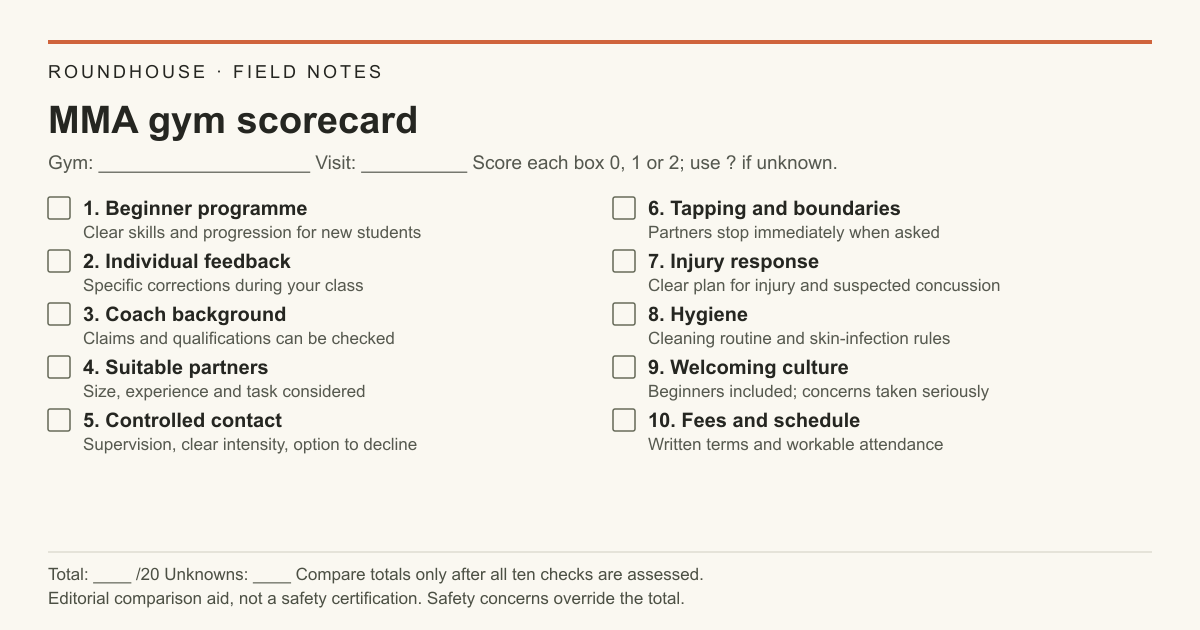
A ten-point MMA gym scorecard
Score each point from 0 to 2: 0 means a clear concern, 1 means partly met and 2 means clearly demonstrated. Write down what you actually saw or heard. Mark anything you could not assess as unknown and ask again; do not treat an unanswered question as proof of safety.
| Check | Evidence to look for | Score /2 |
|---|---|---|
| 1. Beginner programme | The coach explains what new students learn and how they progress | ___ |
| 2. Individual feedback | Beginners receive specific corrections during the class | ___ |
| 3. Verifiable background | The coach’s training and claimed qualifications can be checked | ___ |
| 4. Suitable partners | Pairing accounts for size, experience and the task | ___ |
| 5. Controlled contact | Contact is supervised, intensity is explained and you can decline | ___ |
| 6. Boundaries and tapping | Partners stop immediately when asked or when someone taps | ___ |
| 7. Injury response | There is a clear response to injury and suspected concussion | ___ |
| 8. Hygiene | Mat cleaning and skin-infection rules are explained and followed | ___ |
| 9. Welcoming culture | Beginners are included; bullying and harassment are addressed | ___ |
| 10. Clear terms and a workable schedule | Fees and cancellation terms are written; attendance fits your life | ___ |
Total: ___ /20. Unknown checks: ___.
This is Roundhouse’s editorial comparison aid, not a validated safety rating or a certification of any gym. Use the total only when all ten checks have been assessed:
- 16–20: a stronger candidate for a short initial plan, after resolving safety concerns.
- 11–15: revisit and ask about the weak spots before deciding.
- 0–10: substantial concerns; compare another gym.
Safety problems override the total. A gym scoring well elsewhere can still be the wrong choice.
Red flags that override the score
Stop the trial or reconsider joining if:
- Beginners are pressured into hard sparring before they are ready or after they decline.
- The coach dismisses possible concussion symptoms or sends a dazed student back into contact.
- A partner ignores a tap or a request to stop and the coach does not intervene.
- Mats are visibly dirty and the gym cannot explain its cleaning routine.
- You are pressured to pay for a long plan immediately.
Not allowing casual spectators is not automatically a safety failure: privacy or youth safeguarding may explain it. Ask for a trial, an approved observation slot or a clear explanation of beginner training. Refusing every reasonable way to understand the class is a reason to look elsewhere.
What to check during a trial class
Book a trial and go with a plan. Use this to watch the gym, not just to survive the class.
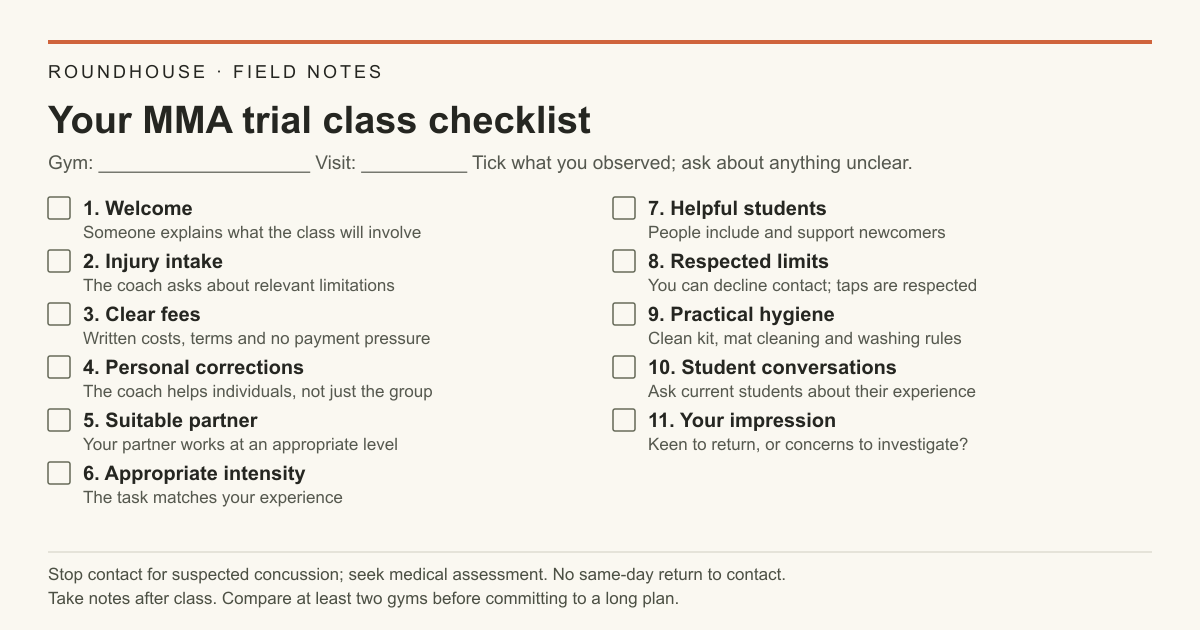
Open the printable trial checklist.
- Does someone welcome you and explain what will happen?
- Do they ask about injuries or health problems?
- Do you get a clear answer on fees, without pressure?
- Does the coach correct people individually?
- Are you paired with someone who looks after you?
- Does the intensity match your level?
- Do people swap partners and help each other?
- Is anyone being pushed past their limits?
- Is there a practical washing arrangement and a clear rule for clean kit and mats?
- Can you speak to a few students without the coach nearby?
- Do you feel better and keen to return, or worried?
Notice how you feel in the car or on the way home. If you’re nervous but excited, that’s normal. If you’re uneasy about how people were treated, trust that.
Check mat hygiene and skin-infection rules
Grappling involves close contact and shared surfaces. Ask how the gym manages both.
The CDC’s athlete hygiene guidance explains that close contact, shared items and contaminated surfaces can spread MRSA. It recommends washing after training, clean clothing and avoiding shared towels. This is general infection-prevention guidance, not a measurement of infection rates in Indian MMA gyms.
Check these in person:
- Staff can explain when mats and shared equipment are cleaned, with what product, and who does it
- Nobody walks onto the mats in outdoor shoes
- Showers or wash areas are available and working
- Shared kit is cleaned and stored properly; smell alone is not a reliable hygiene check
- Suspected skin infections are reported; cuts and wounds are managed under appropriate medical and gym rules
Ask how the gym handles a suspected skin infection. A useful answer includes stopping close-contact training, getting medical assessment and following clinician guidance on treatment and return. Simply covering a suspicious lesion and carrying on is not a substitute for assessment.
Ask how sparring and head injuries are handled
A beginner class should teach you skills before asking you to manage uncontrolled contact. Ask which drills involve contact, what intensity is expected and whether you can decline.
A small 2019 study involved 20 amateur boxing and Muay Thai athletes and 20 controls. Researchers found short-term changes in brain-function, memory and motor-control measures after three three-minute sparring rounds, with measured values returning to baseline at 24 hours. It does not establish long-term outcomes or a safe amount of head contact for a beginner.
Look for these signs of a careful gym:
- Readiness is based on demonstrated skills and control, not a fixed number of weeks.
- The coach explains the required equipment for that drill and checks its suitability.
- Partners are matched thoughtfully by size, experience and intensity.
- The coach stops rounds that become uncontrolled and respects a student’s choice to decline.
- Possible head-injury symptoms lead to stopping contact and medical assessment, rather than another round.
Ask what happens if someone seems dazed, confused or unsteady after a hit. They should stop contact immediately, receive medical assessment and not return to contact that day. Return should follow medical clearance and a supervised progression; feeling normal alone is not clearance. These principles align with the Association of Ringside Physicians’ concussion consensus.
Headguards are not a guarantee against brain injury. The ARP’s headguard position statement says they should not be relied on to prevent concussion. Equipment does not replace controlled contact or an appropriate injury response.
Look at the culture, especially around beginners
A gym is a group of people, and the group shapes your experience. Two gyms with the same coach quality can feel completely different.
Good signs:
- Experienced students help newcomers
- People tap without shame, and thank their partners
- Different ages, sizes, and skill levels train together
- Nobody shows off at someone else’s expense
Warning signs:
- Higher-level students bully or humiliate newcomers
- Everyone spars hard to prove something
- Beginners train alone while the regulars ignore them
- The mood is tense, loud, or aggressive
Look for beginners who feel included and can explain what they are learning.
Talk to newer students and people who have trained there for several months. A trial gives you only a snapshot; do not infer a gym’s retention rate from the faces in one class.
Get fees and cancellation terms in writing
Clear, calm answers about fees are a good sign.
Ask for these in writing:
- The monthly fee for the number of days you want
- Any registration or admission charge
- What longer plans cost and how much you save
- Refund terms if you leave or get injured
- Extra charges for grading, camps, or events
Our MMA training cost guide for India compares selected published gym rates and illustrative first-year budgets. Use it to frame questions, then confirm the quote for your own batch.
Watch for these red flags:
- You’re pushed to pay for a year before a trial
- Fees are vague or change from one call to the next
- Everything is non-refundable with no explanation
- There’s a “special offer” that expires today
I’d start on a monthly plan, and move to a longer one once you trust the coach.
Read reviews for patterns and specifics
Reviews help, but they’re easy to misread. Use them to spot patterns, not to pick a winner.
- Look for recent reviews. A gym can change fast when coaches leave.
- Read across ratings. A useful review explains what happened; its star count does not establish honesty.
- Look for specifics. “Coach corrected my jab” tells you more than “best gym ever.”
- Check for beginners. Do reviewers mention how they were treated as new students?
- Look for repeated, specific injury or hygiene concerns, and how the gym responds. A review remains an account to check, not a verified finding.
- Be careful with perfect scores. A page of only five-star reviews with no detail can be a warning.
Ask in local fitness or martial arts groups, and talk to people who train there. A real student will tell you more in five minutes than a review page will.
Seven questions to ask the coach
Ask these in person, and notice whether the answers are clear.
- What does the beginner program cover?
- When do beginners start sparring, and how is it supervised?
- How are the mats cleaned, and how often?
- What happens if someone gets injured or dazed in class?
- Who will I train with, and how big are the classes?
- Who did you learn from, and who have you coached?
- How do you decide when a student is ready to compete?
A good coach answers calmly and clearly. A coach who gets defensive or vague is telling you something.
Five questions to ask current students
Students can describe the day-to-day experience. Ask a couple of them after class.
- How long have you trained here?
- How were you treated in your first month?
- Have you ever been hurt, and how did the gym handle it?
- Do you feel you’ve improved?
- Would you bring a friend or family member here?
The last question can open a useful conversation. Ask why, and compare more than one student’s account.
Extra checks for youth classes and women
A few extra checks may matter for your shortlist.
For a child or teenager: look for age-appropriate teaching, a coach experienced with young people, and clear supervision, contact, consent and safeguarding policies. Ask who handles concerns. A parent or guardian should understand the programme and use the gym’s approved observation arrangements before enrolling.
For women: ask about partner choice, private changing arrangements and how harassment concerns are handled. If a women’s class or female training partners matter to you, check availability. Their absence alone does not establish poor coaching; watch how boundaries are respected in mixed classes.
For local options, see women’s MMA and BJJ classes in Delhi NCR, which separates published women-only programmes from mixed classes and compares fees and trial offers.
If the gym doesn’t take these questions seriously, choose another.
A simple process for choosing your gym
Use our gym directory or gym finder to build a shortlist. A directory listing is a starting point, not a safety endorsement.
Here’s the process in order.
- Shortlist three gyms within a travel time you can keep.
- Call each one and ask about beginners, fees, and trial classes.
- Take trial classes at your top two in the same week.
- Score each gym with the card above, right after class.
- Choose a short initial plan only after resolving safety concerns, and revisit your score after a month.
If the top two are close, compare beginner teaching, supervision and the commute you can sustain. Ask a second question about any unknown item rather than relying on the total alone.
What to do if you chose the wrong gym
Many people join a gym and realise later it isn’t right. You can leave.
- Stop training if you’re being pushed into unsafe sparring
- Check your fee terms, and ask for any refund you’re due
- See a doctor if you’ve been hurt or hit on the head
- Try a different gym before you give up on the sport
- Don’t feel guilty. A good gym will understand
A bad gym doesn’t mean MMA isn’t for you. It usually means you haven’t found the right one yet.
Common mistakes when comparing MMA gyms
- Choosing by price alone. A cheap batch with poor coaching costs you progress and health.
- Choosing by the gym’s famous name. Watch the class in front of you, not the reputation.
- Choosing by the coach’s fight record. A good fighter isn’t always a good teacher.
- Skipping the trial. You can’t judge a gym from a website.
- Ignoring the commute. If it takes too long to reach, you’ll stop going.
- Prepaying a year at once. Savings don’t help if you leave in month two.
- Ignoring discomfort. Ask what caused it and seek a clear answer; you do not have to stay in a class that feels unsafe.
Frequently asked questions
How do I know if an MMA coach is qualified in India?
Ask which qualifications they hold, who issued them and how to verify them. Check the scope of the qualification, watch beginner teaching and talk to students. A fight record alone does not establish coaching skill.
Is a federation certificate enough?
No single document answers every question about a class. Verify the issuer and what was assessed, then check beginner instruction, supervision and injury response in practice.
How many gyms should I try?
At least two, and ideally three. Try them in the same week so you can compare how each feels.
Should I pick the closest gym?
Only if it scores well. A closer gym helps you keep training, but a poor one isn’t worth the saved travel time.
How long should I stay before judging a gym?
Use the trial to assess immediate safety and teaching, then reassess during a short initial plan. You do not need to wait a month to leave over unsafe contact, ignored injuries or harassment.
Is a big gym better than a small one?
Not by default. Size affects facilities, but class size and coach attention affect your learning more.
What if the gym won’t let me watch a class?
Ask why. Privacy or safeguarding may restrict spectators. Request an approved observation slot, a trial or another way to understand the class. If the gym refuses every reasonable option or explanation, consider another gym.
Are online reviews reliable?
They help when you read for patterns and specifics. Combine them with a trial class and a chat with students.
What’s the single biggest sign of a bad gym?
Beginners being pushed into hard sparring in their first weeks. It shows the coach cares more about toughness than teaching.
Choose the class you want to return to
Choose the coach first, then the culture, then the building. Take trial classes, score each gym, and pay attention to how beginners are treated.
The best gym is the one where you learn safely, feel welcome, and want to come back. Start on a monthly plan, and trust what you see over what you’re told.
This is general information, not medical advice. See a doctor if you have an injury, a health condition, or a history of head injury.