Choose boxing for punch-focused striking and pad work, Muay Thai for striking with kicks and clinch work, BJJ for grappling without intentional strikes, or MMA for learning how striking and grappling connect. If avoiding intentional head strikes is your priority, BJJ is a practical first option. If you want the sport of MMA, a well-coached beginner MMA class can be your starting point; you do not have to earn belts in other arts first.
You want to start training, and four names keep coming up. MMA, boxing, Muay Thai and Brazilian jiu-jitsu all look great on video. Each has fans who will tell you theirs is the best.
There is no universal winner. The useful question is which class matches your goal, your comfort with contact and the gym you can actually attend. Here is a comparison, a goal-by-goal guide and a trial-week plan to help you decide before committing to a membership. Interested in a traditional striking art instead? See our guides to karate and taekwondo.
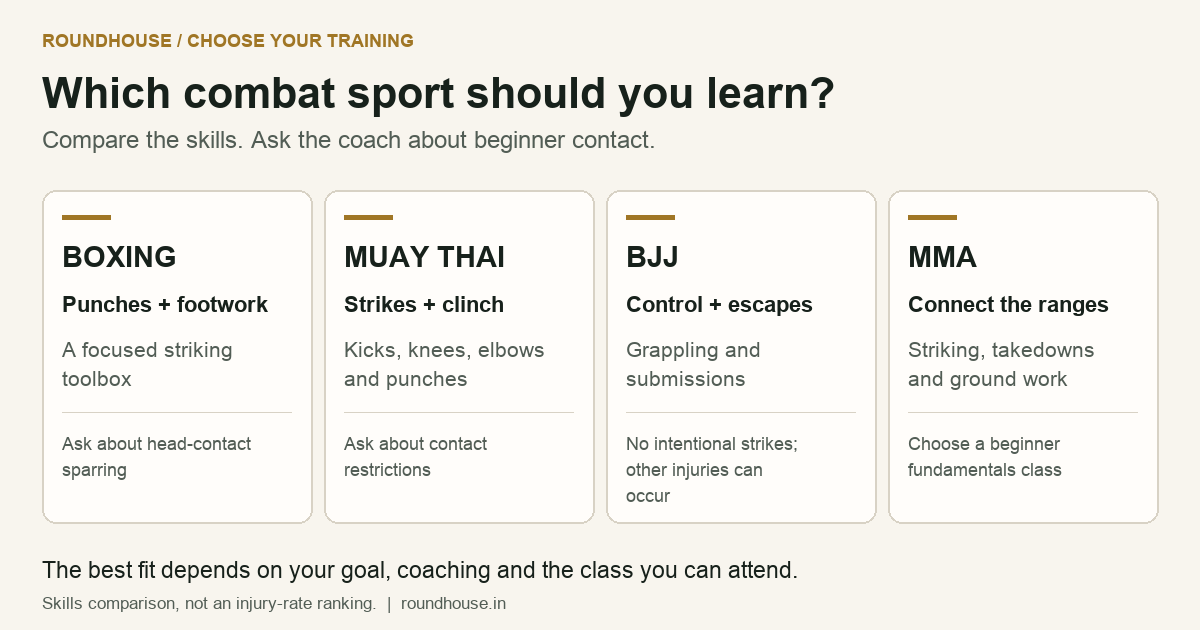
MMA vs boxing vs Muay Thai vs BJJ at a glance
The main difference is the range of skills and the type of contact you practise. The same sport can look very different in a non-contact fundamentals class, controlled partner practice and competition.
| Style | What you learn | A useful reason to choose it | What it leaves out | Contact to ask about |
|---|---|---|---|---|
| Boxing | Punches, defence, footwork and distance | You enjoy pad work and want a focused striking skill | Kicks, takedowns and ground grappling | Head punches in sparring; non-contact classes may be available |
| Muay Thai | Punches, kicks, knees, elbows and clinch work | You want a broader striking toolbox | Ground grappling and submissions | Head/body strikes, leg contact and clinch intensity |
| BJJ | Positional control, escapes, takedowns and submissions | You enjoy grappling and want to avoid intentional strikes | Striking and its integration with grappling | Joint locks, chokes, falls and accidental collisions |
| MMA | Striking, takedowns, ground work and transitions | You want to learn the combined sport | Less time specialising in one art within a mixed class | Whether beginners do contact sparring or ground-and-pound |
This is a skills comparison, not an injury-rate ranking. Ask what beginners actually do in the class you are considering.
Boxing: a focused way to learn striking
Boxing teaches you to punch, defend and move. You learn the jab, cross, hook and uppercut, together with footwork, distance and defensive movement.
What makes boxing appealing
- Its striking toolbox is narrower than Muay Thai's, which can make the first lessons easier to follow.
- Pad work, bag work and skipping offer an accessible way to practise while building conditioning.
- Punching and distance skills can be useful when you later add another striking sport or MMA.
- You may be able to choose fitness or technical sessions without head-contact sparring. Confirm this with the coach rather than assuming it.
What to consider before joining
- Boxing sparring involves intentional punches to the head unless the session specifically excludes them.
- You will not learn kicks, takedowns or ground control in a standard boxing class.
- Understanding a combination is different from using it against a resisting partner. There is no reliable promise that you will become competent in a few weeks.
Who it suits: someone who enjoys punch-focused training and wants a manageable striking starting point. It can also pair with grappling later.
Muay Thai: striking with more tools
Muay Thai is associated with Thailand and is often called the art of eight limbs. It uses fists, elbows, knees and shins, alongside clinch work at close range. Beginner training should introduce these progressively; a class syllabus is not permission to use every technique in sparring.
What makes Muay Thai appealing
- You learn kicking as well as punching, with more ways to manage distance.
- Clinch practice introduces balance, posture and close-range control.
- Pads, bags and technical partner drills make training varied.
- Some of its striking and clinch skills can contribute to MMA, although stance and tactics need adapting when takedowns are possible.
What to consider before joining
- Coordinating kicks, punches and clinch work adds complexity.
- Shin, foot and other contact injuries can occur. Pain is not a requirement for useful training, and hitting hard objects to “condition” your shins is not a sensible beginner project.
- Elbows, knees and hard kicks need appropriate restrictions and equipment in partner practice.
- Availability varies by locality. Check whether a gym actually teaches Muay Thai rather than using the name for a general fitness class.
Who it suits: someone who enjoys kicks and wants more variety in stand-up striking than boxing offers.
BJJ: control, escapes and submissions
Brazilian jiu-jitsu is a grappling sport. You learn to control positions, escape from underneath, take an opponent down and apply submissions such as joint locks and chokes. The balance of standing and ground work varies between schools.
For the differences in clothing, grips and beginner classes, read BJJ gi vs no-gi.
What makes BJJ appealing
- It lets you practise against resistance without intentional punching or kicking under standard BJJ rules.
- Positioning, leverage and timing matter. They can help you handle a stronger partner, although size and strength still matter too.
- You learn escapes and how to regain a useful position when grappling.
- There is plenty to keep learning without needing to compete.
What to consider before joining
- Knees, shoulders, fingers and the neck can be injured. “No strikes” does not mean “no risk.”
- Takedowns and accidental collisions can still cause head injuries.
- Chokes and joint locks need close supervision, prompt release and partners who respect a tap immediately.
- Close contact makes mat, clothing and skin hygiene important.
- Progress and belt promotion take time. The official IBJJF graduation system has age- and rank-specific rules and exceptions; do not treat a minimum eligibility period as a guaranteed promotion date.
Who it suits: someone who enjoys grappling and wants a sport without intentional strikes. For that particular goal, it is our first style to try, rather than an automatic best choice for every beginner.
MMA: learn how the ranges connect
Mixed martial arts brings striking, takedowns and ground grappling together. The distinctive skill is moving between them: defending a takedown while striking, getting back to your feet, or managing position when strikes are possible.
What makes MMA appealing
- You train the connection between skills that separate boxing or BJJ classes do not necessarily cover.
- A good fundamentals programme introduces the different ranges together.
- It is a direct route into learning the sport if MMA itself is your goal.
What to consider before joining
- A mixed syllabus means learning several unfamiliar skills at once.
- Gym quality varies. A class called “MMA” may be mostly pad work and conditioning, with little grappling or transition coaching.
- Strikes, takedowns and submissions create several sources of injury exposure. That does not establish that every recreational MMA class is more dangerous than every boxing or BJJ class.
- Ask how beginners are separated from experienced fighters and when, if ever, they are introduced to head-contact sparring.
Who it suits: someone who wants the combined sport and has access to a structured beginner programme.
You do not need a fixed six or twelve months in other arts before starting MMA. If the local MMA class cannot teach fundamentals carefully, a good boxing or BJJ class is a better starting point while you look for another option.
Which style fits your goal?
Choose by the experience you want to repeat each week, rather than a universal ranking. A convenient class with good teaching is more useful than an ideal style you rarely attend.
| Your priority | First option to explore | What to check |
|---|---|---|
| Fitness through pads and bags | Boxing or Muay Thai | Class intensity, progression and whether contact sparring is optional |
| Avoiding intentional head strikes | BJJ or non-contact striking | Takedown supervision in BJJ; a clear no-head-contact policy in striking |
| Learning kicks and clinch work | Muay Thai | Beginner syllabus and restrictions on elbows, knees and hard kicks |
| Ground control and escapes | BJJ | Positional drills, stand-up practice and immediate respect for tapping |
| Learning the sport of MMA | MMA fundamentals | Coaching across striking, takedowns and ground work |
| Training around a busy job | Whichever good class you can attend | Commute, timetable, recovery and a sustainable membership |
For a fuller first-month checklist, read How to Start MMA Training in India.
Head contact is a separate decision
The important safety choice is whether your training includes intentional head impacts. The sport's name alone does not tell you your exposure.
A 2019 sparring study assessed 20 amateur boxers and Muay Thai athletes after three three-minute sparring rounds, alongside 20 controls doing mock sparring. It found short-term changes in brain-function, motor-control and memory measures, with measured changes returning to baseline at the 24-hour follow-up. This small study does not quantify your long-term risk or establish a safety ranking across all four sports.
BJJ does not include intentional strikes under standard rules, which removes that particular exposure. It still involves falls, collisions and other injuries. Boxing, Muay Thai and MMA can be practised through non-contact drills; ask whether this remains a genuine option as you progress.
Headgear is not a guarantee against concussion. The Association of Ringside Physicians' headguard position statement says it should not be relied on to prevent concussion or other traumatic brain injury. Light sparring is still contact, and a coach's intensity policy matters more than treating equipment as permission to absorb hits.
If you develop possible concussion symptoms after an impact, stop contact training and seek medical assessment. The Ringside Physicians' concussion consensus advises against sparring or competition while symptomatic. Do not use this comparison article as a return-to-training protocol.
What about self-defence?
Training can develop movement, composure and useful skills under controlled resistance. Grappling teaches positional control and escapes; striking teaches distance and defence. Combining them broadens the situations you practise in the gym.
Neither approach makes you safe against weapons, multiple attackers or surprise. Staying aware, de-escalating and leaving are priorities. Going to the ground can make escape harder in an uncontrolled situation, so sport success is not proof of real-world safety.
If this is your main interest, ask whether the coach teaches disengagement and getting back to your feet, rather than promising invincibility. BJJ plus boxing is one possible training combination; it is not a validated guarantee of self-defence effectiveness.
How long does each style take to learn?
Expect gradual improvement rather than a deadline for competence. Attendance, coaching, prior experience and what you mean by “good” matter more than a fixed number of months.
| Style | What the early learning usually focuses on | A useful progress question |
|---|---|---|
| Boxing | Stance, basic punches, defence and footwork | Can I perform the drill with control and keep my balance? |
| Muay Thai | Stance, basic strikes, checking and simple clinch positions | Can I coordinate the movement without rushing or losing posture? |
| BJJ | Positions, escapes, safe partner practice and tapping | Do I recognise the position and know one sensible next step? |
| MMA | Those fundamentals plus transitions between ranges | Can I follow the task and move between skills safely? |
Enjoying a class or remembering its drills does not mean you are ready for hard sparring. Let the coach assess readiness. A trial gives you a first impression; several weeks of regular attendance give you a better view of the teaching and your enjoyment.
Injuries and hygiene: what to watch for
No beginner class is risk-free. Contact level, partner behaviour and coaching affect exposure within each style.
| Style | Examples of concerns to discuss with the coach |
|---|---|
| Boxing | Head impacts, hand/wrist problems and shoulder overload |
| Muay Thai | Head/body impacts, shin/foot contact and poorly controlled clinch work |
| BJJ | Joint and neck injuries, falls, accidental impacts and skin infections |
| MMA | The combined concerns of striking and grappling, especially during transitions |
This table identifies possible concerns; it does not compare their frequency.
A University of Colorado report on US high-school sport described wrestling accounting for 73.6% of recorded skin infections across the sports studied. That is a share of infections in that sample, not the probability that an individual grappler gets infected, and not a rate for BJJ gyms in India.
The CDC's advice for athletes includes showering after exercise, washing training clothing after use and not sharing towels or personal items. Tell the coach about a suspicious skin lesion and seek assessment before contact training; covering something up is not a substitute for proper evaluation.
Also look for clean mats, trimmed nails, removal of jewellery, partners who release submissions immediately, and a coach who stops uncontrolled rounds.
Can you train more than one style?
Yes. One striking art and one grappling art can be a useful combination, but more classes are not automatically better. Start with an amount you can recover from.
Here is an illustrative beginner week:
| Day | Session |
|---|---|
| Monday | Boxing or Muay Thai fundamentals |
| Tuesday | Rest or easy activity |
| Wednesday | BJJ fundamentals |
| Thursday | Rest or easy activity |
| Friday | Optional repeat of the class you want to practise more |
| Weekend | Recovery and ordinary activity; no obligation to add another hard session |
Start with the two classes if you are new to structured training. Add the optional third only when the first two fit your schedule and recovery. If strength training is already part of your week, use our MMA and weightlifting weekly plan to think through the total workload.
If MMA is your goal, a fundamentals course can replace this split rather than being another class piled on top.
Pick the coach, then the style
A well-run beginner class is more useful than a prestigious label with poor teaching. Watch a class, talk to students and ask specific questions before paying.
- Who teaches beginners, and what experience or qualifications can the gym substantiate?
- Are skills explained and corrected, or are newcomers left to copy advanced students?
- Can you decline sparring or a particular contact drill without pressure?
- How are partners matched, and what happens when someone ignores the agreed intensity?
- Are mats and shared equipment cleaned, and is there a clear injury-response process?
- Does the timetable and commute fit your real week?
- What are the current fees, trial terms and cancellation conditions?
Use the Roundhouse gym finder to shortlist available listings. You can also filter for boxing, Muay Thai, BJJ or MMA. Listing information can be incomplete; confirm current coaching, timetables and pricing directly with the gym. An enquiry does not book a trial.
Common beginner mistakes
- Choosing only by what looks impressive on video.
- Treating a gym name or logo as proof of teaching quality.
- Joining an advanced MMA or sparring class when you need fundamentals.
- Assuming that headgear, gloves or a “light” round make head impacts harmless.
- Ignoring commute time and recovery.
- Signing a long contract before understanding the class and its terms.
- Judging the whole sport by one uncomfortable first session, or staying with a class where safety concerns are dismissed.
A one-week plan to choose your first class
Use the week to sample coaching, not to prove how much contact you can tolerate. Trial availability and pricing vary; check them before visiting.
- Days 1–2: try a boxing fundamentals or non-contact class near you. Ask how sparring is handled.
- Days 3–4: if recovered, try a BJJ fundamentals class. Learn the tapping rules before any partner work.
- Days 5–6: if recovered, try Muay Thai or an MMA fundamentals class. Observe the other style if you do not want another session.
- Day 7: rest and compare the teaching, commute, contact policy, fees and whether you want to return.
Spread this across two weeks if three unfamiliar sessions are too much. You do not need to try every sport to make a useful first choice. The class you enjoy and can attend consistently is a good place to begin.
Frequently asked questions
Which is better for beginners, boxing or Muay Thai?
Boxing has a narrower striking toolbox, which may make the first lessons easier to follow. Muay Thai adds kicks, knees, elbows and clinch work. Both can be suitable with progressive coaching; choose by your interest and the actual class.
Is BJJ or MMA better for self-defence?
BJJ focuses on grappling and escapes, while MMA integrates striking with grappling. Neither guarantees safety in an uncontrolled situation. Avoidance, disengagement and getting away remain priorities.
Which one burns the most calories?
There is no reliable winner for every class. Session length, work/rest intervals, body size and effort affect energy expenditure. Choose a class you can attend consistently rather than a promised calorie number.
Should I learn striking or grappling first?
Either is a reasonable starting point. Try boxing or Muay Thai if striking interests you, or BJJ if you want grappling without intentional strikes. Coaching quality and your preferred contact level should guide the choice.
Can I learn MMA without learning other styles first?
Yes. A structured MMA fundamentals programme can teach the base skills and their connections. You do not need previous belts or a fixed period of boxing and BJJ, but an advanced fight-team session is not the same as beginner instruction.
Is BJJ safe for beginners?
BJJ excludes intentional strikes under standard rules, but injuries can occur from submissions, takedowns and accidental impacts. Learn to tap, choose controlled partners and work with a coach who respects your limits.
Which martial art should I choose if I am over 35?
Age alone does not choose the style. Look for progressive instruction, suitable partners and a manageable contact policy. Discuss relevant injuries, health conditions or previous head injuries with a qualified clinician before deciding what training is appropriate for you.
Which martial art is best for children?
Look for an age-appropriate programme with safeguarding, parent involvement, clear contact restrictions and patient coaching. Ask exactly what children practise rather than choosing solely by the sport's name. This adult comparison is not a youth contact-training prescription.
Your first choice does not have to be permanent
If you want one sport to try and avoiding intentional strikes is a priority, start by looking at BJJ. For punch-focused pad work, look at boxing. For kicks and clinch work, try Muay Thai. For the combined sport, choose a structured MMA fundamentals class.
The right coach and a sustainable routine matter more than winning an argument about styles. Start small, ask about contact, and use your trial to judge the actual gym.
This is general information, not individual medical advice. Training examples are illustrative. Discuss an injury, relevant health condition or history of head injury with a qualified clinician before starting or resuming contact training.
Sources and further reading
- Sparring and short-term brain-function changes — Di Virgilio and colleagues, 2019. Small acute study; not a comparison of lifetime risk across these sports.
- Headguard guidance — Association of Ringside Physicians, published online 2023. Equipment guidance, not a guarantee against concussion.
- Combat-sport concussion guidance — Association of Ringside Physicians. Clinical consensus; individual assessment is still needed.
- Official IBJJF graduation system. Check current eligibility rules rather than relying on a universal belt timeline.
- US high-school skin-infection study report — University of Colorado, 2016. Different population and setting from recreational BJJ in India.
- Athlete skin-infection prevention — CDC. Practical hygiene guidance for athletic settings.