Gi BJJ is trained in a jacket, trousers and belt. No-gi uses fitted training clothes, usually a rashguard and grappling shorts. The main difference is how you control the other person: gi gives you fabric grips; no-gi makes you work without them.
That changes the grappling. It does not tell you which beginner class has the better coach, which one fits your week or which one you will enjoy enough to keep attending.
If you are choosing your first class, start there. You can decide how much you care about lapel guards after you have found a gym that teaches you properly.
Gi vs no-gi at a glance
Both are ways to train Brazilian jiu-jitsu. You will encounter positions, escapes, takedowns, guard work and submissions in each. The uniform changes the options available within those situations.
| Question | Gi BJJ | No-gi BJJ |
|---|---|---|
| What do you wear? | Grappling jacket, trousers and belt; academy rules may add requirements | Fitted top and suitable shorts or leggings, according to class rules |
| Can you grip the clothes? | Legal jacket and trouser grips are part of the game | Do not use the top or shorts as grips |
| What replaces a sleeve or collar grip? | You can use fabric as well as body control | Wrist control, head position, underhooks and other body controls become central |
| Are there clothing-based submissions? | Collar and lapel options can be part of the syllabus | No collar or lapel to use |
| Is one always faster? | Fabric can help maintain control; rounds can still be fast | Losing fabric grips changes exchanges; rounds can still be slow and controlled |
| Does it have belts? | Belt rank is visible on the uniform | Rank can still matter even when no belt is worn |
| Which is closer to MMA clothing? | The jacket adds grips absent from ordinary MMA training | The absence of jacket grips is more relevant, but the rules still differ from MMA |
| Which should a beginner choose? | A well-taught class you can attend consistently | A well-taught class you can attend consistently |
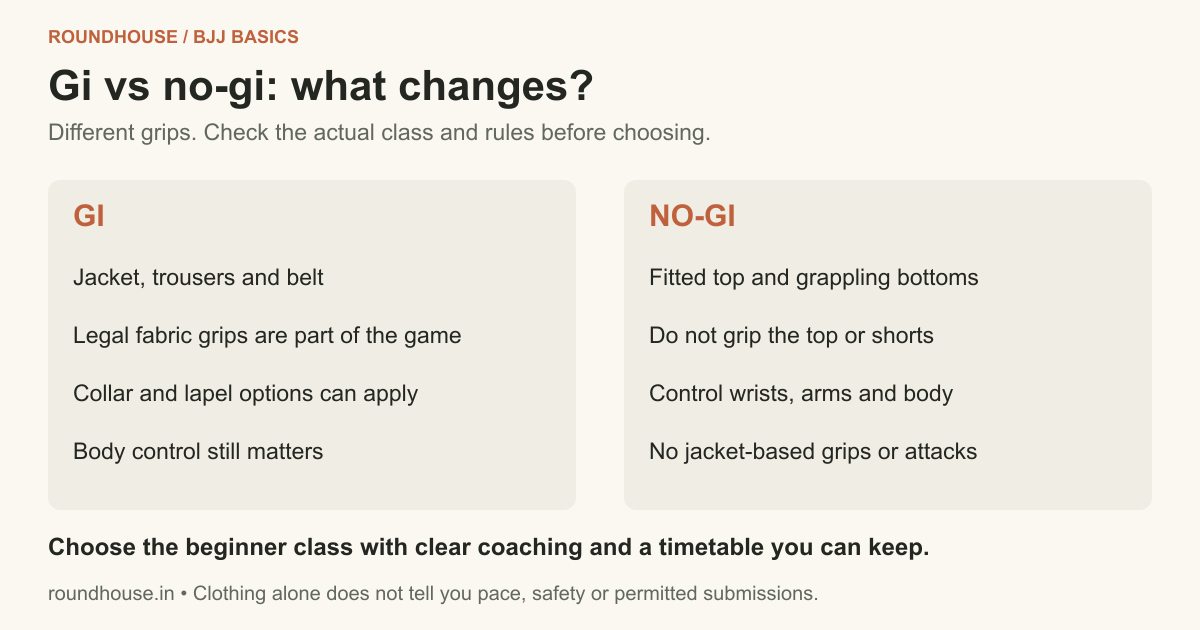
What changes when you put the gi on?
The jacket and trousers become part of the problem you are solving. A partner can control a sleeve, hold a collar or use a legal trouser grip. You have to recognise those grips and learn what they allow.
A sleeve grip can keep an arm connected to your partner. A collar grip creates different possibilities from holding a wrist. Lapel-based techniques use the jacket itself. Those details take practice; they are not accessories to an otherwise identical class.
You will also use controls that exist without the jacket. Positions, balance and the ability to escape still matter. Gi training does not mean every exchange has to begin with grabbing fabric.
The IBJJF uniform requirements describe competition gis and no-gi kit separately. Your academy may permit clothing combinations in class that would not pass a particular tournament's inspection. Ask about the class first, then check event requirements if you decide to compete.
What changes when the gi comes off?
There is no sleeve to keep hold of and no lapel to feed into a grip. You have to control the person through their body rather than their jacket.
You will hear terms such as underhook: an arm positioned underneath your partner's arm to help control their upper body. Hand fighting means working for useful hand and arm positions while dealing with the other person's attempts to do the same.
Those are things a beginner coach should explain. You do not need to arrive knowing a vocabulary list.
Clothing grips are not a fallback when an exchange gets difficult. For example, the official ADCC rules prohibit holding the T-shirt or shorts. Grabbing a rashguard because you lost wrist control changes the rules, rather than solving the same problem.
That does not make no-gi “BJJ with less technique”. It gives you a different set of constraints to work within.
Is gi slower and no-gi faster?
That is a useful shorthand until people start treating it as a law.
Fabric gives you additional ways to stay connected and restrict movement. Without those grips, some exchanges can become harder to hold. You may notice more changes of position while you are learning no-gi.
But the pace of a round also depends on the task, the partners and the coach. A no-gi session built around controlled positional work can be measured. Two experienced gi players can move quickly.
Do not choose gi because someone promises it requires no athletic effort. Do not avoid no-gi because you assume every round will be an uncontrolled scramble. Watch the beginner class you would actually join.
Ask whether the coach sets a specific starting position, explains the goal and controls the intensity. Those answers tell you more than a highlight reel.
Which is easier for a complete beginner?
Both can feel confusing. In gi, someone may hold you in place using grips you have not learned to recognise. In no-gi, you may keep losing contact because you do not yet know how to control the position.
Neither experience proves you chose the wrong format. You are learning an unfamiliar activity against another person who has their own plan.
The more useful question is how the class handles that gap. Look for explanations you can follow, supervised practice and partners who respect the instructions. You should be able to say you are new without being treated as an inconvenience.
A good beginner session gives you something specific to work on. “Try to escape from here” is clearer when the coach has shown the position, explained the task and set limits on what the other person can do.
Our guide to choosing a good MMA gym includes coaching and trial-class questions that also help when visiting a BJJ academy. The scorecard is a decision aid, not an official accreditation system.
If your goal is MMA, should you choose no-gi?
No-gi is the more direct place to practise grappling without jacket grips. That is a reason to include it if MMA is your goal. It is an observation about the clothing constraint, not proof that no-gi classes alone prepare you for a fight.
MMA adds strikes, different equipment and situations involving the cage or wall. A position you are happy to hold during a grappling round may need changing when strikes are possible.
Ask your MMA coach how grappling fits into the programme. Do they teach getting back to your feet? Do they connect takedowns and ground positions with the rest of MMA? Is the separate no-gi class part of that plan or simply another optional session?
Gi training can still be something you enjoy and learn from. You do not need to dismiss it to recognise that your MMA practice needs time without a jacket.
If you are still choosing between sports, read MMA vs boxing vs Muay Thai vs BJJ. Decide whether you want the sport of grappling or the combined demands of MMA before trying to optimise the uniform.
Does no-gi mean all submissions are allowed?
No. The uniform does not tell you the full ruleset. Age, experience division, organiser and class policy matter.
The ADCC Opens rules page links a division-specific legal-techniques chart. An advanced division is not permission to bring the same techniques into a beginner round.
IBJJF also publishes its rulebook, updates and illegal-techniques material. Check the current documents for your division rather than relying on an old social-media explanation.
At the gym, ask which submissions are permitted in your class and what the coach expects you to do when a partner taps. If you do not understand a technique or the agreed rules, stop and ask. You do not need to find out through a surprise during sparring.
This guide is not a submission tutorial or a complete competition-rules summary. It will not tell you a particular leg lock is legal for everyone who trains without a gi.
Are there belts in no-gi?
Not wearing a belt does not make rank irrelevant.
The IBJJF ranking system separates athletes by age and belt division in both gi and no-gi. ADCC Opens also uses belt information and training experience when defining skill divisions, as described on its rules page.
An academy can have its own approach to teaching and promotion. Ask how it places beginners, tracks progress and decides who trains together.
A visible belt is useful information in a gi class, but it does not replace a conversation about the round. In no-gi, introducing yourself and saying you are new is particularly useful when you cannot read someone's rank from their clothes.
What should you buy for the first class?
Ask the academy before buying anything. Send a simple message:
“I'm new to BJJ. Is the beginner class gi or no-gi? What kit do I need for the trial, and do you have a suitable loaner?”
For gi, confirm that they want a BJJ gi and ask about fit, colour and what to wear underneath. Do not assume a uniform sold for another martial art is what the coach wants.
For no-gi, ask about the top, shorts or leggings they accept. Check pockets, zips and exposed hard fastenings before turning up. The IBJJF competition uniform page gives one example of detailed restrictions; its colour, length and rank requirements are not automatically the dress code for every academy.
Avoid buying tournament-specific kit until you know which event you are entering. A product described as “competition legal” still needs to match the rules you will compete under.
Is no-gi cheaper?
Price the actual kit the gym requires. A class that accepts suitable clothes you already own may cost less to start than one requiring a new gi. An academy-branded kit requirement can change that calculation.
Include washing and the number of sessions you plan to attend. If you train again before the previous kit can be washed and dried properly, you need a workable laundry arrangement and may need another set.
There is no useful universal India price to give you without choosing the exact products and seller. Ask about loaners, uniform policies and whether the class fee includes anything before you make the comparison.
Our MMA training cost guide explains how to separate class fees, equipment and other costs. Its examples are for MMA, so use the budgeting method rather than assuming the same kit applies to BJJ.
Which is safer?
You cannot answer that from the uniform alone. This guide does not establish that either format has a lower injury rate.
For a beginner, ask about supervision, partner selection, permitted techniques and how quickly a partner releases when you tap. Check whether you can sit out a round or decline a technique you have not been taught.
Both formats involve close contact. The CDC's guidance for athletes recommends showering after exercise, not sharing towels and washing and thoroughly drying training clothing after each use, following its care instructions.
If you suspect a skin infection, seek medical advice and tell the coach before returning to contact training. A rashguard does not establish that an infection has been dealt with.
Can you train both?
Yes, if the timetable and your workload make sense. You do not need to train both immediately to qualify as someone who is taking BJJ seriously.
If two classes a week are realistic, start with the two you can attend consistently and ask the coach whether they form a sensible beginner programme. Splitting those sessions between formats is one possibility. Following a structured introductory course in one format is another.
Be clear about the session you are in. A sleeve-based solution cannot be copied unchanged into no-gi, and clothing grips that belong in a gi round should not carry over by accident.
If you are adding BJJ around MMA and lifting, put the whole week on paper first. Our MMA and weightlifting schedule can help you see where another hard session would land. Every available class does not have to become part of your week.
How to choose your first format
If both classes are equally accessible and your main goal is MMA, start by discussing no-gi with your MMA coach. If you want gi competition or are interested in the jacket-grip game, start with gi.
If you simply want to try BJJ, choose the better beginner class. A clear coach, suitable partners and a timetable you can keep are good reasons to pick one academy over another.
Ask to watch or trial a session. Check what you need to wear, what beginners practise and whether contact work is optional or structured. Then make the decision based on that class.
You can change the balance later. You do not have to settle the entire gi-versus-no-gi argument before your first lesson.
Browse BJJ gyms on Roundhouse, then confirm with each academy whether it offers gi, no-gi or both. A BJJ directory label does not by itself confirm the format, timetable or beginner provision.
Already training and looking for rounds elsewhere? Our city-by-city open-mat guides distinguish published sessions from guest access, with kit rules and fee checks before you travel.
Frequently asked questions
Should I start with gi before trying no-gi?
There is no universal requirement to learn gi first. Ask how the academy's beginner programme works. Start with the class that fits your goal and gives you clear instruction, appropriate partners and a schedule you can maintain.
Can I grab the rashguard in no-gi?
Do not use the rashguard or shorts as grips. Ask your coach to explain the permitted body controls and hand positions. Clothing rules and legal techniques should be clear before a round starts.
Does no-gi BJJ include punching?
Ordinary no-gi BJJ is grappling, not an MMA round. Do not introduce strikes because the clothes look similar. If a class includes a specialised ruleset or MMA work, the coach should make that explicit beforehand.
Can I attend a no-gi class in ordinary gym clothes?
Only if the academy accepts the specific clothes. Ask about fit, pockets, zips, exposed fastenings and any required rashguard or shorts. What is accepted for a trial may differ from a regular class or tournament.