Most people who want to start MMA never do. They watch a few fights, search for a gym, and stall on the same thought. I'm not fit enough, young enough, or brave enough.
You don't need any of those. You need a good gym, a few basic things in your bag, and a plan for the first year.
This guide covers all of it, from picking a gym to your first sparring round.
How do you start MMA training in India? The short answer
If you only read one section, read this one.
Pick a gym that teaches both striking and grappling to beginners. Start with 2 classes a week and add a third when you recover well. Begin with drills; progress to controlled sparring only when your coach judges you ready. The three-month and six-month milestones below are a conservative example, not evidence that contact becomes safe on a particular date.
Everything below explains why, and how to do it well.
What is MMA (and what isn't it)?
Mixed martial arts combines striking and grappling in one sport. You punch, kick, throw, wrestle, and submit your opponent. Training borrows from boxing, Muay Thai, wrestling, judo, and Brazilian jiu-jitsu (BJJ).
MMA isn't street fighting. A good gym teaches rules, control, and respect for your partner. Most people who train never fight in public, and that's fine.
I'd say MMA is the best all-round combat sport to learn. You get fitness, self-defence skills, and a skill you can keep improving for decades.
Is MMA right for you?
If you're healthy and willing to show up, yes. Here's what stops people, and why it shouldn't.
"I'm not fit enough." Classes are built for beginners who aren't fit. You get fit by training, not before it.
"I'm too old." Plenty of people start in their 30s and 40s. You'll train more carefully than a 20-year-old, and that's an advantage.
"I have a desk job." That's most beginners. Expect stiff hips and a tight back at first, and ask your coach for mobility work.
"I'm worried about getting hurt." Getting hit is part of it, but good gyms control that heavily. Safety depends far more on the gym than on the sport.
If you're under 18, get a parent's consent and look for a gym with a youth program. If you have a heart condition, a past head injury, or a joint problem, see a doctor before you start.
What is the state of MMA in India?
You should know this before you pick a gym. It affects who you trust.
MMA is growing in India, with competing claims about who governs it. In a Lok Sabha answer dated 28 July 2025, the sports ministry said it had not recognised an MMA National Sports Federation, although multiple bodies claimed to govern the sport. That dated answer is not a guarantee of today's recognition status.
Here's what that means for you:
- There's no single national belt or coaching certificate that tells you a gym is good.
- A federation badge on a gym's wall doesn't prove the coach can teach.
- You judge a gym by its coaches, its students, and how it treats beginners.
Check the current status before you join any federation or enter any event. The situation has been changing, and today's answer may differ from this one.
Indian fighters are breaking through
The sport has real momentum. In June 2024, Puja Tomar became the first Indian to win a fight in the UFC, beating Rayanne dos Santos by split decision. Anshul Jubli and Bharat Kandare have also fought in the UFC.
Tomar came from Budhana in Uttar Pradesh and had a background as a five-time national wushu champion. She also built her record in India with Matrix Fight Night before getting the UFC call. That's a useful reminder that Indian fighters can get there from Indian gyms.
In September 2026, MMA made its Asian Games debut in Aichi-Nagoya, and Suchika Tariyal won India's first Asian Games MMA medal, a bronze in the women's traditional 60 kg event. That raises the sport's profile, but it doesn't settle which body runs MMA in India.
What should you decide before you walk into a gym?
Take ten minutes to answer three questions. They'll save you months.
What do you want from it? Fitness, self-defence, a hobby, or competition each point to a different gym and schedule. Most people start with fitness and find they want more.
How many days can you train? Two days a week works. Three is better. Be honest about your work, commute, and family, and pick a number you can keep for a year.
What's your budget? Fees vary a lot between cities and gyms, so ask before you assume. I'm not going to quote numbers here because they change fast and differ by locality. Call three gyms and compare them.
If you have any medical concern, see a doctor first. A quick check beats finding out mid-class.
How to choose an MMA gym in India
This is the most important decision in this guide. A great gym makes you better and keeps you safe. A bad one does neither.
What to look for
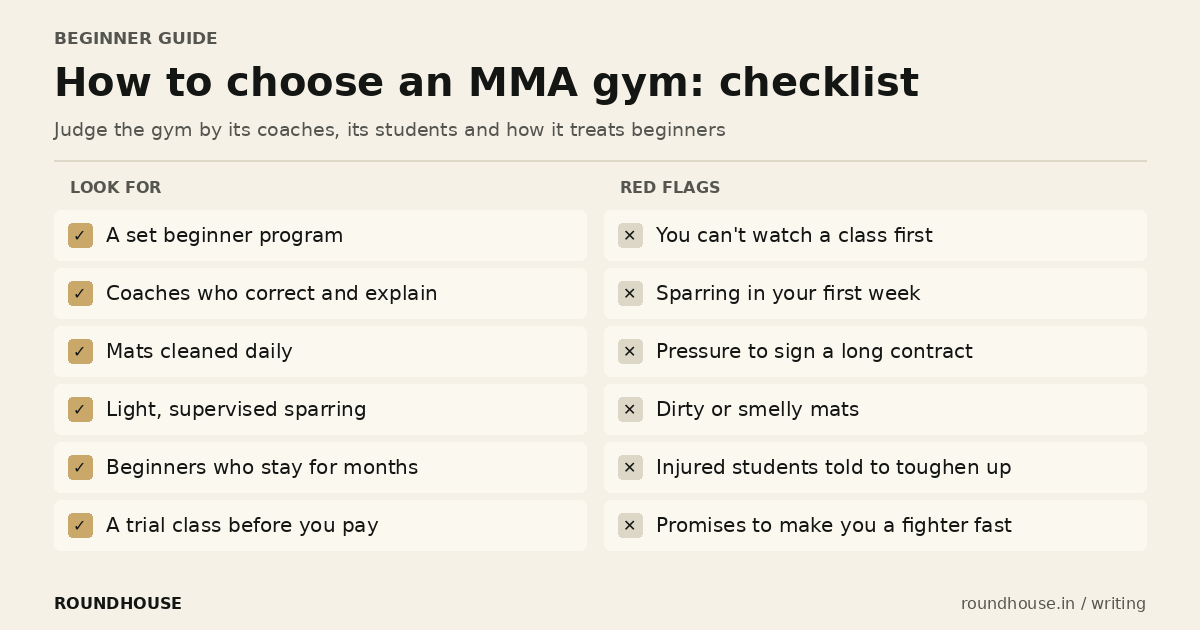
- A proper beginner program. You want a fundamentals class with a set curriculum, not a mixed class where you're thrown in with fighters.
- Coaches who teach. Watch whether the coach corrects people, explains, and demonstrates. A good fighter isn't always a good teacher.
- Clean mats. Mats should be cleaned daily. You should see people showering or wiping down after class.
- Controlled sparring. Beginners should spar lightly with experienced partners, never with someone trying to prove something.
- A mixed crowd. If everyone is a hard-hitting fighter and you see no beginners, that's a warning.
- Small enough classes. If 40 people share one coach, you won't get corrected.
- A trial class. Any good gym lets you try one or two sessions before you pay.
Red flags
- You can't watch a class before signing up
- Beginners are told to spar in their first week
- The coach pushes you to buy a long membership straight away
- Mats look dirty or smell bad
- Injured students are told to "toughen up"
- The gym promises you'll become a fighter in a few months
My rule is simple. Pick the gym where beginners stay.
If you see people who started six months ago still training there and smiling, that's a good sign. If you only see new faces every month, people are leaving.
Questions to ask at the gym
- What does the beginner program cover?
- When can beginners start sparring, and how is it supervised?
- How are the mats cleaned, and how often?
- Which coach would I train with, and what's their background?
- What happens if I get injured?
- Is there a trial class, and what are the fees and contract terms?
If a gym doesn't answer these clearly, move on. There are other gyms.
Find a beginner-friendly MMA gym near you
Roundhouse lists MMA, BJJ, boxing, Muay Thai and wrestling gyms with the sources behind each listing. Start with the MMA gym finder, or go straight to the shortlists for beginner MMA in Noida, beginner MMA in Hyderabad, MMA gyms in Gurugram and the best combat sports gyms in Delhi NCR. Take the six questions above with you, and confirm current fees and trial availability with the gym. A Roundhouse enquiry is a request, not a confirmed booking.
What should a beginner buy for MMA (and what should you skip)?
Don't buy gear before your first class. Most gyms will tell you what you need, and some lend equipment for the trial.
For your first class
- Shorts with no pockets, and a t-shirt or rash guard
- Hand wraps
- A water bottle and a towel
In your first month
- Boxing gloves. Ask your coach about weight, because gyms often want 14 or 16 oz for sparring
- A mouthguard, fitted properly
- Shin guards, once you start kicking pads
- A groin guard
Later, as you progress
- Headgear for sparring
- MMA gloves (small, open-fingered) once you grapple and strike together
- A BJJ gi, if your gym trains in one
Skip these at the start: MMA gloves, expensive fight shorts, and supplements. Gear doesn't make you better, and your needs change once you know what you like.
On the mats, you train barefoot. Wear flip-flops or slides anywhere off the mat, including the bathroom. It's a simple habit that protects your feet.
What happens in your first MMA class?
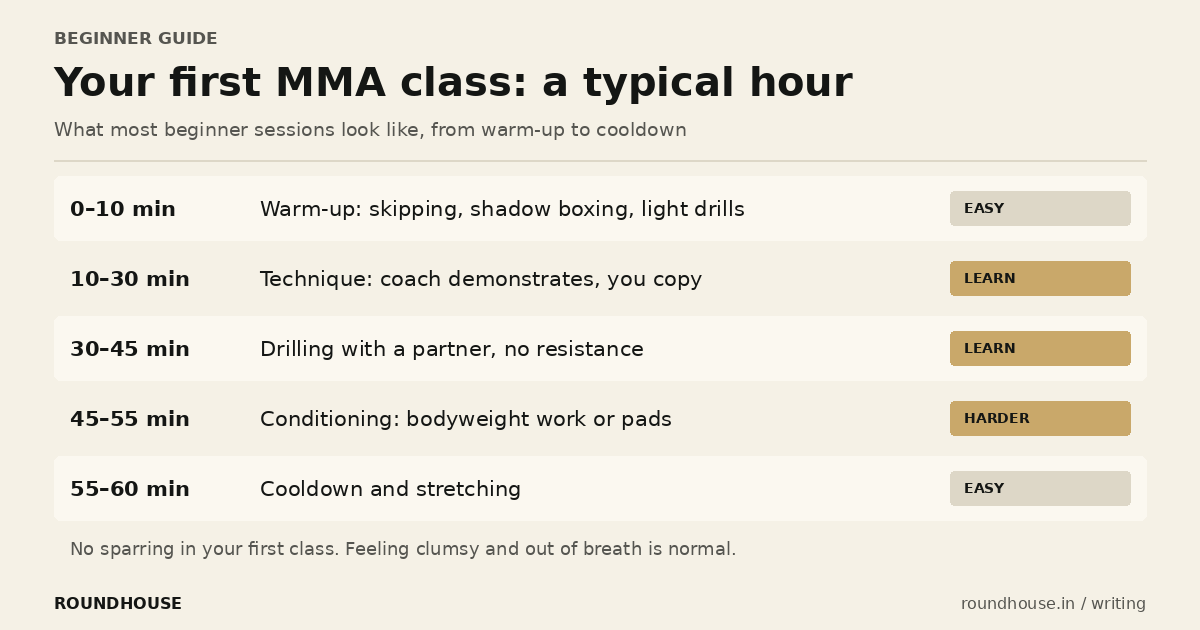
Most beginners are nervous. Here's what a typical one-hour class looks like.
| Time | What you do |
|---|---|
| 0 to 10 minutes | Warm-up: skipping, shadow boxing, light movement drills |
| 10 to 30 minutes | Technique: the coach demonstrates, you copy with a partner |
| 30 to 45 minutes | Drilling: repeat the moves with a partner, no resistance |
| 45 to 55 minutes | Conditioning: bodyweight work or pad rounds |
| 55 to 60 minutes | Cooldown and stretching |
You'll feel clumsy, and that's normal. Everyone else started the same way. Expect to run out of breath within ten minutes.
Eat a light meal 1.5 to 2 hours before class. Don't train on a full stomach or an empty one. Bring water.
After class, shower and put your clothes straight in the wash. We'll cover why in the skin infections section.
Which disciplines make up MMA?
MMA is a mix, so you'll train several arts. Here's what each one gives you.
| Discipline | What it teaches | Why it matters |
|---|---|---|
| Boxing | Punching, head movement, footwork | The base of good striking |
| Muay Thai | Kicks, knees, elbows, clinch | Adds the lower body and close range |
| Wrestling | Takedowns, takedown defence, control | Decides where the fight happens |
| Brazilian jiu-jitsu | Ground control, escapes, submissions | Your safety net on the floor |
| Judo | Throws and gripping | Useful for standing grappling |
India has a long wrestling tradition through kushti and akhadas. If there's a good wrestling coach near you, grab the chance. Wrestling is the base many top MMA fighters build on.
Which one should you start with?
My pick for most beginners is boxing plus BJJ or wrestling. Learn to hit and learn to grapple at the same time. You'll understand what each skill is solving.
If your gym teaches an "MMA fundamentals" class that covers both, start there. Don't spend a year on one art before touching the other, because MMA depends on how they connect.
Your first 12 months of MMA: a roadmap
This is an illustrative progression, slow on purpose. Move according to recovery, skill, coaching and personal goals rather than the calendar. Recreational trainees can choose to avoid head-contact sparring altogether.
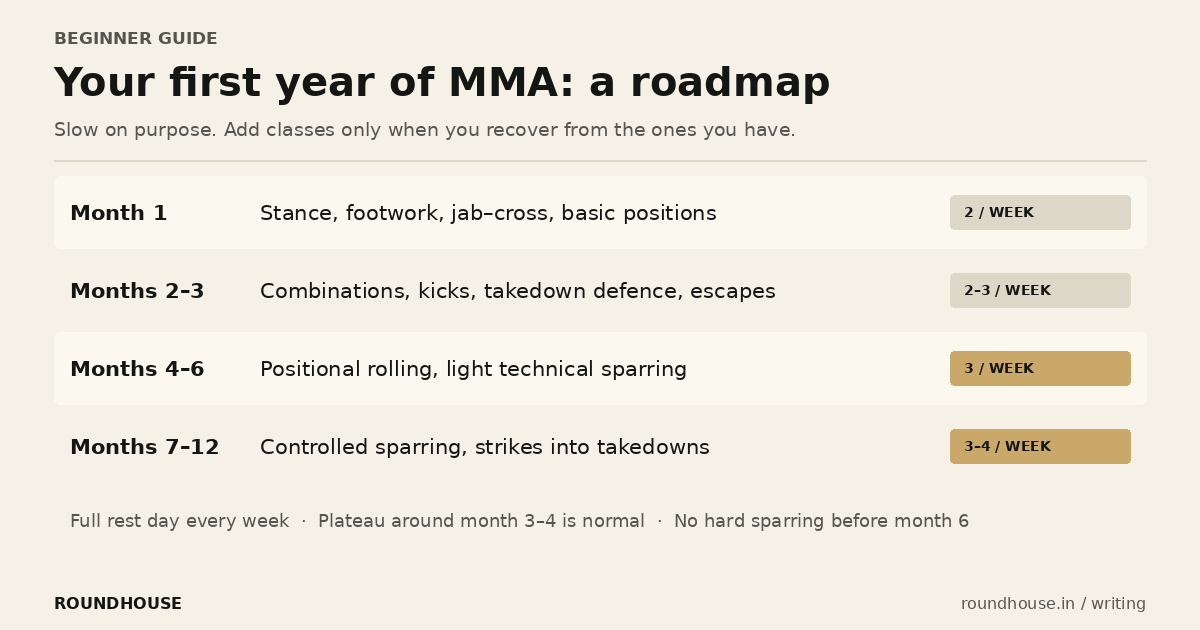
| Phase | Classes per week | Focus | What to expect |
|---|---|---|---|
| Month 1 | 2 | Learn the basics: stance, footwork, jab and cross, basic grappling positions | Sore, clumsy, and out of breath |
| Months 2 to 3 | 2 to 3 | Combinations, basic kicks, takedown defence, guard and mount escapes | Moves start to feel familiar |
| Months 4 to 6 | 3 | Positional rolling, light technical sparring | You can hold your own in drills |
| Months 7 to 12 | 3 to 4 | Controlled sparring, linking strikes and takedowns | You'll know if you want to compete |
A few notes on this plan:
- Don't add classes until you've recovered from the ones you have.
- Take a full rest day every week.
- Expect a plateau around month 3 or 4. It's normal, and it passes.
What basics will you learn first?
You won't learn fancy moves in the first few months. You'll learn the basics, and that's where good fighters are built.
Striking: stance, guard, footwork, the jab, the cross, the hook, a basic round kick, and how to block and slip.
Grappling: the sprawl, a basic takedown, how to bridge and shrimp, escaping a mount, holding guard, and basic positions on the ground.
General: how to fall safely, how to tap, and how to move with a partner without hurting them.
Spend time on these, not on flashy techniques. Boring fundamentals win fights.
Do you need to get fit before starting MMA?
No. But a little extra training makes classes easier and helps you avoid injury.
- Walk, jog, or skip a few times a week to build a base
- Do bodyweight squats, push-ups, and planks at home
- Stretch your hips and hamstrings daily
Once you're training 3 days a week, add 1 or 2 strength sessions. Keep them short and keep them away from your hardest class days. We've covered that in detail in our guide to combining weightlifting and MMA.
How to start sparring safely
Sparring is where beginners get hurt, so this section matters.
A conservative starting point: spend your early months on drills and fundamentals. The sample roadmap introduces light technical sparring around months 4 to 6, subject to coach approval; it is not a universal clearance rule. Start with technical drills where one person attacks and the other defends. Progress only when you can control your movements and your partner's safety, with a coach watching.
Light means you can talk, you're not trying to hurt your partner, and you stop when either of you says so. If you can't keep that pace, slow down.
Hard sparring isn't how you get good. It's how you get hurt. You learn far more from drilling and light rounds than from taking punches.
Why this matters for your head
Head impacts add up, even when they don't knock you out. A study of 20 amateur boxers found short-term changes in brain function and motor control after just three 3-minute sparring rounds.
Ringside physicians have also pointed out that most head impacts in combat sports happen in training, not in fights. That's why the fix is in how you train.
Here's how I'd protect your head:
- Keep head contact light in most sparring rounds
- Use a mouthguard and the protective equipment your coach requires. The Association of Ringside Physicians says headguards should not be relied on to prevent concussion.
- Spar with partners who control their power
- Stop and rest if you feel dizzy, foggy, or get a headache
If you feel dizzy, foggy or develop a headache after head contact, stop training and tell your coach. A suspected concussion needs medical assessment even if symptoms improve. The CDC advises removal from sport, no return the same day and no return until cleared by a healthcare provider. Worsening headache, repeated vomiting, seizures, increasing confusion or difficulty staying awake require emergency medical care.
What are the common MMA injuries and how do you avoid them?
Training can cause injuries, including serious ones. Good coaching and controlled contact can reduce risk; they cannot remove it. Here are some problems to watch for.
| Injury | How it happens | How to reduce the risk |
|---|---|---|
| Sore hands and wrists | Poor punching form, no wraps | Wrap properly and learn form early |
| Toe and foot injuries | Kicking or catching toes on the mat | Learn kicks slowly and keep toenails short |
| Knee strain | Twisting during grappling | Tap early and don't force positions |
| Neck and shoulder strain | Grappling and clinch work | Build neck strength gradually |
| Cauliflower ear | Friction on the ears | Wear headgear when rolling |
| Cuts and bruises | Contact | Cover cuts and clean them after class |
The best injury prevention is simple. Tap early and tap often. Tapping isn't weakness. It's how you come back to class tomorrow.
Skin infections: the danger nobody warns you about
Grappling involves close skin contact and shared mats. Skin infections are a recognised risk in contact sports; hygiene helps reduce transmission.
A study of US high school athletes found that wrestling made up nearly three-quarters of all skin infections. About 60% of the infections were bacterial and about 28% were ringworm. The CDC advises athletes to shower right after training.
India's heat and humidity make this more important. Here's what I'd do:
- Shower with soap straight after every class
- Wash your training clothes after every session
- Don't share towels, gloves, or gear
- Keep cuts covered before you train
- Check your skin regularly for red, ring-shaped, or itchy patches
If you suspect ringworm or another skin infection, stay off the mats, tell your coach and get medical advice before returning. Infections need different treatments; do not assume every rash needs an antifungal cream. The CDC's athlete guidance recommends showering after exercise, avoiding shared personal items, covering wounds and seeking care promptly for a suspected infection.
What should MMA beginners eat, and how should they recover?
You don't need a perfect diet. You need enough protein, enough carbs, and enough sleep.
Protein. The International Society of Sports Nutrition says 1.4 to 2.0 g per kg of bodyweight a day works for most people who exercise. For a 70 kg person, that's roughly 100 to 140 g a day.
Carbs. You need them for energy. Rice, roti, poha, oats, bananas, and potatoes all work. Don't cut them on training days.
Water. Start hydrated, keep water accessible and plan for the heat and session duration. Avoid forcing excessive fluids. Salt or nimbu pani is not a universal treatment for cramps: an evidence review on exercise-associated cramps describes multiple contributing factors and recommends individual assessment rather than blanket advice to drink more.
Sleep. Aim for 7 to 9 hours. Beginners who sleep badly get injured more and learn more slowly.
Here's a simple training day with Indian food:
- Breakfast: eggs and roti, or a paneer paratha with dahi
- Lunch: rice, dal, sabzi, and chicken, fish, or paneer
- Before class: a banana and a glass of lassi or chai
- After class: whey, or a besan chilla with curd
- Dinner: roti, dal, sabzi, and an egg, chicken, or paneer dish
If you're vegetarian, dal, chana, rajma, soya chunks, paneer, and dahi cover your protein. You don't need supplements to start. For a rough estimate of your own numbers, try the Indian macros calculator.
The mental side of starting MMA
The hardest part of MMA isn't physical. It's turning up when you feel embarrassed, tired, or stuck.
Ego will hurt you more than any opponent. You'll get tapped by people smaller than you. That's how you learn, so thank them and ask what you did wrong.
Fear is normal. Everyone is nervous before their first spar. Good partners know it and look after you.
The first three months are the hardest. You're the least skilled you'll ever be, and everything feels awkward. Most people who quit do it here.
My advice is to commit to six months before you judge anything. If you attend 2 or 3 times a week for six months, you'll be well past the worst of it.
If your family isn't convinced
Many Indian families worry about injuries, studies, and careers. That's a fair concern, and it helps to answer it with specifics.
Show them the safety rules, the coach, and the gym's hygiene. Explain that you won't be fighting for months, and maybe never. Invite a parent to watch a beginner class if the gym allows it.
MMA for women in India
Women start MMA for the same reasons men do: fitness, confidence, self-defence, and competition. The sport is growing for women in India, and Puja Tomar's UFC win and Suchika Tariyal's Asian Games bronze have made that visible.
When you choose a gym, add a few questions:
- Is there a women's class or a women's training group?
- Are there female coaches or training partners?
- Does the gym have separate, safe changing facilities?
- How does the coach handle size differences in partner work?
Ask for a trial class and watch how people treat each other. If a gym makes you uncomfortable, trust that and try another.
Should you compete in MMA?
Not for the first year. After that, it's your call.
The amateur route
Many people start with a grappling tournament, like BJJ, because the risk is lower. Others move to amateur MMA after a year or two of solid training. Your coach should decide when you're ready, not your ego.
Because India has multiple competing federations, check who's running any event. Ask your coach these questions:
- Is the event run under clear rules, with referees and medical cover?
- Are fighters matched by weight and experience?
- Is there a medical check before the fight?
- Is there any insurance or injury cover?
Don't enter an event just because someone offers you a slot.
The professional route
Going pro is a different decision. Indian promotions like Matrix Fight Night exist, and some fighters reach international promotions. But reporting on Indian MMA describes fighters stranded between potential and poverty because of weak structure and funding.
I'd say train for yourself first. If you still want to fight after a few years, speak to your coach and to fighters who've done it. Make the decision with full information.
Common beginner mistakes
- Choosing a gym by price or location alone. A gym that's close but unsafe isn't a bargain.
- Sparring too early. It slows your learning and raises your injury risk.
- Training too often too soon. Start with two days and add a third when you recover well.
- Buying gear before trying a class. You may change your mind about what you need.
- Skipping the hygiene routine. Skin infections end your training week fast.
- Ignoring pain. Sharp pain isn't soreness. Stop and get it checked.
- Comparing yourself to others. Everyone started from zero.
- Skipping rest. You get better while you recover, not while you train.
- Quitting at month three. That's when it's hardest and when most people give up.
Myths that keep people from starting
"You have to be fit first." You get fit by training. Good beginner classes scale to your level.
"You'll have to fight." No. Most students never compete.
"MMA is just brawling." It's a technical sport with rules, strategy, and a lot of practice.
"You need to start young." Many people begin in their 30s and 40s and train for years.
"Only big, strong people can do it." Technique beats size in training, and weight classes exist for a reason.
Your 30-day MMA starter plan
Use this checklist to go from thinking about it to training.
Week 1: Research
- Search for MMA and BJJ gyms near you, and shortlist three
- Read each gym's reviews and social media
- Call or message each one and ask the six questions from the gym section
Week 2: Trial
- Book a trial class at your top choice
- Watch a class at your second choice if you can
- Wear shorts, a t-shirt, and bring water, a towel, and hand wraps
Week 3: Commit
- Pick the gym where you felt looked after
- Check fees, contract terms, and cancellation rules before you pay
- Buy a mouthguard and hand wraps if you haven't yet
Week 4: Build the habit
- Attend 2 classes this week
- Set up your recovery routine: shower, wash clothes, eat protein, sleep
- Write down one thing you learned in each class
At the end of the month, ask yourself if you want to keep going. If yes, add a third class in month two.
Frequently asked questions
How long does it take to get good at MMA?
Most people feel comfortable with the basics within 6 months. Real skill takes years, and that's part of what makes it rewarding.
How many days a week should a beginner train MMA?
Two or three. Start with two, and add a third once you stop feeling wrecked the next day.
Can I learn MMA at home?
You can learn conditioning and basic movement at home. You can't learn grappling or sparring safely without a partner and a coach.
What age can you start MMA?
Youth programs exist for children, usually with parental consent. Adults can start at any age, with a doctor's check if you have health concerns.
Is MMA safe?
It carries real risks, like any contact sport. A good gym with controlled sparring and good hygiene lowers them a lot.
Do I need to know a martial art before starting MMA?
No. Beginner classes assume you know nothing.
Should I start with BJJ or boxing?
If you can only start one, I'd pick whichever your best local coach teaches. Add the other within a few months.
Is MMA legal in India?
MMA training is widely available, but federation recognition and legal permission for a particular event are separate questions. The sports ministry's July 2025 answer addressed recognition of an MMA National Sports Federation, not a blanket ban on training. Before competing, check the organiser's rules, required permissions and current recognition status; this guide is not a legal clearance for an event.
Can I train MMA and lift weights?
Yes. Two short lifting sessions a week work well, as long as you plan them around your hardest classes. See our weekly plan for combining weightlifting and MMA.
What if I hate MMA after a month?
Try a different gym before you quit the sport. A bad coach or a bad culture can ruin a good sport.
The bottom line
Start small. Choose a gym that looks after beginners, train two or three days a week, and don't spar hard until you're ready. Keep your hygiene routine tight, eat and sleep properly, and give it six months before you judge it.
Do that, and you'll find what keeps people training for decades. It's hard, it's humbling, and it's one of the best things you can do with your week.
This is general information, not medical advice. See a doctor before you start if you have an injury, a health condition, or a history of head injury.