You want to start karate in India. A class nearby looks promising: the coach has a black belt, the photographs show a few medals, and the evening batch fits after work. So far, so good.
Then you ask what you'll actually do there. Kata? Sparring? A room full of children preparing for their next grading? All can be part of karate. They aren't the same reason to join.
Before paying, establish three things: what this dojo teaches, how it introduces contact and who will teach your beginner batch. The style name helps you ask better questions. Watching the class tells you whether the answers hold up.
Why there are so many different versions of karate
Karate's roots are in Okinawa. The Okinawa Karate Information Center describes several origin theories and warns that sparse historical records make a precise birth date difficult to establish. You don't need a tidy origin story to choose a class.
What matters for your search is that karate developed through different teachers, styles and organisations. A style is a technical tradition. An association organises or certifies a particular network. A competition has a rulebook. A dojo is the school where you actually train.
Those labels can overlap without meaning the same thing. Two schools may teach Shotokan under different associations; two schools with different style names may enter the same competition format.
When a school tells you its style, follow up with the association and the programme. That turns a name you can't yet evaluate into information you can check.
What you're signing up to learn
Karate involves striking with the hands and feet, movement, defensive techniques and practice with partners. In a Shotokan organisation such as JKA Australia, training is described through three connected areas:
| Term | What it means in class | What to look for as a beginner |
|---|---|---|
| Kihon | Repeating fundamental techniques and stances | Someone explains the movement and corrects your attempt |
| Kata | A set sequence of techniques | You learn how to move through it, rather than merely follow the row ahead |
| Kumite | Work with a partner, including forms of sparring | The task, targets and contact level are explained before you begin |
Those terms are useful because they let you ask about the lesson itself. “We teach traditional karate” is a description of an approach. It still leaves open how much time you spend on each part.
For example, if you want partner work and the trial is almost entirely solo practice, ask when partners enter the programme. It may be a deliberate beginner lesson. It may also reflect the school's usual emphasis. One visit alone won't tell you which.
Where kata application fits
Learning a kata's order and understanding a movement with a partner are different tasks. You'll hear bunkai used for analysis or application of the movements; JKA's Malaysian seminar report provides an example of kata practice connected with bunkai. Ask your instructor how that connects to the form you're learning.
You don't have to dismiss solo practice because it has no opponent. You also don't have to accept a dramatic demonstration as proof that you could use the movement under pressure. Ask what each exercise is intended to develop and what changes when a partner can respond.
For instance, learning where to step in a sequence is one problem. Judging distance against a moving person is another. A useful explanation connects them without pretending that memorising one automatically solves the other.
This is where a syllabus becomes more informative than a list of belt colours. You can see how a school links basic movement, forms, prescribed partner drills and less predictable practice.
Styles matter, but they don't write the whole timetable
Shotokan, Goju-ryu and Kyokushin give you different starting points. They don't let you predict every coach, lesson or sparring round carrying those names.
Shotokan: look beyond the line drills
JKA Australia identifies its style as Shotokan and describes basics, kata and kumite as parts of its training. If you're considering a Shotokan dojo, ask how those parts fit together in your actual batch.
A neat row of students doing the same punch doesn't tell you whether the instructor can teach a new adult. Watch what happens when someone gets it wrong. Does the coach identify the problem, demonstrate a correction and check the next attempt?
You don't need to recognise perfect technique to notice whether teaching is happening.
Goju-ryu: ask what “hard and soft” means in practice
The International Okinawan Goju-Ryu Karate-do Federation explains the name as hard and soft style. That is a clue to the tradition, not a promise of an easy class.
Ask the dojo to show you what a beginner learns and how partner exercises relate to the forms. You shouldn't need a vocabulary lesson to get a straightforward explanation of your first few weeks.
Kyokushin: have the contact conversation early
Kyokushin is associated with knockdown competition, but “full contact” isn't a complete rulebook. The KWU kumite rules linked here distinguish age groups and equipment and prohibit punches to the head. Other formats and events can differ.
Don't turn a senior tournament clip into an assumption about beginner training. Ask which rules the dojo uses, what contact you would do, what equipment is required and how partners are matched.
A clear answer is more useful than “we train hard”. You can want demanding training and still expect the instructor to explain it.
Training karate and entering karate tournaments are separate choices
The World Karate Federation's documents page publishes separate rulebooks for kata and kumite. A student preparing to perform a form and a student preparing for a sparring event are working towards different competition tasks, even when they share a dojo.
Other organisations run their own formats. The existence of a WKF rulebook doesn't make every karate event a WKF event, and a school teaching Kyokushin doesn't establish the rules of every tournament it might enter.
Before paying for tournament preparation, get the event name, organiser, category and current rules. Ask whether you'll need a separate licence or registration, equipment, travel and coaching support. A club photograph labelled “national championship” leaves those questions open.
If you want to train without competing, say so. Ask whether you can stay in the general programme and what partner practice it includes. You shouldn't have to buy a competition ambition just to learn karate.
What your first class should help you discover
Your first lesson isn't an audition for a fight team. Use it to find out whether you understand the instruction and can see yourself returning.
The exact order of warm-up, basics, forms and partner work will vary. There's no universal first-class script, and you shouldn't be promised that sparring always starts after a particular number of weeks.
Before the trial, tell the instructor you've never trained. Ask what to wear, whether any equipment is needed and whether the batch is intended for your age and experience. Wait for that answer before buying a uniform.
During the class, pay attention to a few ordinary moments:
- When you lose your place, does someone help you rejoin the drill?
- When an exercise involves a partner, do you know what each person is supposed to do?
- Can you ask for an explanation or a different partner without being mocked?
- Is the coach watching the group, including people away from the front row?
These are things you can observe. A photograph of the instructor's medals can't answer them.
What progress can look like before your next belt
The early weeks can feel repetitive. You may do a movement many times and still need the same correction when you return. A belt isn't the only way to make that work visible.
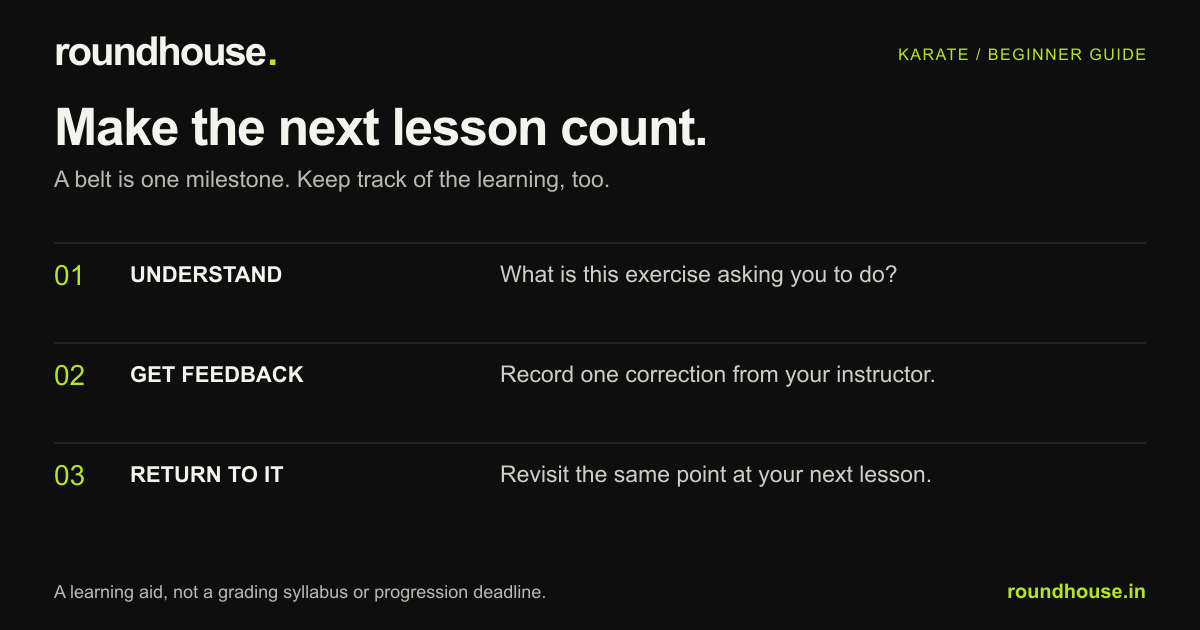
Ask the instructor for one technical point to focus on and one way to recognise a better attempt. “Improve your basics” is difficult to act on. “You kept losing your balance at that transition; let's check the same transition next class” gives you something to revisit.
Use the following as a conversation guide, not a promised timetable or a universal grading syllabus:
| Part of learning | A question that makes progress visible |
|---|---|
| Understanding | Can I explain what this exercise is asking me to do? |
| Remembering | Can I attempt the sequence without following the person beside me? |
| Control | Can I repeat it at the pace and range my instructor has set? |
| Responding to feedback | Does the correction appear in my next attempt? |
| Partner work | Do I understand my role, distance and agreed contact? |
| Retention | What do I still remember when I return to the next lesson? |
A student can improve in one area while struggling in another. Forgetting a turn in a kata doesn't erase a better stance; remembering the whole kata doesn't establish that every movement is well executed.
A simple way to review your first block of classes
After the first few visits, write down the exercise you were taught, the correction you received and the question you're taking back. You can use the blank karate learning log in a spreadsheet or print it.
The file has space for eight lessons because that is a manageable note-taking block, not because a skill or belt should take eight lessons. There is no readiness score and no requirement to make entries public.
At the end of that block, ask the instructor to review the notes with you. Are you working towards a clear syllabus? Are you getting corrections you can understand? Does the next step make sense? That conversation is more useful than asking whether you're progressing as fast as a child in the next row.
Belts: find out what the certificate actually represents
A belt can give you something concrete to work towards. The question is what you have to demonstrate to earn it.
Karate organisations use kyu grades before dan grades, but you shouldn't expect one universal colour sequence, syllabus or examination timetable. JKA's grading system is an example of an organisation publishing rank requirements and examiner arrangements. It isn't the grading policy of every dojo in India.
Ask your school for the syllabus for the next grade, the examiner's name, the issuing organisation and the full examination charge. If it claims an affiliation, check that claim with the organisation rather than relying on a logo on a poster.
Also separate the instructor's own rank from authority to issue a particular organisation's certificates. They are different questions.
A promised black-belt date is a poor substitute for that information. Ask what happens if you aren't ready for an exam, or choose to keep training without taking the next grading immediately.
Get the first-month cost and the continuing cost
“Monthly fee” may be only one line in the quote. Before joining, ask which of these apply:
| Cost | What you need in the answer |
|---|---|
| Classes | Batch, attendance allowance and payment period |
| Joining or association registration | Whether it is compulsory and whether it renews |
| Uniform | Required type, price and whether you can buy it yourself |
| Gradings | Exam, certificate and belt charges, including any separate amounts |
| Protective equipment | The list for your programme and when you need it |
| Competitions | Whether participation is optional, with entry and travel paid separately |
There isn't a responsible single price we can give for karate across India. Get a quote from the school you're considering and compare like-for-like access. Don't add tournament expenses to your budget unless you intend to enter.
Between classes: practise what you were actually taught
Ask for a small piece of your current lesson to revisit at home and have the instructor check it next time. That might be remembering an agreed sequence or rehearsing a movement at a pace they have demonstrated.
A video from a different style can use a different stance, sequence or terminology. Before changing what you were taught, ask whether the video belongs to your school's syllabus. Collecting several incompatible versions can make the next lesson harder to follow.
Keep partner drills and contact work in the setting your instructor has arranged. Reading a beginner article doesn't provide the supervision, space or partner agreement needed to improvise them at home.
If you're also lifting or doing another sport, show the instructor your actual week. Start with the classes you can attend, then discuss additional work. An extra conditioning plan copied from an advanced athlete isn't automatically part of your beginner programme.
Our guide to combining MMA and lifting workloads discusses the broader problem of adding sessions to an already busy week. It isn't a karate-specific prescription.
When to ask for a change, or try another dojo
Some first-day confusion is expected. Confusion that never gets explained deserves a conversation.
If you keep missing instructions in a mixed-level group, ask whether there is a smaller beginner session or a time for questions. If a regular partner uses more contact than agreed, speak to the instructor before the next drill and establish how the pairing will change.
Administrative problems count too. If the price of a compulsory grading only appears after you've enrolled, request the full schedule of charges. If you need to miss a month, check the pause or rejoining policy before renewing.
You may decide the style interests you but the school's timetable or teaching doesn't suit you. That is a reason to look at another dojo, not evidence that you failed at karate. Keep your grading documents and ask a prospective school how it treats previous training; don't assume ranks transfer automatically.
If you're choosing for a child
Watch the actual children's batch. An impressive adult demonstration doesn't show how a coach handles a distracted child or a frightened beginner.
Ask how children are grouped, how contact is introduced and how a child can stop a partner exercise. Find out who you contact with a concern and what parents can observe. Judge the arrangements you see rather than assuming the word “discipline” guarantees good teaching.
A trial should also give the child a say. Wanting to return is useful information; it doesn't need to be dressed up as a promise of confidence, better grades or a transformed personality.
Shortlist a dojo you can keep attending
Start with karate classes in India, or look in Delhi NCR, Mumbai, Pune, Hyderabad, Chennai and Bengaluru.
Use the listing to prepare an enquiry, then confirm the current batch, instructor, fee and trial. Public information about a school isn't an inspection of its teaching.
If you're deciding between arts, read karate vs taekwondo. If you need help narrowing the locations, try Find My Gym.
After the trial, ask yourself whether you'd want to come back next week. If the teaching makes sense, the contact is clear and the journey works, you have a stronger reason to join than a highlight reel.
Frequently asked questions
Can an adult beginner join karate?
Yes. Ask for a batch that accepts adults with no experience. Don't assume an all-ages timetable provides appropriate instruction for you; confirm how beginners are taught and try the class.
Which karate style is best for a beginner?
There is no style name that settles the decision. Use it to understand the training approach, then compare the instructor, beginner provision, contact rules and timetable at the available dojos.
Will I have to spar in my first class?
That depends on the school and programme. Ask before attending what partner work is planned, what contact is involved and how a new student is introduced to it.
How long does a karate black belt take?
There is no single timeline across organisations and schools. Ask for the grading syllabus, eligibility requirements, examiner and issuing body instead of relying on a promised completion date.
Do I need a uniform before the trial?
Check with the dojo first. Ask what clothing is accepted for a trial and when its required uniform and equipment become necessary. Don't buy a full kit from a generic shopping list.
How much does karate cost in India?
Get a school-specific quote. Compare class access and any required registration, uniform, grading and equipment charges; a monthly headline price doesn't establish the complete cost.
Is kata the same as sparring?
No. Kata is a set sequence; sparring involves a partner under an agreed task and rules. Ask how your dojo connects forms, application exercises and partner practice rather than treating any one of them as a substitute for all the others.
Can I learn karate online without a dojo?
Videos can support practice and terminology, but they don't by themselves provide live correction or supervised partner work. Ask a qualified instructor how online lessons and in-person practice fit your goals before treating a video course as equivalent to a dojo programme.