Creatine monohydrate can support strength training and short, repeated hard efforts. For combat athletes, those benefits have to be weighed against possible body-mass gain. Evidence for better gym performance is stronger than evidence that creatine improves the outcome of an MMA fight, boxing match or BJJ competition.
That is the useful starting point. You do not need a supplement stack because you have joined an MMA gym. You need a reason to use each thing you buy.
If you lift alongside martial arts, creatine deserves a closer look. If you are already struggling to make a weight class, the decision needs more care than “everyone at the gym takes it.”
Here is what the research supports, where the claims get ahead of it and how to think through the practical trade-offs.
What does creatine actually do?
Creatine helps replenish ATP, the molecule your muscles use to supply energy. In muscle, phosphocreatine acts as a readily available reserve for brief, intense work. Supplementation can increase that reserve.
Think about a hard lifting set or repeated bursts of power. That is the kind of demand this energy system helps support. Sport Integrity Australia explains the mechanism in those terms.
This does not mean a five-minute round runs entirely on creatine. It also does not mean taking a scoop before class will suddenly fix your conditioning.
Your question should be specific: are you trying to improve the strength work supporting your sport, or expecting a powder to solve a problem with the sport itself?
What does the combat-sport research show?
A 2025 narrative systematic review of creatine in combat athletes included 19 studies, with its search running through March 2025. Sports included wrestling, judo, taekwondo and boxing.
The review reported improvements in strength and power, alongside increases in body mass and fat-free mass. Its abstract did not report improvements in sport-specific endurance, recovery or fatigue measures.
That makes “creatine helps fighters recover faster” too broad a summary. It also matters that fat-free mass includes water; an increase is not automatically all new muscle tissue.
A useful reading of this review is that creatine may support some physical qualities relevant to combat sports. It does not establish that every fighter benefits, or that a better strength or power test translates into more competition wins.
Different sports and performance tests answer different questions. A result from a judoka is relevant context for an MMA athlete, but it is not direct proof of better MMA fight performance.
Where is the stronger evidence?
There is a clearer case for creatine as an addition to resistance training.
A 2024 systematic review and meta-analysis in adults under 50 included 23 studies. Creatine plus resistance training improved upper- and lower-body strength compared with resistance training and a placebo.
The evidence was heavily weighted towards male participants. Results from mixed populations and lifting tests still need care when applied to a particular combat athlete. A pooled improvement is not a promise that you will add a specific number of kilograms to a lift.
For someone following a sensible MMA strength programme, that is a reasonable use case to discuss. The supplement supports a training process you are already doing.
It does not choose the right exercises, manage your sparring load or tell you whether another lifting day belongs in your week.
| What you want | What the evidence can support | What you should not assume |
|---|---|---|
| Better strength-training progress | An added benefit alongside resistance training in studied populations | A guaranteed increase in your own lifts |
| More power in short efforts | A plausible, studied performance benefit; results depend on the task | Automatically harder punches or better takedowns |
| Better performance throughout a whole round | General high-intensity findings provide context | Proven improvements in every sport-specific endurance test |
| Easier recovery between hard classes | A question that needs sport- and outcome-specific evidence | Permission to keep adding hard sessions |
| More competition wins | Training qualities may contribute to preparation | A demonstrated improvement in win rate |
The table separates research findings from practical interpretation. It is not an evidence-grading system or a list of predicted effects for an individual athlete.
The weight-class trade-off comes first
Creatine can increase body mass, including through increased body water. The Australian Institute of Sport's creatine guidance identifies this as a consideration for athletes trying to make weight.
A change that barely matters to a recreational lifter can matter a lot when you are close to a competition limit.
Consider this illustrative calculation, not a prediction: an athlete weighing 70.0 kg has 0.3 kg of room below a hypothetical 70.3 kg limit. If their mass rises by 1.0 kg, they weigh 71.0 kg, or 0.7 kg above that limit. Whether the extra mass is water does not change the weigh-in arithmetic.
The 1.0 kg figure is an example. It is not an expected response, an upper limit or a reason to attempt a particular cut.
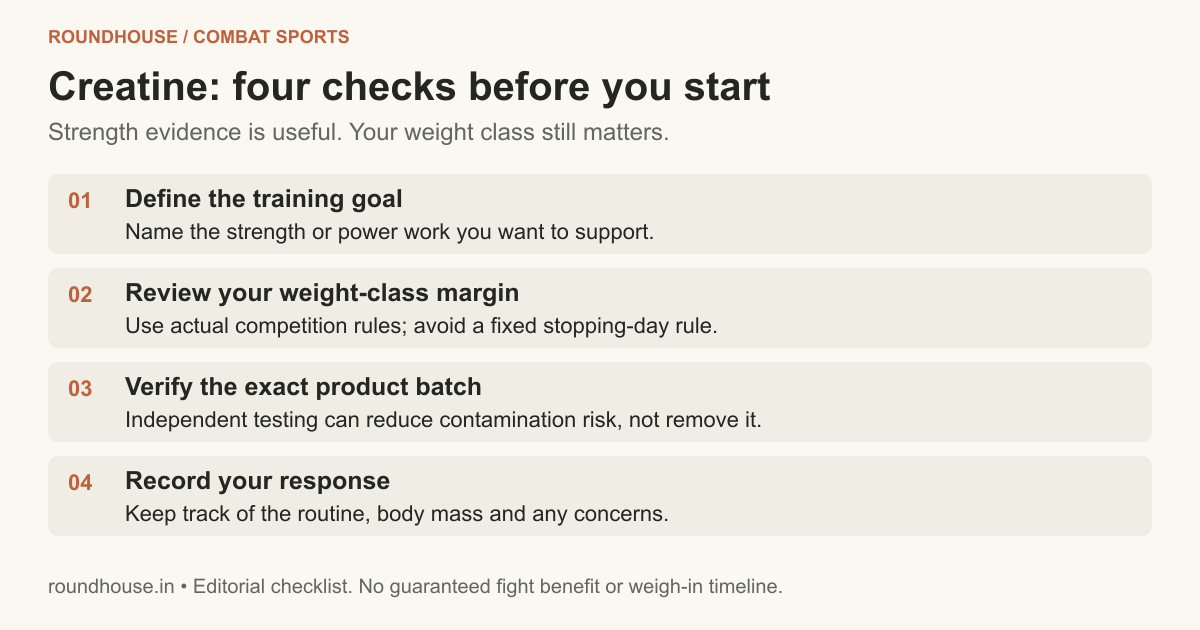
Before adding creatine, ask:
- Is a competition booked, and what are its actual weight and weigh-in rules?
- What does your body mass normally do across comparable mornings?
- Is there room for a change without escalating a weight cut?
- Who is responsible for the nutrition plan if you compete?
Do not use a fixed “stop this many days before weigh-in” rule from a general article. The AIS describes a gradual change after stopping; that is not an individual countdown for making a division.
Discuss the decision with a sports dietitian familiar with weight-category sport. Starting a new supplement just before a bout gives you little opportunity to understand your response.
How much creatine do people usually take?
For healthy adults choosing to supplement, 3–5 grams of creatine monohydrate per day is a commonly used approach. The ISSN position stand describes this range and distinguishes ongoing intake from an optional higher-dose loading phase.
This is general sports-nutrition information. It is not an individual prescription, particularly if you have a medical condition or are managing competition weight.
Is a loading phase necessary?
No. Loading raises muscle creatine more quickly, but a slower approach can also increase stores.
In a 1996 trial involving 31 men, 3 g per day for 28 days produced a gradual increase in muscle creatine comparable to the increase reached more quickly with a higher-dose protocol. That study measured muscle creatine, not MMA performance or the safety of a weight cut.
There is no need to turn “works faster” into “you must load.” Decide whether you need supplementation at all before worrying about the fastest way to start.
Does the timing matter more than consistency?
The ISSN guidance centres on increasing and maintaining muscle stores. That is different from treating creatine like an immediate pre-workout stimulant.
Choose a routine you can follow. Taking it with a regular meal is a practical option; it does not require buying a recovery shake or setting a narrow post-training timer.
Rest days belong to the same ongoing routine. Do not interpret a daily protocol as “only take it on the days you lift.” If a clinician or sports dietitian has given you a specific plan, follow that plan.
Which type should you buy?
Plain creatine monohydrate is the sensible starting point. It is the form with the established research base. The AIS guidance does not find a scientific reason to favour alternative forms promoted as better absorbed.
A longer ingredient list is not evidence of a better product for your sport. Keep the buying decision simple:
- Identify the form and the amount of creatine per serving.
- Check how many servings the container actually provides.
- Verify the product's authenticity and the exact batch-testing claim.
- Compare cost only after those checks.
These are purchasing checks, not endorsements of a brand or retailer. We are not ranking products or claiming that a particular seller currently has verified stock.
If your budget is tight, write down what you would give up to buy it. A supplement can be optional even when it has credible evidence. Your class fees and a workable food budget still have to fit.
For the separate question of everyday protein intake, use our MMA and lifting protein guide. Creatine is not a replacement for meeting your food needs.
Side effects and kidney questions need a precise answer
Stomach upset can occur, particularly with larger amounts taken at once. The AIS suggests that avoiding loading and using a lower-dose approach with meals may help with tolerability. Persistent symptoms are a reason to get advice, not keep increasing the dose.
Kidney claims deserve more care than either “it destroys your kidneys” or “it is safe for absolutely everyone.”
The accessible abstract of a 2026 meta-analysis of randomized trials reported increased serum creatinine, but no statistically significant differences in urea or estimated glomerular filtration rate between creatine and control groups. The authors called for more trials extending beyond a year.
Creatinine is a blood marker used in assessing kidney function. An altered marker needs clinical interpretation; it is not something to diagnose from a supplement label or dismiss because you take creatine.
Tell your clinician about supplement use when discussing blood tests. Known kidney disease, other medical conditions or medication use belong in that conversation before starting. Findings from studied adults do not supply blanket clearance for every person or every dose.
This guide is written for adult readers. It is not a dosing guide for children, pregnancy or the treatment of a medical condition.
Is creatine banned in combat sports?
Creatine itself is not prohibited under the World Anti-Doping Code, according to Sport Integrity Australia. That does not make every container labelled creatine free of contamination.
Its supplement risk guidance recommends independent batch testing as a way to reduce risk. Lower risk does not mean zero risk.
For an athlete buying in India, the practical task is to verify the exact product and batch through the testing programme's own records. A logo in a marketplace photo or a statement about another product from the same brand is not enough.
Keep the batch details and purchase record. Confirm the requirements that apply to your sport and competition. No product recommendation in an article should replace that check.
How would you decide whether it is useful for you?
Start with the problem you are trying to solve. “Everyone uses it” is not a training goal.
If your priority is supporting a structured strength block, you have a clearer reason to consider creatine than if you are hoping it will compensate for missed classes. If your immediate problem is an unmanageable week, first review how your lifting and MMA sessions fit together.
If you decide to try it with appropriate guidance, keep a simple record:
| Record | Why it belongs in the discussion |
|---|---|
| Product, batch and daily amount | Makes the actual routine clear |
| Start date and changes to the routine | Avoids relying on memory |
| Body mass under comparable conditions | Helps identify a relevant change for your division |
| Stomach symptoms or other concerns | Makes tolerability part of the decision |
| A few existing training measures | Keeps attention on the goal you chose |
| Other training, food or sleep changes | Prevents crediting every improvement to the supplement |
This is an editorial record-keeping suggestion, not a controlled experiment or medical monitoring protocol. If you start a new programme, eat more and take creatine at the same time, the log cannot isolate which change caused your progress.
Do not test it by turning normal sparring into a harder session. Keep the comparison tied to work already planned with your coach.
The decision can also be “not now.” A booked competition, uncertain product source or unresolved medical question is enough reason to settle those issues first.
What is worth taking away?
Creatine has a credible place in the conversation about strength and power. The combat-sport decision still depends on the person, the training goal and the weight class.
Write down those three things before buying anything: what you want it to help, what body-mass change would mean for you and how you will verify the product. If you cannot answer them yet, that is the next step.
Frequently asked questions
Does creatine improve MMA performance?
It can support strength training and some short, high-intensity performance measures. Those findings do not establish a guaranteed improvement in MMA bout performance or win rate. Match the claim to the outcome researchers actually measured.
Will creatine make me miss weight?
It can increase body mass, but your response and remaining margin matter. Do not use an assumed gain or a fixed stopping date to plan a cut. Discuss supplementation alongside your actual division and weigh-in rules with a qualified sports dietitian.
Do I need to load creatine or take it before every session?
Loading is optional. A commonly used alternative is daily creatine monohydrate without a loading phase, allowing stores to rise gradually. The purpose is ongoing muscle stores, rather than an immediate effect from taking a scoop just before class.
Can I use creatine instead of protein powder?
They address different things. Protein powder is one way to add dietary protein; creatine is a separate supplement. Neither is compulsory, and neither replaces an adequate overall diet. Decide whether you have a specific need before buying either.