A bodybuilding split can leave you too sore for your next MMA class. A strength plan that ignores your fight schedule can create the same problem. The useful programme is the one you can recover from while still learning and moving well on the mats.
This guide provides three sample sessions, an eight-week progression and a two-day option. One or two lifting days remain the starting point for many recreational trainees. A third day is optional, for someone already comfortable with the lifts whose MMA quality and recovery remain steady. Our guide to combining weightlifting and MMA explains that decision in more detail.
The template is for healthy adults with some lifting experience, outside competition preparation. Beginners should learn the exercises with a qualified coach first. It is not an injury-rehabilitation plan or a fight-camp prescription.
The short answer: what should your MMA strength week look like?
Use Day A for controlled strength work, Day B for brief power practice, and an optional Day C for moderate-load strength and trunk work. Allow roughly 45–60 minutes for Day A and 30–45 minutes for the other sessions, including warm-up. Take longer if you need it; do not rush rest periods to meet a timer.
Keep ordinary lifting sets about two or three repetitions short of failure. Power sets finish when speed or control deteriorates, well before fatigue. Place demanding lifting around your priority MMA sessions, and remove the optional day if it reduces the quality of those sessions.
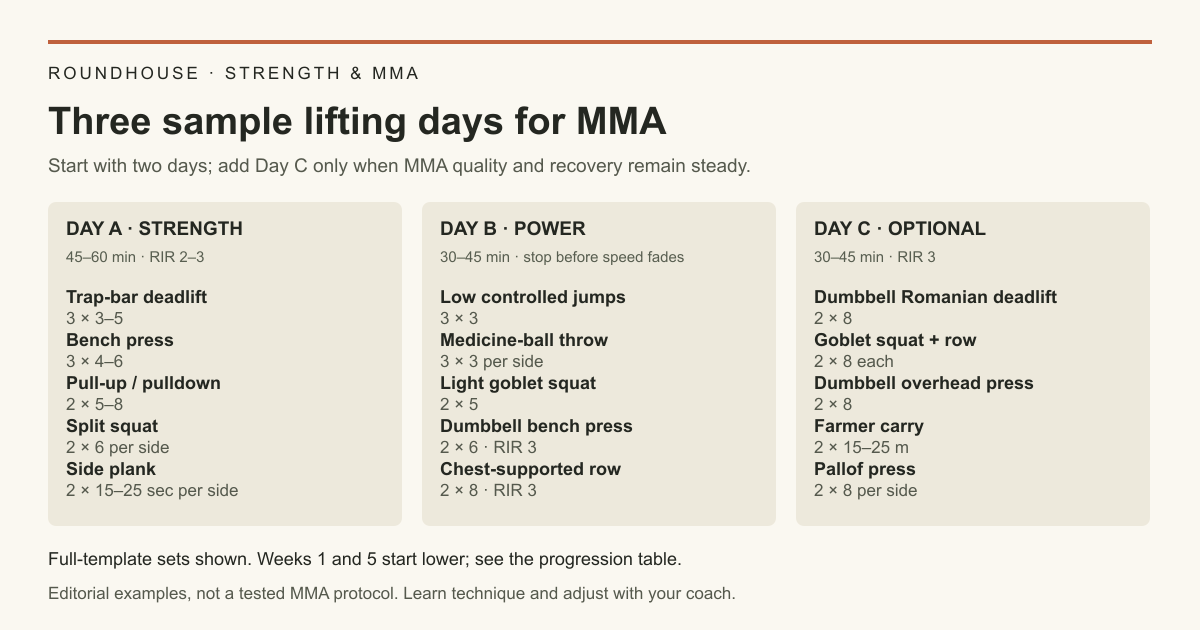
Open the session reference graphic.
What does the research support?
A 2023 systematic review of Olympic combat-sport athletes reported improvements in physical-fitness measures following strength-training interventions. It covered sports including boxing, judo and wrestling, rather than MMA. It supports resistance training as a useful component of preparation, not these exact exercises or this eight-week template.
In a 2018 study of 17 national-level male MMA athletes, ten athletes followed a specific strength-and-conditioning programme and seven followed a comparison programme. The four-week intervention used three sessions a week and combined strength, power, intervals and sport-specific work. The specific group improved tested strength measures by roughly 16–20%. Those were experienced athletes in a small study, and their sessions lasted approximately 65–85 minutes. This article's shorter sessions do not reproduce that protocol, and the percentage is not a result to expect from this plan.
A 2022 cross-sectional study of 21 male MMA athletes compared strength across weight classes and competitive levels. Its findings concerned bench-press and isometric lower-back strength; the groups were small. An association between a strength measure and competitive level does not show that increasing that measure causes fight success.
The research supports building useful physical capacities alongside skill work. It does not establish that completing these sessions will improve your clinch, win a fight or prevent injury.
Does lifting interfere with MMA training?
Strength training has a recovery cost. That does not mean endurance work automatically cancels strength gains.
An older 2012 meta-analysis of 21 studies reported interference between some endurance and resistance-training outcomes. The updated 2022 review of 43 studies found no significant reduction in maximal-strength or muscle-size gains overall, but smaller improvements in explosive strength. The explosive-strength effect was more pronounced within the same session than with sessions separated by at least three hours.
These studies examined aerobic and resistance exercise, not the contact, decision-making and fatigue demands of MMA. Applying their findings to sparring is an inference. A six-hour gap may be a useful scheduling choice, but it is not a proven minimum that makes heavy lifting and hard sparring safe together.
Keep the workload modest, stop short of failure and watch whether the next MMA session gets worse. If it does, reduce lifting before adding more conditioning.
Is three days right for you?
Start with the two-day option unless you already tolerate that workload well. Session count alone cannot decide what you can recover from: three hard MMA classes may demand more than five easy technical sessions.
Consider the third lifting day when:
- Your MMA sessions are mostly technical or moderate, with demanding sessions clearly identified.
- You already know the movements and can repeat two lifting days without persistent soreness or a drop in MMA quality.
- Sleep, food and work demands allow consistent recovery.
- You are building general capacity rather than preparing for an imminent fight.
Use fewer or shorter sessions when MMA intensity rises, sleep deteriorates or recovery slips. The tables below are editorial examples to discuss with a coach, not a validated dose based on the number of classes you attend.
How to read the workouts
Repetitions in reserve (RIR) describe how many more clean repetitions you estimate you could perform. RIR 2 means stopping with about two left. It is an estimate, especially for beginners. Technique should remain consistent; grinding or losing position is a reason to end the set.
Rest about two to three minutes between the main strength sets and roughly 60–90 seconds between lighter accessories. Rest longer when needed to restore quality. For jumps and throws, recover between sets rather than turning them into a conditioning circuit.
Warm up before each session
- Start with around five minutes of comfortable movement, such as walking, a bike or light skipping if suitable.
- Rehearse the movements you will use: a few controlled bodyweight squats, hinges and shoulder movements.
- Perform two or three progressively heavier practice sets before the first loaded main exercise. Add practice sets for other lifts as needed.
Warm-up sets are additional to the working sets in the tables. A warm-up does not guarantee you will avoid an injury.
Day A: controlled strength
Choose loads that leave about two or three clean reps in reserve. This is the most demanding lifting session, not a day for maximum attempts. Use a rack and appropriate safeties or a competent spotter for the bench press.
| Exercise | Working sets × reps | Effort and purpose |
|---|---|---|
| Trap-bar deadlift | 3 × 3–5 | RIR 2–3; controlled hinge, no grinding |
| Bench press | 3 × 4–6 | RIR 2–3; consistent position and control |
| Pull-up or lat pulldown | 2 × 5–8 | RIR 2–3; use assistance if needed |
| Split squat | 2 × 6 each side | RIR 3; begin with bodyweight if needed |
| Side plank | 2 × 15–25 seconds each side | Stop before position deteriorates |
The trap bar is an option, not an essential piece of MMA equipment. Ask a coach to check your setup, brace and comfortable range of motion.
Day B: brief power practice
Power work means a small number of controlled, fast repetitions. It is not an invitation to use your heaviest load. Learn the landing and throwing drills with a coach; use a suitable surface, clear space and equipment intended for the task.
| Exercise | Working sets × reps | Effort and purpose |
|---|---|---|
| Low countermovement jump, with a controlled landing | 3 × 3 | Full reset between reps; omit if landings are not controlled |
| Rotational medicine-ball throw | 3 × 3 each side | Light ball, clear throwing area; quality over distance |
| Light goblet squat | 2 × 5 | Controlled lowering and a brisk, controlled rise; easy load |
| Dumbbell bench press | 2 × 6 | RIR 3; controlled assistance work |
| Chest-supported row | 2 × 8 | RIR 3; steady movement |
Stop jumps and throws if speed, landing quality or coordination deteriorates. If you cannot do them confidently, omit them while learning rather than chasing a substitute that looks explosive. Band rotations are a controlled trunk alternative, not the same ballistic stimulus as a throw. Heavy-bag power punches add contact and skill demands; they are not a default replacement in this gym session.
Optional Day C: moderate strength and trunk work
This session uses lighter effort, but it still adds training load. It is not a recovery day, an injury-prevention protocol or a guarantee of stronger joints. Keep approximately three repetitions in reserve on the loaded exercises.
| Exercise | Working sets × reps | Effort and purpose |
|---|---|---|
| Dumbbell Romanian deadlift | 2 × 8 | RIR 3; comfortable hinge range |
| Goblet squat | 2 × 8 | RIR 3; controlled squat |
| Seated cable or chest-supported row | 2 × 8 | RIR 3; avoid swinging |
| Dumbbell overhead press | 2 × 8 | RIR 3; use a comfortable range |
| Farmer carry | 2 × 15–25 metres | Moderate load; stop before posture or grip control fails |
| Pallof press | 2 × 8 each side | Controlled trunk work; light resistance |
If the following MMA session feels worse, first remove Day C rather than assuming lighter weights mean negligible fatigue. During a busy week, fewer accessory exercises can be appropriate.
An eight-week progression
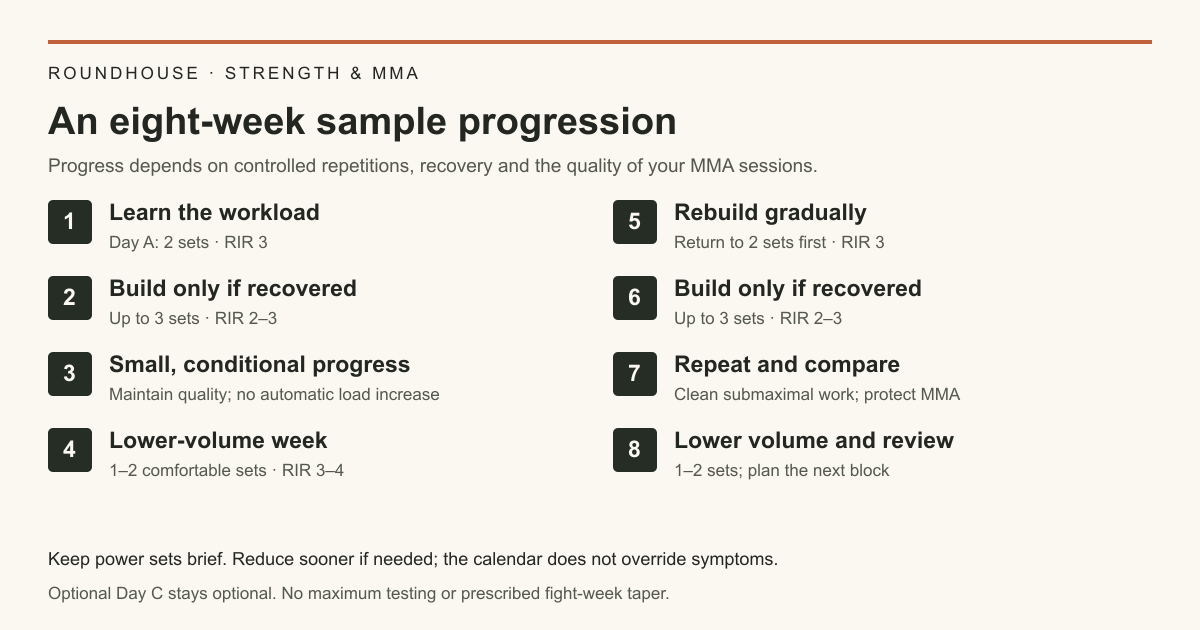
Use the same exercises long enough to practise them. This example contains two three-week building blocks with lower-volume weeks at weeks four and eight. The deload timing is a planning convention, not a biological requirement for every athlete; reduce sooner if needed.
| Week | Day A main lifts | Day B and optional Day C | Decision |
|---|---|---|---|
| 1 | 2 working sets per main lift; lower end of rep range, RIR 3 | Begin with 2 sets per drill or exercise | Learn the workload and log how MMA feels |
| 2 | Up to 3 sets if recovered; stay at RIR 2–3 | Use the session tables if quality remains good | Repeat the load or add a rep within the range |
| 3 | 3 sets if tolerated; RIR 2–3 | Keep power volume low; do not chase fatigue | Add a small load only after meeting the progression rule |
| 4 | 1–2 comfortable sets, RIR 3–4 | About half the usual sets; omit optional work if needed | Lower-volume week; no maximum testing |
| 5 | Return to 2 sets first, RIR 3 | Resume only work you recovered from previously | Rebuild rather than compensating for the lighter week |
| 6 | Up to 3 sets if recovered, RIR 2–3 | Keep the same quality limits | Progress only when the next MMA sessions remain good |
| 7 | Maintain tolerated sets, RIR 2–3 | Avoid extra conditioning or accessory volume | Compare clean, submaximal sets with earlier weeks |
| 8 | 1–2 comfortable sets, RIR 3–4 | Reduce sets again | Review the log and plan the next block with your coach |
Week 1 introduces the workload with fewer main-lift and power sets; Week 5 restarts Day A at two main-lift sets. Increase only as the table permits and recovery supports it. In the two-day version, follow the same weekly decisions and omit Day C. Do not combine deloads with an aggressive weight cut or use them to justify extra sparring.
When should you add weight?
For ordinary main lifts, reach the top of the rep range across your planned sets with about two or three clean reps left, and check that subsequent MMA quality remains steady. Then use the smallest practical load increase. Around 2–5% can be a reference, but the equipment available and your technique matter more than a fixed kilogram rule.
If the available jump is too large, keep the load and practise clean repetitions. For pull-ups, improve controlled repetitions or reduce assistance before adding weight. Power drills progress through consistent speed and control, not through grinding heavier repetitions. You do not need a one-repetition maximum test to run this template.
A sample week around four MMA sessions
Schedule the priority MMA work first. This week is one illustration; change it to fit your class timetable and response.
| Day | Lifting | MMA or recovery |
|---|---|---|
| Monday | Day A | None, or only easy movement |
| Tuesday | None | Technical striking |
| Wednesday | Day B | Technical grappling later, if recovered |
| Thursday | None | Most demanding supervised MMA session; contact remains optional |
| Friday | None | Rest or comfortable movement |
| Saturday | Optional Day C | Technical MMA later, only if recovered |
| Sunday | None | Rest |
Monday to Thursday is about 72 hours, not a universal recovery guarantee. Wednesday's power practice sits closer to the demanding session, so omit jumps, shorten the session or move it if Thursday suffers. Optional Saturday lifting should not turn a technical class into another exhausting double day.
If two sessions share a day, separate them by several hours where practical, eat and drink normally between them, and protect the more important session. Six hours is a workable option, not a proven MMA-specific threshold. Do not assume lifting must always come first. Avoid combining demanding leg lifting and demanding sparring when fatigue reduces movement or decision-making.
The two-day version
Keep Day A and Day B, and omit Day C. If recovery supports it, add one carry or trunk exercise from Day C to the end of Day B for one or two easy sets. Do not bolt the whole optional session onto it.
This is the simpler starting template for a busy recreational trainee. If two days still degrade your MMA sessions, reduce sets or discuss a one-day version with your coach. Five MMA classes do not automatically rule out lifting, but their intensity must be counted.
What changes during a fight camp?
Use an individual plan with your fight and strength coaches. Maintain familiar work while reducing unnecessary fatigue; avoid introducing new exercises near competition.
There is no universal rule to stop heavy lower-body work exactly seven to ten days before a fight. Taper timing depends on the athlete, the training block, competition demands and any weight-management plan. This recreational template does not prescribe a fight-week taper or a weight cut.
A quick readiness check
This is an editorial decision aid, not a diagnostic screen.
| State | What you notice | Useful response |
|---|---|---|
| Ready to practise | Ordinary energy, manageable soreness and controlled warm-up repetitions | Begin the planned session; reassess as you go |
| Reduce the workload | Unusual fatigue, poor sleep or heavier-than-usual effort on familiar warm-up sets | Keep loads comfortable, remove a set or optional exercise, and protect MMA quality |
| Stop and assess | Sharp pain, dizziness, numbness, illness symptoms or loss of coordination | Stop the session; seek appropriate medical advice rather than relabelling symptoms as normal fatigue |
Persistent low energy or falling performance deserves attention to total workload, sleep and food. It can also have other causes; a log is not a diagnosis. Seek professional assessment when symptoms persist or concern you.
Equipment swaps for a normal gym
Choose a substitute you can perform with control. A similar movement pattern does not make two exercises identical, and their loads cannot be transferred directly.
| Original exercise | Possible alternative | Important difference |
|---|---|---|
| Trap-bar deadlift | Dumbbell deadlift or a coached barbell hinge | Different setup, grip and loading; learn it before progressing |
| Bench press | Dumbbell bench press or suitable push-up | Different stability and resistance; keep reps controlled |
| Pull-up | Assisted pull-up or lat pulldown | Assistance and machine numbers are not comparable loads |
| Medicine-ball throw | Controlled band or cable rotation | Trunk alternative, not an equivalent ballistic drill |
| Farmer carry without a walking area | Short, controlled suitcase hold | Static hold rather than a walking carry |
| Pallof press | Light band Pallof press | Secure the band and use a clear, stable space |
Recovery basics: food, sleep and bodyweight
The ISSN's protein position stand describes 1.4–2.0 g per kilogram of bodyweight per day as sufficient for most healthy exercising adults. For 70 kg, that is 98–140 g daily. It is general guidance, not an individual nutrition prescription; medical conditions and dietary restrictions may require professional advice.
For body-weight targets, meal planning and the limits of those ranges, read how much protein you need when training MMA and lifting.
Rice, roti, poha, oats, bananas and potatoes are possible carbohydrate foods to include according to your overall needs and tolerance. Avoid treating a hard training week as a reason to under-eat.
Seven to nine hours is a common healthy-adult starting range for sleep. Athlete needs vary; the 2021 athlete sleep consensus recommends accounting for individual circumstances and training demands. A programme cannot compensate for persistent sleep loss.
Strength work can also build muscle. Low repetitions do not guarantee that your bodyweight will stay unchanged. If you compete in a weight class, monitor ordinary bodyweight trends and work with appropriate coaches and nutrition professionals; do not use dehydration or crash dieting to offset the programme.
Download the training log
Download the eight-week CSV training log. Open it in a spreadsheet and record the exercise, load, completed reps, estimated RIR and how the next MMA session felt. A rest day or omitted session is a useful entry, not a failure.
Compare repeatable, clean submaximal work across the block. Do not turn the log into a competition to add weight every session.
Common mistakes
- Treating every set as a maximum effort. Preserve clean reps and leave room for MMA.
- Calling Day C recovery. It is another load to recover from.
- Rushing practice sets or copying a technical lift before learning it.
- Adding weight automatically even when MMA quality has fallen.
- Assuming 48 or 72 hours guarantees recovery before sparring.
- Training through sharp pain, dizziness or neurological symptoms.
- Treating scheduled deloads as permission to ignore fatigue between them.
- Copying a professional athlete's workload while overlooking work, sleep and coaching support.
Frequently asked questions
Can I do this with five MMA sessions a week?
Consider the two-day option first and assess class intensity, lifting experience and recovery. Five mostly technical classes and five demanding classes are different workloads. Remove optional work if MMA quality declines.
Should I lift before or after MMA training?
Protect your priority session. Separate days or several hours between sessions can help planning, but no fixed gap guarantees recovery. If skill practice is the priority, lifting first is not automatically the right choice.
How heavy should I lift?
Use a load you can control while retaining about two or three clean repetitions on ordinary strength sets. Power drills stop earlier when speed or coordination deteriorates. Avoid grinding or maximum attempts in this template.
Will this make me too bulky for my weight class?
No plan can guarantee unchanged bodyweight. Strength and muscle size can both increase; nutrition and training history influence the response. Track trends and discuss competition weight with suitable professionals.
I have never lifted. Where do I start?
Learn basic squats, hinges, rows and presses with a qualified coach, using comfortable loads. The learning phase may take longer than two weeks. Move into the template when your technique and recovery support it, rather than on a fixed date.
How long until I see results?
Responses vary. Use the eight-week log to compare clean sets and whether MMA quality remains steady. A small athlete study's percentage gains are not a promise about your progress or fight performance.
Can I do this at home?
Some movements can be adapted with suitable dumbbells, bands and safe equipment. Jumps, throws and carries also need clear space and control. Home substitutions do not reproduce every gym stimulus.
When should I stop and get medical advice?
Stop for sharp pain, dizziness, numbness, loss of coordination or other concerning symptoms. Persistent pain or fatigue should be assessed. Symptoms following a head impact need medical evaluation; do not use this programme to decide when contact training can resume.
Build strength you can recover from
Start with the workload you can repeat while maintaining good MMA sessions. Use controlled strength work, brief quality power practice and optional moderate work only when recovery supports it. Adjust rather than forcing the calendar.
To choose where to train, use our MMA gym-selection scorecard. For the financial side, see the MMA training cost guide. Good planning includes coaching, time and recovery as well as exercises.