The karate school has an evening batch ten minutes away. The taekwondo academy has better videos, but getting there means crossing town. You've read three comparisons and still don't know which class to book.
Part of the problem is the question. “Which art is better?” invites sweeping answers about a choice you'll make between two particular teachers, schedules and groups.
Try taekwondo first if learning its kicking game is what interests you. Try karate first if a particular dojo's mix of basics, forms and partner work appeals to you. If both sound good, use the trial classes to choose. Neither name tells you how well you'll be taught.
The differences worth understanding before a trial
| What you're comparing | Karate | Taekwondo |
|---|---|---|
| Technical emphasis | Striking with hands and feet; emphasis varies by style and dojo | Strong kicking emphasis, alongside other techniques |
| Forms | Kata | Poomsae in Kukkiwon-associated training; a different pattern system in ITF training |
| Partner work | Kumite, ranging from prescribed drills to different sparring formats | Drills and sparring under the academy's training and competition framework |
| Competition | Different styles and organisations use different formats | WT-associated Olympic sport and ITF competition are distinct routes |
| Grades | Kyu and dan systems, with organisation-specific requirements | Colour-belt and black-belt systems; identify the actual certificate issuer |
| What the name doesn't settle | Class quality, beginner contact, price or teaching time | Class quality, beginner contact, price or teaching time |
This is a starting comparison, not a description of every school in India. The differences become useful when you connect them to what happens during an ordinary lesson.
Compare four layers, not two labels
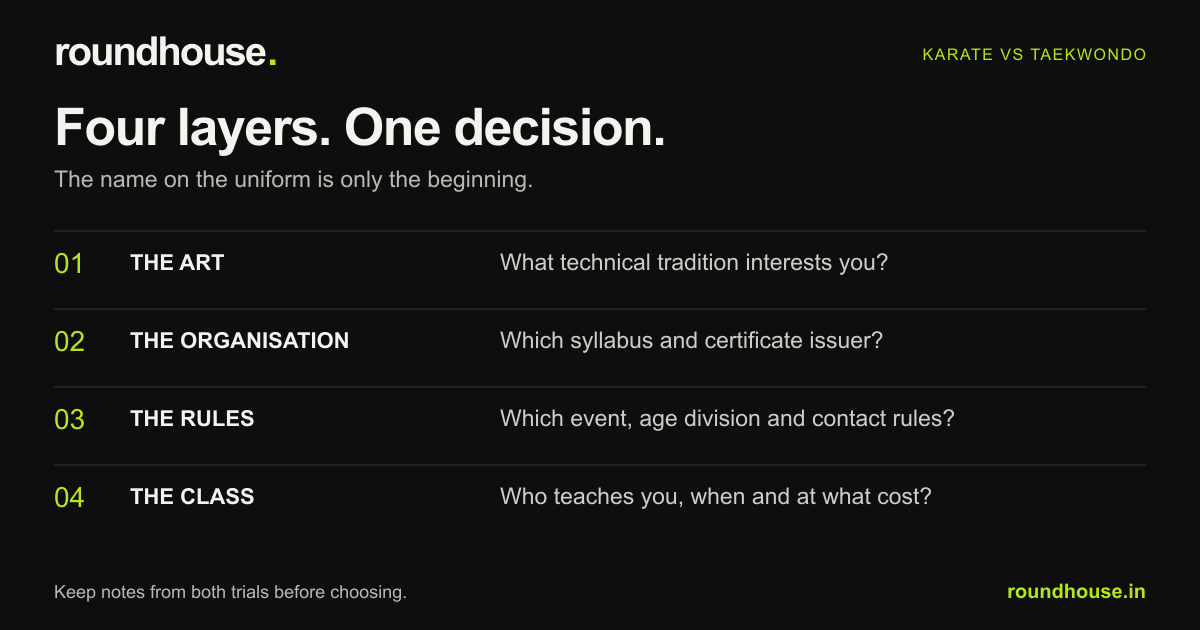
A useful comparison separates the art, the organisation, the rules and the class. Otherwise you can end up comparing an elite athlete in one format with a children's trial at another school.
The art gives you the broad technical tradition. The organisation identifies a syllabus, grading network or competition body. The rulebook defines a particular event. The class tells you who teaches you on Tuesday evening and what you practise there.
These layers explain why apparently contradictory descriptions can both miss the point. A karate dojo can spend substantial time preparing athletes for a sporting ruleset. A taekwondo academy can offer forms-focused training to students who don't enter sparring events.
Ask both schools to identify all four layers in their offer. It becomes easier to see whether a claimed difference is about karate and taekwondo, or simply about these two programmes.
First, picture the training you want to return to
If kicks are the reason you're looking at martial arts, there's no need to invent a more impressive justification. Ask a taekwondo academy how it teaches beginners to kick, move and work with pads or partners.
If a karate class interests you, ask how much time beginners spend on basics, forms and partner practice. JKA Australia describes kihon, kata and kumite as connected parts of its Shotokan training. That doesn't establish the timetable of every karate dojo.
You may discover you enjoy repeating a form and gradually cleaning up its movements. You may be more interested in learning to judge distance against a partner. Both preferences are useful, and neither can be settled by watching a tournament knockout.
The trial should help you find out whether the actual lesson contains enough of what you came for. If you're unsure whether it was representative, ask to watch another session before committing.
“Karate has punches; taekwondo has kicks” doesn't get you far
Both arts contain hand and foot techniques. A more useful difference is which techniques the programme spends time developing and what its sparring rules reward.
A competition-oriented academy may organise much of its partner work around a particular scoring system. Another school may give more time to forms or a broader grading syllabus. Ask which programme you'd join rather than assuming every student trains like the competition squad.
A Shotokan label still leaves questions about partner work. A Kyokushin label still leaves questions about how beginners are taught. Ask for an explanation of your programme before deciding that either school fits you.
If a dojo advertises Kyokushin, for instance, ask which knockdown rules it uses and how contact develops. The KWU kumite rules distinguish divisions and equipment; a senior match isn't a lesson plan for someone on their first week.
Forms, partner drills and sparring answer different questions
Both arts can include rehearsed sequences and practice with another person. Having those components on a website doesn't tell you how they are connected in the lesson.
A form lets a student repeat an ordered task. A prescribed partner exercise adds another person while keeping some actions agreed in advance. Less predictable sparring changes what you need to notice and respond to, within a set of rules.
None of those descriptions establishes how much pressure or contact a beginner will face. Ask the coach to explain an actual drill from the trial: what were the students trying to learn, and what would change when they progressed?
Karate's competition landscape also includes distinct tasks. The WKF publishes separate kata and kumite rulebooks. ITF taekwondo has its own patterns framework as well as sparring. A comparison that treats both arts as one kind of fight misses those choices.
If you enjoy precise solo work, ask about the forms programme. If interacting with a resisting partner is what attracts you, ask about the route to that practice. You may want both, and the balance can be more important to you than the name on the uniform.
Point scoring doesn't mean no contact
Don't choose a class on the assumption that points make it gentle or protective gear makes any drill appropriate for everyone.
The ITF describes its sparring as semi-contact with excessive contact penalised. Even that label needs an explanation in the context of your batch: what targets, what intensity, what equipment and what partner matching?
Ask both schools the same question:
What partner work would I do as a new student, and how do you decide when I'm ready for more contact?
Then watch whether the instructor's explanation matches the class. Look for an understandable task, agreed contact and attention when partners get carried away. Those observations tell you more than a promise that the art is “safe” or “hard”.
You can choose demanding training without treating avoidable confusion or humiliation as part of the price.
If your goal is competition, name the competition
Taekwondo has an established Olympic sport route. The IOC records its medal debut at Sydney 2000. That makes WT-associated taekwondo a relevant starting point if Olympic-style competition is specifically what you want to train for.
It doesn't establish that the nearest academy can coach you through that route. Ask which events its students enter, who coaches competitors and what eligibility, registration, selection and travel are involved.
For karate, ask the same questions with the actual event and rules named. “National champion” is difficult to assess without knowing the organiser, division, format and result.
For either art, you should also be able to ask about training without competition. Joining a class and committing to tournament travel are separate decisions.
A belt isn't a comparison score
You won't learn much by asking which art gets you a black belt faster. Without the syllabus and issuing organisation, you're comparing a colour and a sales timeline.
Ask each school for the next grading requirements, examiner, certificate issuer and total fee. If an affiliation is advertised, check it with the named organisation.
In taekwondo, keep WT competition affiliation and Kukkiwon certification separate. Kukkiwon explains its Poom and Dan promotion system; it isn't simply another name for World Taekwondo. For an ITF school, establish the exact organisation behind the certificate.
These checks don't replace watching the teaching. A verifiable rank answers a credentials question. It doesn't show you how well someone explains a new movement to your child or to you.
What is the cheaper option, once you can actually attend?
There is no national price comparison that can tell you which of your nearby schools costs less. Compare the written quotes for your actual programme and the sessions you can attend.
Here's a hypothetical example, not Indian market pricing:
| Four-week class offer | Listed class fee | Usable sessions for this example | Class fee per usable session |
|---|---|---|---|
| School A | ₹2,400 for 8 sessions | All 8 | ₹300 |
| School B | ₹3,000 for 12 sessions | All 12 | ₹250 |
| The same School B offer, if your timetable permits only 8 | ₹3,000 | 8 | ₹375 |
The arithmetic is class fee divided by usable sessions. It excludes joining charges, equipment, gradings, taxes and travel. Missed-session and make-up policies could change the usable number; establish them before doing your own calculation.
School B's lower advertised per-session cost depends on using all twelve sessions. If you can attend only eight, the comparison changes. The extra access might still be useful later, but don't buy it as if you already use it.
Put the journey beside the fee
Suppose one school is 10 minutes away each way and the other is 45 minutes away. At two visits a week for four weeks, the first requires 160 minutes of travel and the second 720 minutes. The difference is 560 minutes, or 9 hours 20 minutes, over that example month.
That doesn't automatically make the nearer school better. Better teaching or a programme you strongly prefer can justify a longer journey. The point is to include the journey in the decision instead of discovering it after buying the pass.
Use the blank school comparison worksheet to record two quotes, your timetable and observations. It has no built-in rankings or formulas that pretend to measure school quality.
Compare the two classes with the same questions
A trial becomes more useful when you stop relying on the general impression of the room. After each visit, write a few specific observations.
| Ask or observe | Notes to make after each trial |
|---|---|
| Beginner instruction | Who taught you, what did they explain and did they check your attempt? |
| Partner work | What contact was involved and were the rules clear? |
| Actual timetable | Can you attend this batch consistently, including the journey? |
| Your goal | Did the lesson contain the activity you want to learn? |
| Costs | What is compulsory beyond classes, and what is optional? |
| Progression | Can the instructor explain what you'd work on next? |
Don't turn the notes into a made-up total out of 100. If one school can't explain its contact rules, a cheaper uniform shouldn't cancel that out.
If both schools teach well, prefer the one whose lessons you enjoy and whose schedule you can keep. You're choosing where to start; you don't have to decide your entire martial-arts identity at enrolment.
Three situations where the answer changes
These are illustrative decisions, not accounts of people Roundhouse has assessed.
You're an adult who wants a hobby after work
You've found a karate batch you can reach on two evenings and a taekwondo class with one suitable time. Both instructors explain beginners well; you enjoy the trials equally.
In that situation, the karate timetable gives you a more workable starting routine. That is a choice between available classes, not proof that karate is the better adult martial art. If the taekwondo trial interests you much more, check whether a second suitable batch exists before ruling it out.
You're choosing for a child who loves kicking videos
Start with that interest, but watch the child's actual lesson. Does the coach provide tasks the child can follow? How are partners arranged? Does the child want to return after experiencing the class itself?
A taekwondo trial may turn the interest into a workable activity. A nearby karate class may turn out to be the one the child enjoys. You don't need to defend a style preference on the child's behalf before you've seen either group.
You want to compete and already know the event
Now the competition route deserves more weight. Ask each school whether it trains students for that exact format, what additional sessions involve and how entry or selection works.
An excellent general class may still be the wrong programme for a specialised goal. Conversely, access to a successful squad doesn't tell you whether its academy has suitable instruction for a new hobbyist. Match the offer to the person joining.
If fitness is your reason, compare the lessons you can sustain
A style label can't tell you the exercise demands of a particular class. A forms lesson, a beginner technical session and a competition preparation session can look very different.
Tell each instructor what you're seeking and what other exercise you already do. Ask to try the ordinary class you'd attend, rather than judging the school from a special event or advanced squad session.
We aren't ranking the two arts for calorie burn, flexibility, injury risk or health outcomes. Such a ranking would require evidence tied to populations, programmes and outcomes, not a list of techniques. For this decision, start with a lesson you enjoy, understand and can return to.
When another martial art belongs on the shortlist
If the activity you want is sustained boxing exchanges, clinch work or ground grappling, describe that before choosing a karate or taekwondo package. Don't assume a school teaches those activities because it also advertises self-defence.
The MMA, boxing, Muay Thai and BJJ comparison covers that wider choice. It may confirm that karate or taekwondo interests you, or help you ask for a different class. You haven't wasted a trial by learning what you don't want to spend your evenings doing.
Adults, children and self-defence need different enquiries
For an adult beginner, establish that the advertised batch actually teaches adults starting from zero. A mixed-age timetable may work for you, but ask how instruction and partners are arranged.
For a child, watch the child's intended group. Ask how the coach handles fear, distraction, mismatched partners and a request to stop. Don't substitute a claim about discipline for observing how the class is run.
For self-defence, ask what the school means by it. Which situations does it address, how is partner resistance introduced, and does the programme discuss avoiding or leaving a confrontation? Neither art's name guarantees what you'll be able to do outside class.
If what you actually want is boxing-style hand exchanges, clinch work or ground grappling, widen the shortlist. Our MMA, boxing, Muay Thai and BJJ comparison helps you make that broader choice.
Choose the first trial
Browse karate classes and taekwondo classes, or use Find My Gym to narrow the locations. Confirm current beginner provision directly before going.
For the details specific to each art, read karate for beginners in India and taekwondo for beginners in India.
If one clearly interests you more, start there. If you keep switching between them in your head, book a trial at each. An hour of instruction will give you something an endless comparison cannot: a real class to decide about.
Frequently asked questions
Is karate or taekwondo better for a beginner?
Choose between the available beginner programmes, not the names alone. Compare instruction, contact rules, the training you enjoy, cost and a timetable you can attend.
Is karate mostly punches and taekwondo mostly kicks?
Taekwondo has a strong kicking emphasis, but both arts include hand and foot techniques. Ask what your actual class practises and which sparring framework it uses.
Which has less contact?
The art's name doesn't settle that. Styles, events, age divisions and beginner programmes differ. Ask each instructor about permitted targets, intensity, equipment and how contact is introduced.
Which is better for a child?
Watch the child's intended batch in each school. Compare teaching, partner matching, contact rules and how the coach responds when a child is uncomfortable or needs help.
Which should I choose for competition?
For Olympic-style taekwondo, ask about the academy's WT-associated competition programme. Karate and ITF taekwondo offer other formats. Identify the event, eligibility and coaching support rather than relying on a generic competition claim.
Which is better for self-defence?
Neither name provides a guarantee. Ask what the school actually teaches and how it practises with partners. Don't infer real-world capability from a belt, a tournament result or a marketing label.
Which costs less, karate or taekwondo?
Compare school-specific written quotes, compulsory extras and the sessions you can actually attend. A lower monthly fee or a lower advertised per-session figure alone doesn't establish the cheaper usable programme.
Can I switch between karate and taekwondo later?
You can enquire about starting the other art, but don't assume a belt or certificate transfers automatically. Show the new school your training and grading history, ask how placement works and expect to learn its syllabus and rules.