You have picked a tournament, opened the entry form and reached the weight categories. Suddenly there is more to think about than the match: whether your gi counts on the scales, what “beginner” means here and whether your coach will be allowed beside the mat.
Those are useful questions to settle while you still have time to change the booking. Your first BJJ competition starts with choosing the right division, understanding the rules and putting a few ordinary arrangements in place, so that when your name is called you can concentrate on grappling.
There is no single registration process or rulebook for every tournament in India. An event using IBJJF-style rules, an AJP tournament and an ADCC submission-grappling event can ask different things of you. Start with the organiser’s event page, then work through it with your coach.
This guide is for a first-time adult competitor. Children’s eligibility, consent and technique restrictions need their own check with the organiser and coach.
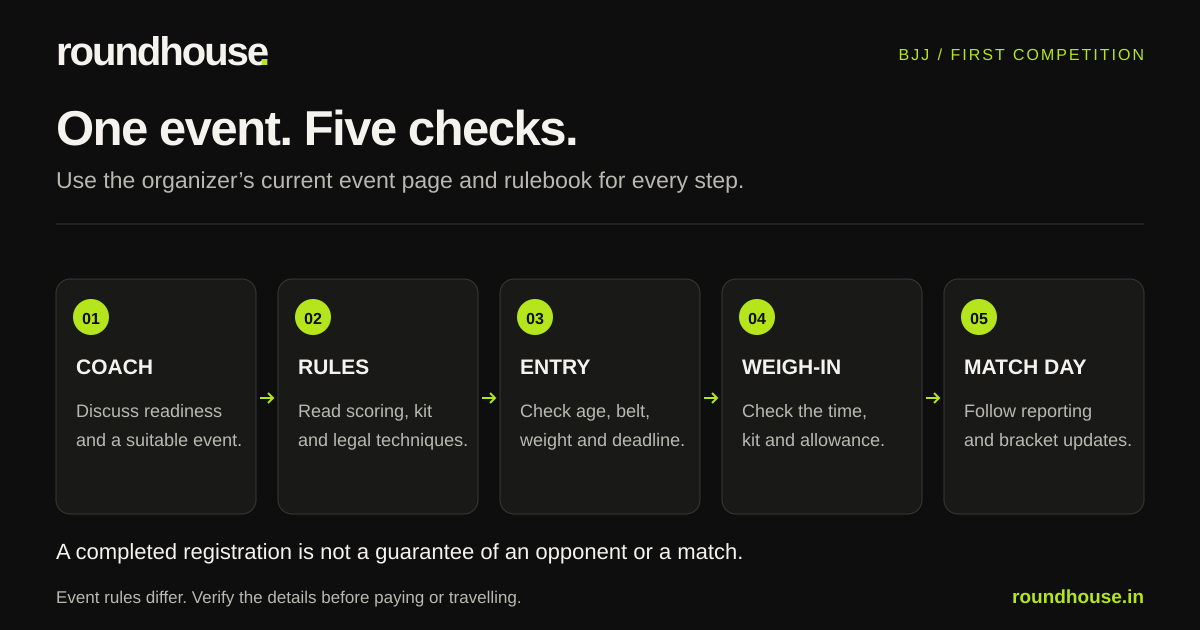
Original Roundhouse illustration: settle the arrangements before your name is called.
Choose the event with your coach
A familiar event within reach of your gym can make a practical first competition. Ask whether teammates are entering, whether a coach can corner you and whether the event offers a division that matches your experience. If you are still choosing where to train, use Roundhouse’s BJJ gym directory and ask about competition support during your trial.
India has hosted different competition formats. AJP ran its India National in Greater Noida on 21 June 2025, while the official ADCC calendar lists the India Open at Greater Noida on 17 October 2026. Those are examples of past events, not open registrations. Use the organisers’ current calendars to find the next one. (AJP event report, ADCC India Open 2026)
Before booking travel, check whether the event is gi, no-gi or both, and which rules apply to your division. Ask about the bracket format too: single elimination and round robin can give you quite different days on the mat, while a small category may leave you waiting for the organiser to offer a merger or another arrangement.
Get that policy, the withdrawal terms and any coach-pass requirements in writing before paying. It is much easier to choose a suitable event now than to resolve a disagreement at the registration desk.
Register for the division you actually belong in
Ask your coach to check your age category, belt or experience division, weight and academy name. Declare relevant wrestling, judo or other grappling experience when the organiser asks for it. Your BJJ belt alone may not answer every eligibility question.
Do not choose a lower division because it is your first tournament. Equally, do not assume that entering an absolute division is a routine extra: an absolute is an open-weight category, and its skill requirements still need checking.
Some organisers use Smoothcomp; others have their own system. The ADCC India Open’s 2024 event page, for example, instructed athletes to create a Smoothcomp fighter profile, choose their weight class and follow its payment process. That historical page is useful for understanding the steps, but its dates and payment instructions should not be reused for a new event. (ADCC India Open 2024 registration)
IBJJF’s own championships require active membership under the athlete’s current belt and academy. That is an IBJJF requirement, not proof that every local tournament using IBJJF-style rules requires IBJJF membership. Check your event’s actual entry conditions. (IBJJF first-championship guide)
After entering, save your confirmation and receipt. Open the public competitor list and check that your name, team, division and payment or approval status are correct. Submitting a form and having an approved entry are different steps.
Put every deadline in your calendar
Record registration closing, division corrections, withdrawal, weigh-in and competition dates separately.
Smoothcomp allows changes to details such as weight class, age division and academy while the organiser permits editing. If the edit option has closed, contact the organiser. Do not rely on turning up and asking the desk to move you. (Smoothcomp registration changes)
Budget for the whole trip
Our BJJ cost guide separates class fees and equipment from the competition budget. An entry fee is only one line in that trip’s total. Add travel, local transport, accommodation if needed, food, any required membership and suitable kit. Confirm whether gi and no-gi are separate entries and whether an absolute division costs extra.
For a dated reference, the ADCC India Open 2024 page listed ₹3,800 for its adult beginner/intermediate entry. That is a historical example, not a current national price. Get the amount and cancellation terms from the event you intend to enter. (2024 event fees)
If the trip becomes too expensive, ask your coach about a nearer competition. You can learn plenty from a first event without making it your biggest sporting expense of the year.
Read the rules for your exact division
Start with the event’s linked rulebook, including any local amendments. Then have your coach explain the sections that affect your game.
Work through a practice round with the actual match duration and scoring in mind. Ask your coach when control becomes points, how tied scores are decided and what earns a penalty, including stalling or leaving the mat. Then check the grips and submissions permitted in your division, along with the referee’s instructions for stopping and restarting.
That gives the rulebook a shape you can remember. You can connect a position you already train to the score, the clock and the decision you will need to make.
IBJJF publishes its rulebook and a separate technical-fouls and illegal-moves chart. ADCC also publishes division-specific technique information. Use the chart for your age and experience category; a move seen in an elite adult match may be prohibited in yours. (IBJJF rules library, ADCC rules)
AJP publishes its own competition regulations as well. Do not use “IBJJF rules” as shorthand for every gi tournament. (AJP competition regulations)
For a first event, rehearsing a small plan can be more useful than collecting new techniques. Practise your opening exchange, one route to a position you know, an escape and how you will respond if you are behind on points. Ask a teammate to referee a practice round under the actual rules.
Confirm the weigh-in before choosing a weight class
The important number is the event’s limit under its weighing conditions. Ask whether you weigh in wearing the gi or no-gi uniform, when weighing takes place, whether any allowance exists and what happens if you miss weight.
For IBJJF championships, the published division limit includes the uniform; its first-championship guide says an athlete over the limit is disqualified. Other organisers’ procedures must be checked separately. (IBJJF weight-division guidance)
For your first competition, discuss a category you can comfortably make without a last-minute weight cut. Do not copy a professional athlete’s dehydration routine. If you need individual advice about changing weight, involve a qualified health professional rather than improvising before a match.
Check your weight in the required clothing before the correction deadline. Leave room for differences between scales instead of aiming at the exact limit.
Pack and plan the day before
Prepare a small bag so the morning has fewer decisions:
- Event-required ID, entry confirmation and payment receipt.
- A clean, approved competition uniform and a suitable spare if available.
- Your belt for gi competition; required no-gi clothing for no-gi.
- Footwear for walking away from the mat, a towel and a change of clothes.
- Water, familiar food and a charged phone or power bank.
Read the uniform policy before buying anything. Gi measurements, colours, patches, rash guards and shorts can have event-specific requirements. If you are choosing between formats, read Roundhouse’s gi versus no-gi guide.
Agree with your coach where you will meet, who will watch the schedule and which person you will listen to during the match. Check the venue address and travel time again.
Expect waiting, then a short burst of activity
Follow the organiser’s arrival instructions and keep checking the live schedule. A saved screenshot is useful, but it cannot show a later change.
Find the check-in or information desk, confirm your weigh-in procedure and locate the warm-up area. Warm up with your coach’s help, leaving enough time for any uniform inspection or call to the holding area.
At your mat, listen to the referee. Release a submission immediately when your opponent taps or the referee stops the action, follow the referee’s instructions and tap clearly when you need to submit. Competing does not make it sensible to keep resisting a submission you cannot safely escape.
After the match, take a moment with your coach, then check the bracket before leaving the competition area. Depending on the format, you may have another bout even after a loss; find out where you need to wait and when to start preparing again. Ask where results and any medal presentation will appear once your division is finished.
Leave with something useful to train
With permission where required, ask a teammate to record the match. Later, review it with your coach rather than judging the whole day by the medal table.
Write down one thing you did as planned, one situation you struggled with and one training priority. Save the official bracket or result link, including your event, division and opponents. That gives you a record you can check later.
The next class gives you somewhere to take what happened. Bring the moment you got stuck to your coach, practise it with a partner and keep the result alongside the lesson. That is something concrete to carry into your next competition.
Frequently asked questions
How long should I train before my first BJJ competition?
Ask your coach to assess your readiness for the event and division you have in mind. Training time alone cannot tell you whether you understand the rules, can defend yourself appropriately or will be comfortable with that level of opposition.
Do I need IBJJF membership to compete in India?
Only assume it is required when your event says so. IBJJF requires active membership for its own championships; an independent Indian tournament adopting its rules can have different registration conditions.
Do I weigh in wearing my gi?
That depends on the event. IBJJF’s published weight limits include the competition uniform. Check your organiser’s weighing time, clothing requirements, allowance and missed-weight policy before selecting a category.
Can I enter both gi and no-gi?
Check whether both are offered, whether you qualify for each division and how the timetable works. Ask your coach whether two entries are a sensible first day, then confirm the combined price and refund terms before paying.