You open a fighter’s profile and see 8–2–1 beside their name. It looks straightforward until another page lists a no contest, an old poster calls them undefeated and their bio mentions a BJJ gold medal. Which of those belongs in the MMA record?
Let’s use that made-up profile to work through the numbers. There is no real athlete behind the example; it is a way to see what a record tells you, what it leaves out and which details you need before repeating it.
What does an MMA record like 8–2–1 mean?
Read it in win–loss–draw order. Our hypothetical fighter has eight wins, two losses and one draw, giving them eleven recorded bouts in whichever category the profile describes.
If the same profile says 8–2–1, 1 NC, there is also one no contest. That makes twelve recorded bouts, although the no contest does not increase the win, loss or draw total.
Some profiles omit a zero in the draw column or put no contests in brackets. When you publish your own record, spell out the labels once. “Amateur MMA: 8 wins, 2 losses, 1 draw, 1 no contest” leaves less room for confusion than four unexplained numbers.
Also check the scope. A promotion record covers appearances in that promotion, while a career record may include other organisations. Even statistics pages can use a limited window: the UFC Record Book says its records cover UFC fights from UFC 28 onward. A smaller total is not automatically an error.
The result and the method are different fields
Open one of those eight wins and the entry might say “submission, round 2, 1:45”. Now you have the outcome, the method and the point when the bout ended, rather than a number detached from an opponent and an event.
Under the ABC Unified Rules of MMA, recognised endings include submissions, knockouts, technical knockouts, decisions and disqualifications, as well as draws and no contests.
A submission can involve a tap or verbal surrender, while a technical submission can occur without a tap. KO and TKO are strike- and stoppage-related categories under the applicable rules; TKO can include referee, corner or medical stoppages. A decision records the judges’ verdict, and a disqualification records an outcome arising from a qualifying rules violation.
The announced method matters because a fighter does not have to be unconscious for a fight to end. A doctor’s involvement also does not, by itself, tell you whether the result should be TKO or no contest.
For example, record “W — TKO (doctor stoppage)” if that is the official result. Avoid replacing it with “KO” because the shorter label looks better on a poster.
Unanimous, split and majority decisions
Suppose the next win on our example profile went the distance. “Unanimous”, “split” and “majority” tell you how the judges’ verdicts line up, rather than how many rounds the winner won.
| Decision | What it means |
|---|---|
| Unanimous decision | All three judges favour the same fighter. |
| Split decision | Two judges favour one fighter; the third favours the opponent. |
| Majority decision | Two judges favour one fighter; the third scores a draw. |
A unanimous decision can still have different numerical scorecards. Three judges can agree on the winner without scoring every round identically. MMA Decisions’ definitions illustrate these combinations using published scorecards.
A split decision remains a win for one fighter and a loss for the other unless the official result changes. “I thought I won” belongs in an interview or personal assessment, not in the results column.
A draw is different from a no contest
The final “1” on our hypothetical 8–2–1 profile is a draw, which has its own place in the record.
The same MMA Decisions guide distinguishes a unanimous draw, where all three judges score a draw; a majority draw, where two do; and a split draw, where one scores a draw and the other two favour opposing fighters.
That still leaves the extra bout labelled no contest, usually shortened to NC. This is a separate official outcome, so putting it in the draw column would change the meaning of the record. Neither fighter receives a win from it.
Foul-related stoppages depend on the rules, timing and official ruling. For example, Georgia’s professional MMA rules distinguish an early stoppage caused by an accidental foul from one occurring after the required rounds have been completed, when a technical decision can become possible. This is an example of a specific jurisdiction’s rules, not a rulebook for every Indian event.
For an Indian bout, ask which rules the event adopted and obtain the final result from its responsible officials. Do not decide “NC” yourself from a short video of an eye poke or injury.
A cancelled fight is different again. If your opponent withdraws before the bout takes place, an announcement on a fight card is not evidence that you competed or earned a win.
Keep amateur, professional and other sports separate
Before sharing our example fighter’s numbers, we still need to know whether they describe amateur or professional MMA. Someone making their professional debut might have an amateur record of 4–1–0 and a professional record of 0–0–0; combining them would hide the stage of their career.
The BJJ medal mentioned in the bio belongs in a separate grappling section, with its event and division. Boxing results need their own category too, rather than quietly becoming extra wins in an MMA total.
This distinction matters when you enter events. IMMAF’s athlete eligibility policy considers professional experience and confirmed published professional records, so a poster describing a bout as “amateur” cannot settle eligibility by itself. Check the event and rules with your national federation before entering, and retain evidence if a record database has misclassified a bout.
Keep exhibitions, interclubs and sparring outside your competitive MMA total unless the responsible organisation confirms how a bout is classified. Describe the activity accurately while that question is unresolved.
Why do two websites sometimes show different records?
If our fictional profile still disagrees with another website, the next step is to compare the individual bouts. First make sure both pages identify the same person, allowing for alternate spellings or duplicate profiles, then look for the entry responsible for the difference: a missing event, another sport, a classification or an updated result.
Tapology’s terms explain that classifications such as professional, amateur, exhibition and sport/ruleset involve its editorial judgment. A database entry is useful evidence, but an unresolved disagreement should stay visible rather than being silently converted into whichever total is most flattering.
For a public profile, write something specific: “Amateur status of the 14 June bout awaiting organiser confirmation.” Avoid accusing another athlete of inventing results merely because two pages disagree.
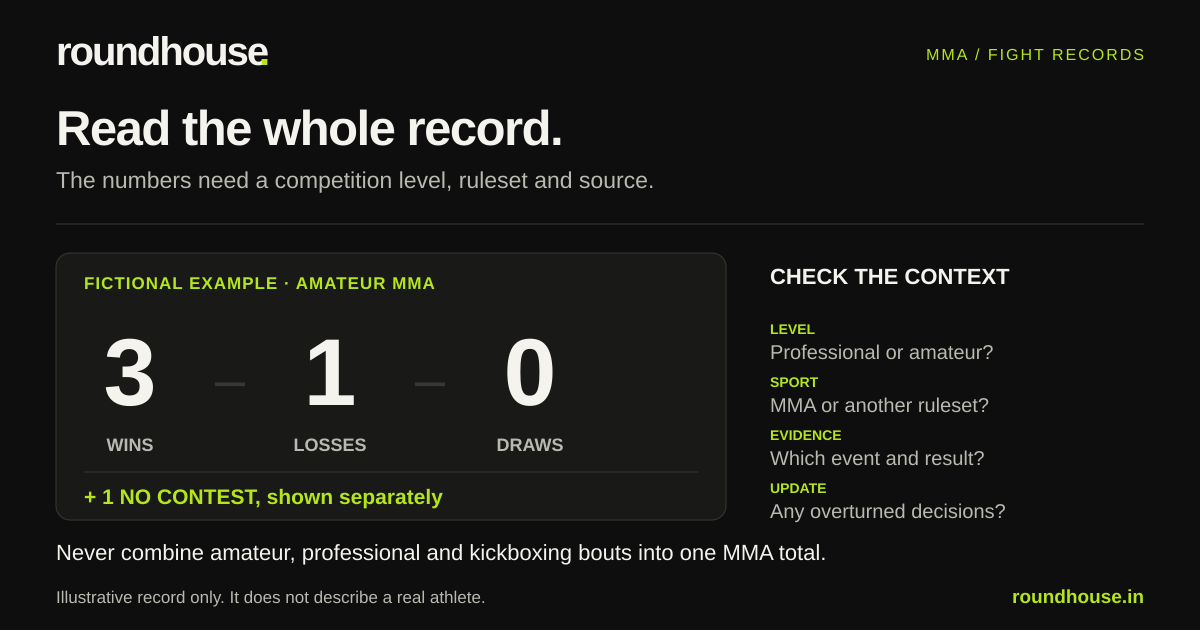
Original Roundhouse illustration: check the category, the outcome and the evidence before sharing a record.
How to document a bout and request a correction
If this were your profile, the easiest time to collect the evidence would be straight after each competition, while the event details are still easy to find. Keep the event name and date, opponent, competition level, weight category, result, method, round and time, together with an official result link or sheet and a video link where available.
When something is wrong, identify the exact bout and the exact change requested. “Please change the result from loss to win” is much easier to review when it includes an official corrected result, rather than several screenshots of congratulations.
Tapology’s support form accepts fighter-page corrections and information about missing bouts. A database correction and a formal appeal of a result are different tasks: contact the responsible event authority about the result itself.
Our amateur fighter profile guide shows how to bring the bout log, achievements and gym affiliation together. Keep a dated note of changes on your own profile. Preserve the evidence behind a correction instead of deleting the inconvenient version from your personal records.
If you are still choosing where to train, use Roundhouse’s MMA gym directory to make a shortlist. Ask the coach how the team chooses events, checks amateur eligibility and helps athletes obtain documented results. Those answers are more useful than a promise of an unbeaten record.
Frequently asked questions
Does a no contest count as a loss?
No. Keep it in a separate NC category. If an official result changes, update both the bout history and the headline total to match.
Does a split decision count as a full win?
Yes. The winner receives one win, and the opponent receives one loss. The method records that the judges disagreed; it does not create a partial win.
Can I combine amateur and professional MMA wins?
For a useful public MMA record, show the two categories separately. A combined total hides the competition level and makes it harder to check the individual bouts.
Can I count BJJ matches in my MMA record?
List them in a separate grappling section. Include the event, gi or no-gi format, division and result so someone reading the profile can understand what you competed in.