In the published examples checked for this guide, BJJ costs ₹3,000 a month plus ₹1,000 registration at Apex Combat Club in Patna, while three classes a week at Knots & Collar in Delhi cost ₹20,000 for a quarter. Those are starting points for a budget, not an average for India, and the difference only becomes useful once you know what each plan lets you attend.
The first quote will probably be a membership price. Then the coach mentions a gi, you work out when to wash it, and a few months later someone asks whether you fancy entering a tournament. The monthly number no longer describes what you're spending.
Follow that journey in the same order: choose your classes, buy their required kit, then add a competition if you want one. Operator and seller examples below were checked on 6 November 2026; confirm prices, offers, stock and access before paying.
If you are still choosing a format, read BJJ gi vs no-gi, then use the BJJ gym directory to find a class you can realistically attend.
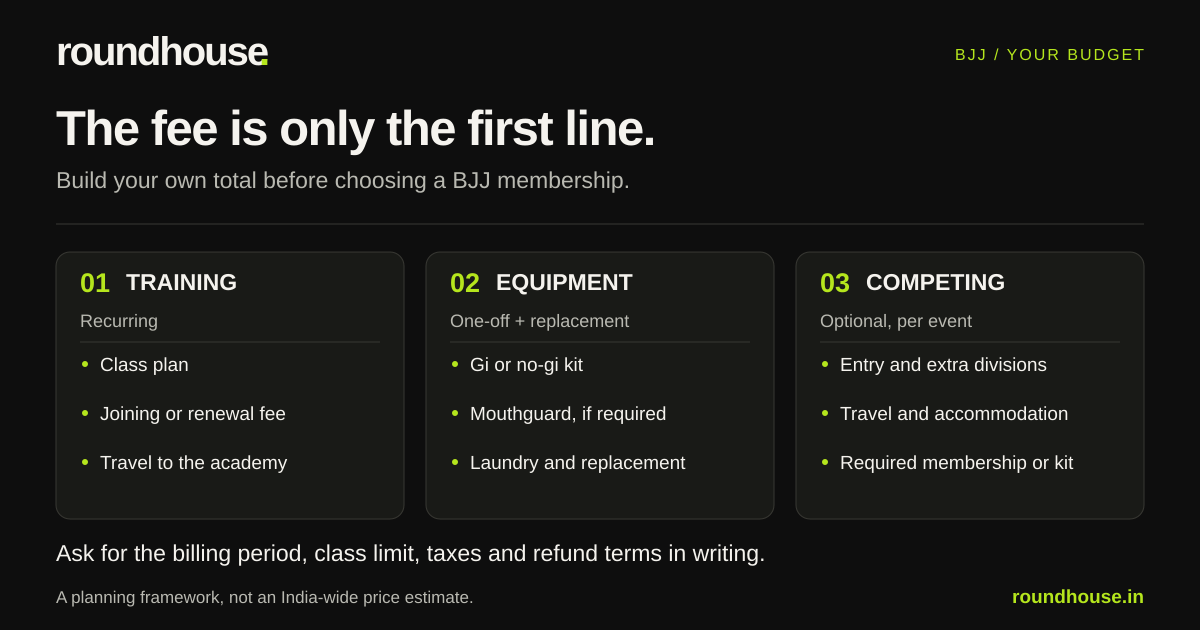
Original Roundhouse illustration: build the budget around your classes, then add equipment and any competition trip.
Start with the classes you can attend
| Academy and place | Published plan | Published price | What to check |
|---|---|---|---|
| Apex Combat Club, Patna | BJJ monthly | ₹3,000 + ₹1,000 registration | Weekly BJJ timetable, gi/no-gi split and whether registration is one-time |
| Apex Combat Club | BJJ quarterly | ₹7,500 + ₹1,000 registration | Whether a renewal attracts another registration charge |
| Knots & Collar, Defence Colony, Delhi | Three classes a week, quarterly | ₹20,000 for three months | Which BJJ sessions count toward the weekly allowance |
| Knots & Collar | Three classes a week, yearly | ₹65,000 for twelve months | Pause, cancellation and renewal terms |
| Indian Combat Sports Academy, Bengaluru | Three-month mixed membership offer | ₹10,500 | Offer eligibility and number of BJJ classes available at your branch |
Apex's BJJ page did not display a weekly schedule when checked, so that needs a conversation before the price becomes a useful comparison. ICSA advertises MMA, kickboxing and BJJ within its beginner offer; its fee buys a mixed programme rather than a dedicated BJJ-only timetable. Knots & Collar also includes other disciplines in its membership, making the sessions you can actually book the next detail to settle.
Calculate what you will actually attend
A ₹20,000 quarter works out to about ₹513 per attended class if you go three times a week for an illustrative thirteen-week quarter: ₹20,000 ÷ 39.
If you attend twice a week instead, the same fee is about ₹769 a class: ₹20,000 ÷ 26. These are calculations, not the academy's advertised per-class rate. Holidays, closures and your attendance change the result.
Once you have a realistic attendance figure, add the commute. The academy across the city can look cheaper on its price page and still cost you more over a month if each visit needs a cab, especially when the class you wanted turns out to run on an evening you cannot make.
Gi costs: buy the right uniform once
A gi is the jacket-and-trouser uniform used in gi BJJ. Before buying one, ask your coach about size, colour, fabric, patches and whether a particular academy uniform is required. This is where a little patience can save you from buying something twice.
Here are seller-published examples, rather than a general market range:
| Item | Listed price on 6 November 2026 |
|---|---|
| Fluvium Prestige black gi with gold embroidery | ₹7,495 |
| Fluvium Gentle Art gi | ₹9,495 |
| Fluvium white pearl-weave belt | ₹899 |
| Knots & Collar black BJJ gi | ₹9,500; all displayed sizes were sold out |
The ₹7,495 gi and ₹899 white belt make an ₹8,394 example basket. Check whether your chosen gi already includes a belt before adding one, and resolve sizing, shrinkage, returns and delivery costs while you can still change the order.
A second gi can make frequent training easier if the first cannot dry before your next class. Treat that as a later purchase based on your schedule, rather than buying two before your trial.
The academy's own rules matter before competition even enters the picture. Knots & Collar's visitor page specifies a white gi for gi classes, so neither black example above is a suitable purchase for that class. Get your academy's specifications first, then check the event's rules before buying a competition uniform.
No-gi costs: less uniform, still some kit
No-gi means you train without the gi jacket and trousers. It does not mean every piece of ordinary gym clothing is suitable for partner grappling.
Fluvium lists its Prestige half-sleeve rashguard at ₹1,199 and Abstract 2-in-1 shorts at ₹1,349. Together, those displayed prices total ₹2,548, before delivery or anything else you need.
Take the same approach to no-gi clothing as to the gi: show your coach what you are considering and check fit, fastenings and pockets before buying. If a competition is already on your calendar, check its colours and ranked-kit requirements as well, because a seller's product name does not establish approval for your event.
You may not need specialist clothing for a trial. BJJ India's FAQ allows a T-shirt and suitable training trousers or shorts for its trial; confirm your chosen academy's policy.
When the tournament invitation arrives
If you decide to compete, start a separate total for that trip. Entry, travel, accommodation, event-specific equipment and coaching arrangements belong together even when you pay for them on different days.
For a clearly dated example, the organiser's ADCC India Open 2024 registration page listed ₹3,800 for the adult beginner/intermediate entry. That event took place on 13 December 2024. This is a historical example, not a current fee or a promise about the next ADCC event.
Check what entry buys: one division, gi and no-gi, or an additional open-weight division can mean different charges. Read the deadline and refund terms, including what happens if you withdraw, miss weight or have no opponent.
Price travel against the full schedule, including any night you need to arrive early. Ask your coach about documents, uniforms and coaching arrangements before booking.
Do not treat an entry fee as a guaranteed number of matches. Read the tournament format and ask what happens to a division with only one athlete. Our first BJJ competition guide follows the rest of the process, from choosing a division to match day.
Three ways to budget your first year
These are illustrative arithmetic examples, not packages sold by the academies. The gear comes from a different seller and might not suit a particular class. Replace every figure with your own confirmed quote.
| Scenario | Calculation | Subtotal |
|---|---|---|
| Twelve monthly Apex BJJ payments, one registration and one gi/belt basket | ₹3,000 × 12 + ₹1,000 + ₹7,495 + ₹899 | ₹45,394 |
| KC three-class yearly plan; suitable white gi and belt still to quote | ₹65,000 membership only | ₹65,000 before kit |
| ICSA published twelve-month offer with one no-gi basket | ₹28,600 + ₹1,199 + ₹1,349 | ₹31,148 |
ICSA also publishes a ₹28,600 twelve-month offer, which is the fee used in the third row. Confirm offer eligibility, branch access and that your selected BJJ sessions allow the no-gi kit before using that example. The KC row deliberately leaves the kit unpriced until you have a suitable white-gi quote.
All three subtotals exclude commuting, laundry, replacements, food, medical expenses, competitions, delivery and any unknown academy charges. The first assumes registration is paid once. The KC row does not establish that there are no additional charges.
Choose a commitment you can keep
Try the class before committing to a long membership. Check that the coach teaches the sessions you want, the timetable fits your week, and the academy explains how beginners join partner practice.
Get the class allowance and full price in writing, including taxes and separate charges for registration, belts, grading, seminars or uniforms. Read the pause and cancellation terms while you are enthusiastic about joining, before work changes your schedule or you need a break.
Longer plans can lower the cost, but only if you use them. Choose a commitment you can keep, then build the rest of the budget around it.
Frequently asked questions
Do I need both a gi and no-gi kit immediately?
Only if your chosen classes require both. Ask which sessions you will attend before buying. A gi-only membership and a mixed grappling timetable can create different equipment needs.
Is the cheapest monthly plan the best value?
Compare the classes you can actually attend, the coaching you receive and the commute. A lower price has limited value if the BJJ timetable never fits your week.
Can I use these totals as a quote?
No. They combine published examples and stated assumptions. Your written academy quote, equipment requirements and actual travel costs should decide your budget.
Should I budget for a tournament in my first year?
Only if you want to compete and have a suitable event in mind. Keep its costs separate until you have the entry terms, travel plan and your coach's advice; a hypothetical tournament should not make ordinary recreational training look more expensive than it needs to be.