The first time an organiser asks for your record, you might find yourself piecing it together from a medal photograph, an old registration email and a result your coach shared in the gym group. You know what you competed in; explaining it to someone who wasn't there takes a little more work.
A useful fighter profile brings that information together, from your current training base to the evidence behind each result. You can start one before your first bout, then let it grow as you compete rather than trying to reconstruct everything years later.
This guide follows that process for an amateur MMA athlete in India, whether you're making a simple website or a document to send an organiser. Your profile helps explain your experience, while the event's registration and medical clearance remain separate tasks.
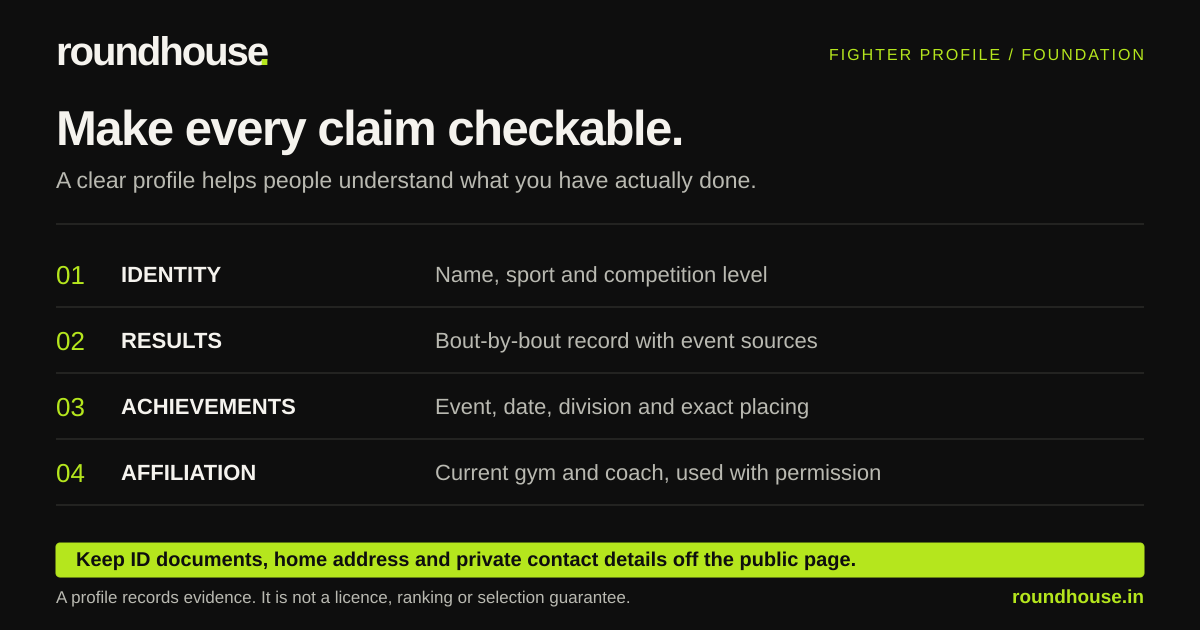
Original Roundhouse illustration: the information to gather before you share an amateur fighter profile.
What belongs on an amateur fighter profile?
Before there's a result to add, your training is the story. Start with a short introduction and your current gym, then give the competition history its own space when you have one. Someone reading the page should be able to follow both without guessing which claims they can check.
| Section | What to include | What to check |
|---|---|---|
| Introduction | Name used on event entries, city, sport and amateur status | Match your spelling to event entries |
| Training | Current gym, coach and disciplines | Confirm how the gym wants its name shown |
| MMA record | Amateur wins, losses, draws and no contests | Link the bout-by-bout results |
| Other competition | BJJ, wrestling, boxing or other experience | Keep sports and competition levels separate |
| Achievements | Event, organiser, year, division and placing | Link the result or bracket |
| Contact | A dedicated email or agreed coach contact | Get permission before publishing someone else’s details |
Keep the introduction to two or three sentences. “Amateur MMA athlete training in Pune, with a background in wrestling” tells a reader where to begin; a paragraph calling yourself the next champion gives them much less to work with.
If you are still choosing your training base, use the Roundhouse gym directory and our guide to choosing an MMA gym. A profile should describe training you actually do.
Separate your record by sport and level
As competition experience builds, resist the temptation to turn it into one impressive total. An amateur MMA record and a professional MMA record belong on separate lines, with BJJ medals and boxing bouts in their own sections, so the reader can see what each part of your experience involved.
Use explicit labels such as Amateur MMA: W–L–D, plus NC, defining wins, losses, draws and no contests. If you have not had an MMA bout, “No MMA bouts yet” is a perfectly useful answer, especially when you already have experience in another sport.
If a result label is unfamiliar, our MMA fight records guide explains decisions, draws and no contests. Under the total, build a bout log:
| Date | Event and organiser | Opponent | Level and rules | Official result | Evidence |
|---|---|---|---|---|---|
| [Date] | [Event name] | [Opponent] | [Amateur MMA; ruleset] | [Win/loss/draw/NC; method, round and time] | [Result link] |
This is a blank template: replace the brackets with checked information and leave an unavailable round or time unfilled. It is better to have a gap you can resolve with the organiser than a precise-looking result reconstructed from a short clip.
How should you label smokers, interclubs and exhibitions?
Keep a separate training-event log until you have confirmed how an event and its record keeper classify each bout. “Smoker” and “interclub” are descriptions people use; the name alone does not settle a contest’s official status.
Ask the organiser what rules applied, who oversaw the event, whether results were issued and whether the bout contributes to an amateur or professional record. Record the answer and retain the original paperwork.
Sparring rounds are training. Do not turn them into wins on a competition record. If a bout’s classification is disputed, say so and ask the relevant organiser or federation to resolve it before changing your total.
Put evidence beside achievements
“National champion” needs context. Name the championship and organiser, year, sport, age category, weight class and result. For BJJ, add belt and gi or no-gi division where relevant.
A medal photograph can accompany an achievement, while a published bracket or official result helps establish what happened. Suppose your first tournament ends with a medal after one contested bout and a walkover: the placing belongs on your page, but so does the organiser's recorded route through the bracket. The medal and the bout total answer different questions.
Use a simple evidence order when building your page:
- Link the organiser’s final results or the body responsible for the bout.
- Add a recognised record-database entry as another reference.
- Keep certificates, registration confirmations and full bout footage in your private archive.
- Label a claim as awaiting confirmation when the underlying result is missing.
This is an editorial approach, not an Indian regulatory hierarchy. As an example of formal record standards elsewhere, the Association of Boxing Commissions requires verifiable, commission-generated results for the MMA registries it certifies. That US framework does not make every database entry an official Indian result.
Describe gym affiliation accurately
Your coach can help fill the gaps before you share the page. Ask them to check how you describe your training and gym affiliation, then agree on who can confirm that relationship if an organiser gets in touch.
There is a difference between training at a gym, representing its competition team and attending one seminar there. Describe each relationship plainly. A seminar photograph does not establish an ongoing affiliation.
If you use several gyms, explain their roles: MMA at one academy, wrestling sessions at another, for example. Agree on which team name you will use for event registration; do not assume the organiser accepts multiple affiliations.
Ask before using the gym’s logo, listing a coach as your manager or publishing their personal number. When you change teams, update the current affiliation while preserving the team you represented in past results.
Protect amateur eligibility before accepting a bout
Once you begin looking for the next bout, the profile becomes a starting point for a more important conversation about eligibility. Calling yourself amateur online cannot settle that question; the competition body makes the decision under its own rules.
IMMAF’s current eligibility policy requires disclosure of relevant martial arts experience. It says a published professional record can affect eligibility, subject to its confirmation. It also excludes athletes who have competed in MMA bouts allowing head elbows or knees from 2025, with a stated grace provision for earlier conflicting rules.
Those are IMMAF requirements, not a universal definition for every Indian event. Before accepting a bout, send its proposed rules and your full competition history to the relevant organiser and federation. Ask for a written answer if your status is unclear.
For an IMMAF pathway, begin with its current national-federation directory. An international affiliation listing and Indian government recognition are different claims; do not use one to imply the other.
Keep public information separate from registration documents
Publish enough for people to understand your sporting history. Keep identity and medical documents for the authorised people who need them.
For a public page, city, current gym, relevant divisions, sourced results and a dedicated contact address usually give a reader enough to work with. Keep your home address, full date of birth, Aadhaar or passport scans, signatures, medical reports and travel bookings out of it.
An organiser may legitimately require information that does not belong on a public profile. Use its specified private submission process. Keep medical and suspension information accurate for officials, and follow their clearance requirements.
For a youth athlete, have a parent or guardian manage the page and contact route. Review photographs and background details before posting; a public athlete page does not need school information or a daily timetable.
Copy this profile template
Introduction
[Name used on event entries] — amateur MMA athlete, [city].
I train [disciplines] at [current gym]. My current competition focus is [sport/division]. Last updated: [date you checked this page].
Training and competition
- Current gym and coach: [Name; affiliation checked on date]
- Amateur MMA record: [W–L–D; NC separately]
- Professional experience: [Accurate statement; separate record if applicable]
- Other combat-sport experience: [Sport, level and source]
- Results: [Bout log with evidence links]
- Achievements: [Event, organiser, year, division, placing and source]
- Contact: [Dedicated email or agreed representative]
- Corrections: [Contact route for factual corrections]
Use the fields you can support. An honest page with no bouts is complete enough to start; invented detail only creates work later.
Check the page after every event
After your first event, the useful habit is to save the final result while it's easy to find, update the bout log and recalculate the total. Ask your coach about unfamiliar result labels, then check that your page, entry forms and database profiles all identify the same person.
If something is wrong, make the correction easy to follow: give the event, date, opponent, incorrect field, requested change and supporting evidence, keeping a dated copy of the response. That small archive becomes more valuable as your record grows and different people help with entries.
IMMAF says its eligibility checks use databases and other public evidence. If an amateur bout is wrongly labelled professional, its policy calls for the national team to present contrary evidence for review. A correction on your own page may therefore be only the first step.
Frequently asked questions
Can I make a profile before my first fight?
Yes. Describe your training and state that you have no MMA bouts yet. Add verified competition results when you have them.
Can my coach verify my record?
A coach can help check your history and confirm your training affiliation. Seek the organiser’s official result for the bout itself. These are different kinds of evidence.
Should I hide losses?
Include every result that belongs in the record you display. A selected highlight reel can sit beside a complete bout history; it should not replace it.
Does a public profile register me for competition?
No. Complete the organiser’s entry, eligibility and medical requirements separately. A profile helps someone understand your experience; it does not clear you to compete.