Your first boxing gloves need to suit the class you will actually attend, fit your wrapped hands and meet your coach’s equipment requirements. The logo comes after those decisions.
A useful first purchase is a pair you can try properly, return if the fit is wrong and use for the work your coach has planned. Buying a professional fighter’s favourite model tells you very little about those things.
The short answer: what should a beginner buy?
For a beginner doing supervised bag and pad work, start by asking the coach which training-glove models and weights they accept. Try the gloves with the hand wraps you will use. Choose a comfortable hand compartment and a closure you can fasten securely yourself.
For some adults, 12 or 14 oz will be a starting point to try for general training. For sparring, 16 oz is a common reference, but the correct model, weight and condition must be approved by your coach. Smaller hands, youth participants and different gym rules require individual choices. There is no universal beginner size.
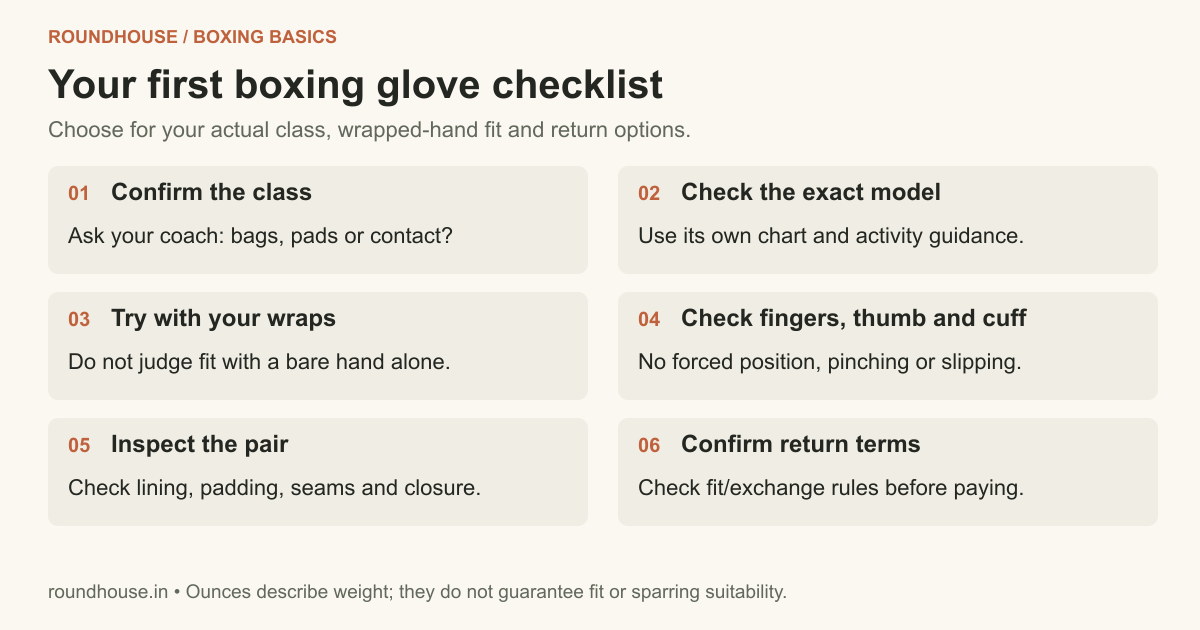
Ask your coach these questions before ordering
Send this message before opening a shopping app:
“I'm buying my first gloves. Will I use them for bags and pads only, or for partner drills too? Which glove type, weight and models do you accept? Can you check the fit and padding before I use them?”
Also ask whether suitable loaner gloves are available for the first session. Do not assume a trial includes equipment. If you have not chosen a gym, our gym-selection guide gives you questions about coaching, supervision and contact boundaries.
You may need different gloves later. That is easier to plan for than buying a pair which your gym will not allow for the activity you intended.
Bag gloves, training gloves and sparring gloves
These labels describe intended use. They are not interchangeable promises of protection.
| Glove category | Intended purchase question | What to check before use |
|---|---|---|
| Bag gloves or bag mitts | Will these be used only on bags and pads? | Read the exact model’s restrictions; a bag-only glove is not a sparring glove |
| General training gloves | Does the maker list the activities my class includes? | “Training” alone does not establish suitability for partner contact |
| Sparring gloves | Does my coach approve this model, weight and condition? | Coach approval is needed before contact; an ounce label alone is insufficient |
| Competition gloves | Are these required for a specific sanctioned event? | Follow that event’s current rules; do not buy fight gloves as a default first training pair |
| Open-finger MMA gloves | Is the coach specifically asking for MMA gloves? | Do not substitute them for boxing gloves in a boxing class |
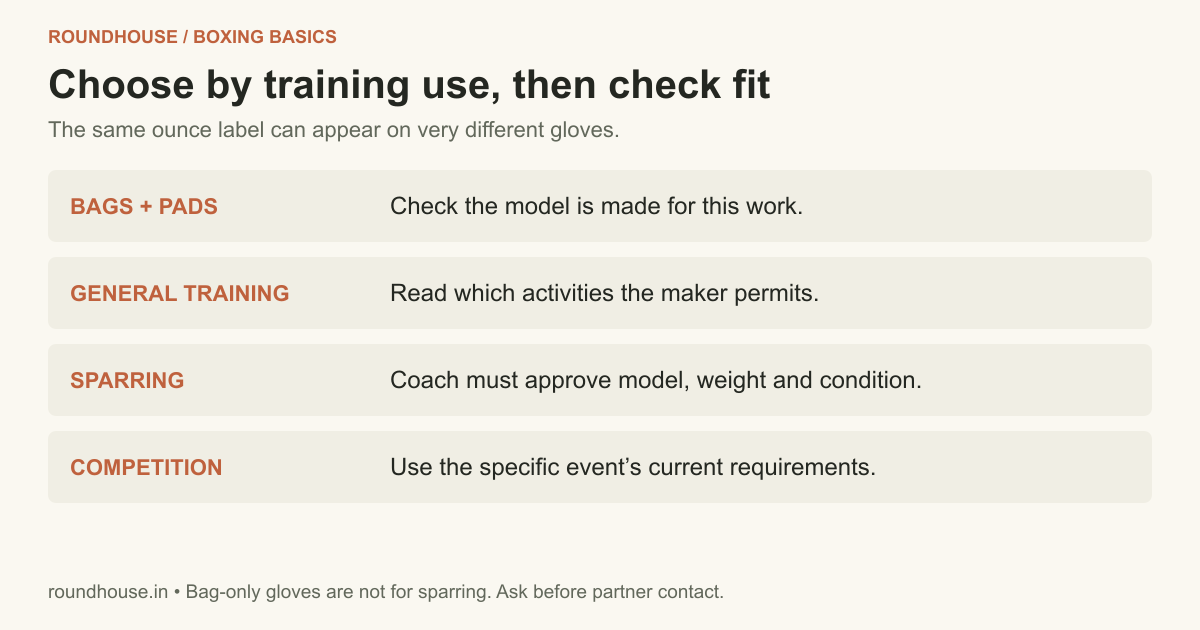
For a concrete example of why the distinction matters, Rival’s RB5 bag-mitt instructions prohibit using that model for sparring or hitting another person. This is a use restriction, not a recommendation to buy it.
If your first class involves bags and pads, buy for that class. If you later progress to sparring, have the coach assess whether a separate pair is needed. Do not assume gloves worn down through bag work remain appropriate for contact.
Still deciding between disciplines? Read MMA vs boxing vs Muay Thai vs BJJ before buying discipline-specific kit.
What do 12 oz, 14 oz and 16 oz mean?
The ounce marking refers to the glove’s nominal weight, not a universal measurement of the space inside it. A heavier label does not tell you exactly how a different model fits, how its padding is distributed or whether a coach will accept it for sparring.
Everlast’s sizing guide suggests 12–14 oz for general training and 16 oz for sparring, while also considering body weight. Treat that as the manufacturer’s starting guidance, not a rule for every adult or brand.
| Label you are considering | A useful question | What the label does not decide |
|---|---|---|
| 10 oz or below | Is this a specific bag model, youth product or competition glove? | It is not automatically the right first glove because it feels light |
| 12 oz | Does this model fit my wrapped hand and suit my bag/pad class? | It does not establish approval for sparring |
| 14 oz | Is this the weight my coach wants for my planned training? | It is not a universal “one pair does everything” choice |
| 16 oz | Is the model actually intended and approved for sparring? | It does not guarantee fit or make head contact safe |
| 18 oz or above | Has my coach or the model-specific chart suggested this for me? | More weight is not automatically a better beginner purchase |
The table is a buying decision aid, not a body-weight prescription. Do not select a child’s gloves from an adult sparring rule of thumb. Ask the youth coach and use the exact product’s youth sizing instructions.
Competition requirements are a separate issue. For example, England Boxing’s 2026 rule-book update changed a competition glove-weight threshold. That illustrates why event rules must be checked; English competition rules are not instructions for a beginner class in India.
Measure your hand, then check the exact model
Use a flexible tape around the palm across the knuckles, following the manufacturer’s diagram. Follow its instruction on whether to measure with or without wraps. Do not add an invented allowance or use a chart from a different model because it looks similar.
Rival’s size charts separate different bag models and sparring gloves, including a 16 oz Small option. This is a useful reminder that glove weight and hand fit are separate decisions.
If your measurement sits between options, ask the seller or manufacturer for model-specific advice and confirm exchange terms. For the actual try-on, wear your normal training wraps. A glove that fits your bare hand may feel quite different once wrapped.
Small hands are a fit question, not a reason to choose a glove marketed by gender alone. Large hands are not a reason to force a purchase which presses the fingers or thumb into an uncomfortable position.
The five-minute try-on checklist
This is an editorial shopping checklist, not a validated safety test. Ask the shop before opening packaging or using the gloves in any way that affects returns.
- Put on your normal wraps. Ask your coach to show you how to wrap correctly. Do not over-tighten wraps to make a loose glove feel secure.
- Seat the hand fully. Your fingers and thumb should rest comfortably. Stop if there is pinching, numbness or pressure that feels wrong.
- Make and relax a fist. Check that you can close the hand without fighting the lining or forcing the thumb into position.
- Fasten the cuff yourself. Check that the closure holds securely without your hand sliding around or the cuff painfully compressing the wrist.
- Check both gloves. Compare the feel of the padding, inspect seams and lining, and look for exposed rough edges or a closure which does not hold.
- Ask for the coach’s check. A comfortable shop fit does not establish that the gloves are suitable for partner work.
Do not test a returnable pair by punching a hard surface or striking a shop bag without permission. Keep the packaging and tags until you understand the return conditions.
For the first training session, introduce the gloves under supervision. Pain is a reason to stop and reassess fit, wrapping and technique; buying more expensive gloves is not a diagnosis. Persistent pain, swelling or numbness needs appropriate medical assessment; see the NHS guidance on wrist pain for warning signs.
Hook-and-loop straps or lace-up gloves?
For a first pair used in ordinary classes, hook-and-loop closures are a practical option to consider because you can fasten and remove them yourself. Check how easily you can operate the actual closure while wearing the other glove.
Lace-up gloves usually require help to fasten correctly. Hayabusa’s buying guide describes the closure trade-off, but its product comparisons are manufacturer marketing rather than an independent ranking.
A closure needs to suit your routine. If you train alone on a bag, needing someone to lace the gloves every time may be inconvenient. If a coach specifically wants a lace-up model for a particular activity, follow their fitting and fastening instructions.
Leather, synthetic materials and build quality
Check the complete glove rather than treating a material label as a quality verdict. Read the model’s material description and care instructions, then inspect the pair you receive.
Useful checks include even-looking padding, intact stitching, a lining that does not bunch under the fingers and a closure that holds properly. A premium outer material does not tell you whether the inside fits your hand.
If you cannot inspect before ordering, ask for clear photos of the actual model and a written exchange policy. A vague “professional quality” description does not answer questions about intended use, sizing or who handles a defect.
For a first purchase, a clear product specification and workable return route are more useful than a claim that a brand is universally best.
How much should you spend in India?
Set a total equipment budget before choosing a pair. Include gloves, suitable wraps and any delivery or import costs. Keep money for the class itself: a first purchase should help you attend, not consume the whole training budget.
Here is an illustrative ₹3,000 shopping envelope, not a seller quote or a claim that these amounts will buy a suitable pair:
| Item | Example allowance |
|---|---|
| Gloves | ₹2,400 |
| Wraps | ₹400 |
| Delivery or contingency | ₹200 |
| Total | ₹3,000 |
If the gloves that fit and meet your coach’s requirements exceed the envelope, revise the budget or ask about a suitable loaner arrangement. Do not make a poor fit acceptable by changing the arithmetic.
Our MMA training cost guide explains how equipment fits into a wider training budget. Its examples are for MMA; confirm what your boxing class actually needs.
Buying online: the details worth checking
Before paying, save the model name, glove weight, hand-size option where offered, seller identity, invoice terms and return conditions. “16 oz boxing gloves” is not a complete specification.
- Check whether returns cover a sizing problem or only a manufacturing defect.
- Check whether trying the gloves with wraps is allowed, and whether used equipment is excluded.
- For imports, check the final delivered cost and who handles exchanges in India.
- Match the seller’s photos and model description to the brand’s own information; an unusually low price alone proves neither authenticity nor a counterfeit.
- Ask what happens if you receive the wrong weight, a damaged closure or an obvious padding defect.
As an example of why you should read the exact product page, Decathlon India’s beginner glove listing displays weight choices and links to warranty and exchange information. Check the selected option, delivery location and current conditions yourself; this guide does not promise availability or a particular return outcome.
This is a selection guide, not a ranked list of “best gloves in India.” No hands-on product testing is claimed for the brands linked here.
When should you replace your gloves?
Inspect them regularly and ask your coach to check changes in the padding or fit. Split surfaces, exposed seams, a failed closure, an uncomfortable thumb position or padding that feels uneven are reasons to stop using the pair and have it assessed.
Do not use a fixed six-month or one-year replacement date as a substitute for inspection. Training volume, use and condition differ. Do not sell worn-out gloves as suitable for sparring simply because the outside still looks presentable.
Keep them dry between sessions
Take gloves out of your bag after training and follow the model’s care label. Wipe them as instructed and allow the inside to dry in a ventilated place before storing them.
Fairtex’s cleaning guidance advises against machine washing, soaking and direct heat, and emphasises airflow. Cleaning products suitable for one material may not suit another; check your own manufacturer’s instructions before applying them.
Use clean, dry wraps and follow the wraps’ separate washing instructions. Do not assume that deodoriser makes damp equipment clean or ready to use.
Frequently asked questions
Should a beginner buy 12 oz, 14 oz or 16 oz gloves?
Start with the activity, your coach’s requirements and the exact model’s fit. Some adults try 12–14 oz for general bag/pad training; 16 oz is a common sparring reference, not a universal size or permission to spar.
Are heavier boxing gloves always safer?
No weight label guarantees suitability or safety. Intended use, padding condition, fit, supervision and the activity all matter. Do not use heavier gloves as a reason to increase head contact.
Can I use bag gloves for sparring?
Do not use a bag-only glove for sparring. Read the manufacturer’s restrictions and have your coach approve the sparring model, weight and condition before contact.
Do I need hand wraps with boxing gloves?
Ask your coach which wraps the class requires and how to use them. Try gloves with those wraps. Adding wraps changes the fit, and overly tight wraps should not be used to compensate for a loose glove.
What if I have small hands but my gym asks for 16 oz?
Look for a suitable hand compartment or a model with an explicit smaller-fit option at the required weight. Ask the coach and manufacturer. Do not assume every 16 oz glove has the same internal fit.
Can I use one pair for bags and sparring?
Only consider it if the manufacturer’s intended use and your coach permit it. Have the condition checked before partner work. A separate pair may be appropriate; a worn bag glove should not be assumed suitable for sparring.
Are expensive or leather gloves always the best first choice?
A higher price or material label does not establish fit or suitability for your class. Prioritise the exact model’s intended use, comfortable fit, sound condition and a workable exchange policy.
Do I need boxing gloves for my first class?
Confirm with the gym before attending. Some offer suitable loaners; others require your own equipment. Check whether wraps or other kit are required and avoid assuming the trial includes everything.
Can I put boxing gloves in the washing machine?
Do not machine-wash them unless the maker explicitly permits it for that model. Follow the care label; the Fairtex guidance cited above recommends controlled wiping and air drying rather than soaking or machine washing.
A simple first-pair decision
Ask the coach what the class needs. Check the exact model’s chart. Try it with wraps. Confirm the intended use and exchange terms. Then buy the pair that passes those checks within your budget.
Before your first session, read our first-class walkthrough for general preparation questions; its illustrative MMA timetable is not a boxing-class schedule. You can also browse boxing gyms on Roundhouse and ask the venue about its actual beginner class.