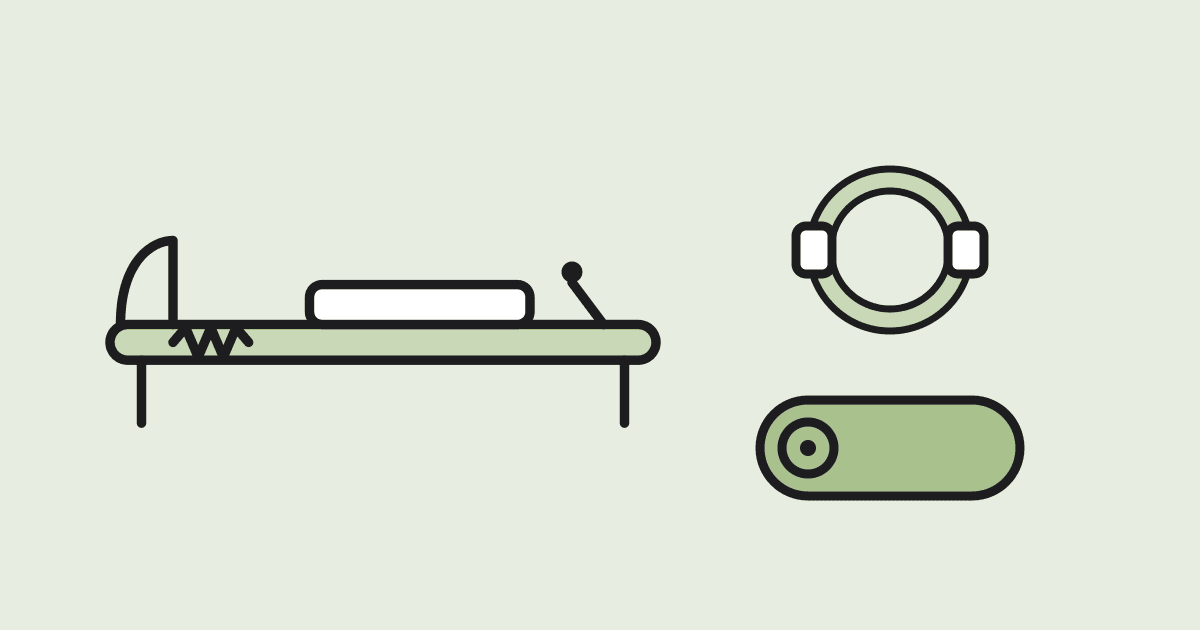
Start with mat Pilates if you want a low-commitment way in that you can keep up at home. Start with the reformer if you want a studio class where springs can make a movement easier or harder, and you are happy to learn the machine first. Both teach the same method. The real differences are equipment, class size and how much the studio has to teach you before you can join a group.
If you already know which you want, the Roundhouse Pilates finder lists reformer, mat and physio-led studios in six Indian cities, each checked against its own website.
What a Pilates reformer is
A reformer is a frame with a padded platform, the carriage, that rolls along rails. Springs connect the carriage to one end of the frame. You lie, sit, kneel or stand on the carriage and move it by pushing against a footbar or pulling ropes or straps (Balanced Body).
The springs are the point. The equipment maker describes them as providing resistance or assistance depending on the exercise (Balanced Body catalogue). Add a spring and a pushing movement gets harder. In other exercises a spring helps you through a range you could not yet control on your own. That is why a reformer can feel both supportive and very hard in the same hour.
The machine is old. Joseph Pilates replaced the weight stack on his early apparatus with coiled springs, lowered the frame and added straps after moving to the United States in 1926, and he named it the Universal Reformer (National Pilates Certification Program). A reformer in the Smithsonian collection carries a patent date of March 1927 (Smithsonian).
What mat Pilates is
Mat Pilates is the same method on the floor. Your body weight and gravity are the only resistance and the only help, with no springs to lighten a hard range (Balanced Body catalogue). Classes often add small props such as a ring, a soft ball or a band.
Because no spring assists you, some mat exercises are harder than their reformer versions, not easier. Mat work is not a lesser version of reformer work. It is the format you can carry anywhere.
Reformer vs mat at a glance
| Reformer | Mat | |
|---|---|---|
| Equipment | A machine per person | A mat, sometimes small props |
| Load | Springs add or take away load | Body weight only |
| Class size | Capped by the number of machines | Can be larger |
| Learning curve | Set-up, springs, getting on and off safely | Learn the movements |
| At home | Needs a machine | Needs floor space |
| Where in India | Studios | Studios, gyms and online |
Class size follows the equipment. Chennai's The Reformry, for example, says it has five reformers and runs small classes (The Reformry), and Pure Pilates in Chennai advertises groups of two to four (Pure Pilates). A mat class has no such ceiling, so ask how many people a class takes.
What the research shows
The evidence for Pilates in healthy adults is modest, and most of it is not a reformer versus mat contest.
- A 12-week mat programme. In a trial of 50 active middle-aged adults, two one-hour mat classes a week for 12 weeks improved abdominal endurance, hamstring flexibility and upper-body muscular endurance compared with a control group. Posture and balance did not improve (Kloubec, 2010). The routine used about 25 basic mat exercises and no equipment.
- A review of the field. The same author's later review found "cautious support" for Pilates improving flexibility, abdominal and lumbo-pelvic stability and muscular activity (Kloubec, 2011).
Two things follow. Mat work alone was enough to change endurance and flexibility in that trial. And this guide did not find strong head-to-head evidence that one format beats the other for healthy beginners. Choose on practical grounds.
Which to start with
Pick mat if:
- you want to try Pilates without committing to a studio package
- you want something you can repeat at home or while travelling
- your nearest studio is a gym or community class without machines
Pick reformer if:
- you like a studio setting and a small class
- you want the springs to scale exercises up or down
- you are ready for an intro or private session first
Many reformer studios start new clients one to one. Chamiers Core in Chennai, for example, recommends starting with private sessions if you have not done other exercise, so the instructor can teach the fundamentals before group classes (Chamiers Core). What to wear and bring is in your first Pilates class.
Physio-led studios, where the website says a physiotherapist is on the team, are worth a look if you are coming back from an injury. That is a question for your physiotherapist, not for this guide.
Reformer and mat studios in India
On 21 November 2026 the Roundhouse Pilates finder listed 94 studios in six cities. Of those, 68 said on their own website that they teach on the reformer, 43 offered mat classes and 13 said a physiotherapist is on the team. Many offer more than one. Filter by type in each city:
- Pilates in Delhi NCR
- Pilates in Mumbai
- Pilates in Bengaluru
- Pilates in Hyderabad
- Pilates in Pune
- Pilates in Chennai
Roundhouse does not print prices. Studios change them often, and many do not publish them. Compare a mat class and a reformer class at the same studio by asking for both.
For a checklist on teachers, class size and trials, read how to choose a Pilates studio.
Frequently asked questions
Is reformer Pilates better than mat Pilates?
Not in any way the evidence settles for healthy beginners. The reformer's springs can make exercises easier or harder. Mat work uses body weight alone and needs no machine. In one 12-week trial, mat classes alone improved abdominal endurance and hamstring flexibility.
Is mat Pilates easier than reformer Pilates?
Not always. On a mat no spring assists you, so some exercises are harder than their reformer versions, where a spring can help you through the movement.
Can a complete beginner do reformer Pilates?
Yes, usually after an intro or private session. The instructor shows you how to set the springs and get on and off the carriage safely before you join a group.
What equipment do I need for mat Pilates at home?
A mat and enough floor space to lie down with your arms overhead. Rings, soft balls and bands are optional extras that classes often use.
How many times a week should I do Pilates?
The trial cited here used two one-hour classes a week for 12 weeks. That is a sensible starting rhythm, not a rule.
Where can I find reformer Pilates near me?
Use the Roundhouse Pilates finder, choose your city and pick the Reformer filter. Turn on Near me to sort studios by distance.