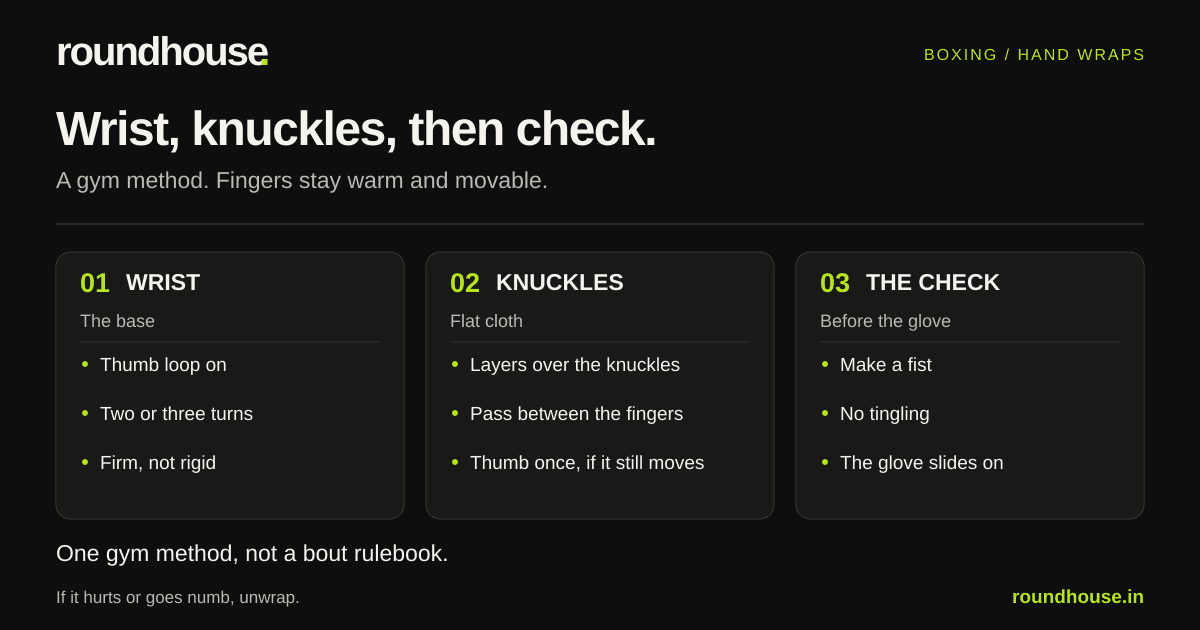
To wrap your hands for boxing, start with the thumb loop, take two or three turns around the wrist, lay flat layers over the knuckles, pass the wrap between the fingers, and finish back at the wrist. The wrap should feel snug when you make a fist, and your fingers should stay warm, their usual colour, and free of tingling. If they do not, unwrap and do it again with less tension.
That order is the method several beginner guides teach. Boxing Trainer London, updated 23 September 2026, uses wrist, knuckles, finger passes, a locking layer and a wrist finish. PunchPro uses the same landmarks and adds one pass around the thumb. ONE Championship's India page also starts from the thumb loop, supports the wrist, covers the knuckles and tells you to ask a coach the first time. None of these is the only legal wrap. They agree on the job: a flat layer, a supported wrist, covered knuckles, and a hand that can still close.
This page is the wrapping method. Choosing 12 oz, 14 oz or 16 oz gloves is a different decision, covered in how to choose your first boxing gloves. Try the gloves with the wraps on. A wrap changes the fit.
Why wrap your hands for boxing
Under the glove, a cloth wrap does three practical things:
- It puts an even layer over the knuckles.
- It gives the wrist something to sit against while you learn to keep the fist and forearm in line.
- It takes up a little space so the hand moves less inside the glove, and it catches some sweat before the lining does.
It does not make a bent-wrist punch safe. It does not let you skip a glove. It is not a splint, and it is not a reason to keep hitting if the hand already hurts. ONE's page is explicit that the first skill is practice, including asking someone who already wraps. Use that. A coach who watches the finished fist will catch a ridge or a gap that a written list will miss.
What length hand wraps to buy
Guides aimed at adult beginners usually point at a long cloth wrap, sold as 180 inches or about 4.5 metres. Those two labels are not the same measurement. One hundred and eighty inches is about 4.57 metres. Shops still print both on the long option.
An Indian product page from Net World Sports sells the same Mexican-style wrap in 2.5 m, 3.5 m and 4.5 m. Boxing Trainer London describes 180 inches as the versatile adult length for bag work, pads and sparring, and a shorter wrap (it uses 120 inches, about 3 metres) for smaller hands or people who want less bulk. PunchPro likewise says 180 inches suits most adult hands.
Buy the length that lets you finish at the wrist without stuffing spare cloth into the palm. If you run out before the wrist is secure, the wrap is too short for the way you wrap, or you used too many early turns. If the palm is a lump and the glove will not go on, you used too much length in the wrong place.
Quick wraps and inner gloves are a different product. They are faster. They also give you less choice about where the wrist support sits. Learn the long cloth wrap if you are going to box regularly. Use a quick wrap only for a light session where your coach is fine with it.
Mexican-style wraps, as ONE describes them, mix cotton with a little stretch. Traditional wraps are closer to plain cotton. Stretch is comfortable and easy to over-tighten. Cotton is stiffer and easier to leave twisted if you rush. The label matters less than a flat finish and fingers that still feel normal.
How to wrap your hands step by step
Sit down. Keep the hand open and the fingers slightly spread. Make a fist only when you are checking the finished wrap, not while you are laying the cloth. The cloth should lie flat. A twist becomes a cord inside the glove.
Do your dominant hand second if you can, or ask someone to start it. Closing the Velcro on your own writing hand is the awkward part, not the pattern.
- Thumb loop. Put the loop on the thumb. The cloth should come off across the back of the hand, not from the palm. The Velcro end stays free.
- Wrist, two or three turns. Take the cloth across the back of the hand and around the wrist. Firm, not a tourniquet. This is the base. Boxing Trainer London says two or three turns. PunchPro says three. Either is fine if the wrist feels supported and you still have cloth left for the knuckles.
- Knuckles, flat. Come diagonally across the back of the hand and lay about three flat passes over the knuckles. Keep the fingers spread so the cloth does not become tight when you close the fist later. Three or four passes is the range those guides use. Stop if the knuckle pad is already bulky.
- Between the fingers. Pass the cloth through each gap, one at a time, and bring it back across the hand. This is what keeps the knuckle layer from sliding when you punch. Do not saw the cloth into the web between the fingers.
- Thumb, once, if you have cloth. Bring the cloth around the thumb once. PunchPro includes this. Keep it loose enough that the thumb still moves. If the thumb tingles, take that pass off. A numb thumb is not extra support.
- Lock, then wrist. One more smooth layer over the knuckles if you still have length, then use what remains around the wrist. Close the Velcro on the wrist. Do not park a thick tab across the knuckles, where it becomes a pressure point inside the glove.
Repeat on the other hand. The second hand is usually worse, because you are wrapping with the hand you just padded. That is normal. Undo it if the cloth twisted.
How tight should boxing hand wraps be
Open the hand. Spread the fingers. Make a fist. Open it again.
| Check | What you want |
|---|---|
| Fingers | Warm, usual colour, no tingling or numbness |
| Knuckles | Covered, with no bare gap and no single thick ridge |
| Wrist | Supported, without a sharp edge on the bone |
| Fist | Closes without the cloth cutting in |
| Palm | Mostly flat, not a ball of spare wrap |
| Glove | The wrapped hand slides in. You do not have to force it |
PunchPro's line is the right standard: firm, and not cutting off circulation. Boxing Trainer London says to rewrap immediately if the fingers tingle, go numb, feel cold or change colour. More tension is not more protection.
Then put the actual glove on. The glove you will use tonight, not a spare pair at home. If the hand will not enter, the wrap is too bulky or the glove is the wrong size for a wrapped hand. Our glove guide covers ounces, bag gloves versus sparring gloves, and why you should try the model with wraps on before you order another pair.
Hand wraps for bag work, pads and sparring
Do not invent a new wrap on the night you spar.
- Bag and pads. You want a stable wrist, covered knuckles, and a glove that does not let the hand slide. The impact is repeated. A loose wrap migrates after a few rounds.
- Sparring. Use a wrap you have already trained in, inside the gloves you will spar in. Ask the coach to look at both fists. A competition or hard sparring session may also ban some cloth and tape. That rule belongs to the gym or the event, not to this page.
- Shadow boxing with no impact. Wraps are optional. Once you touch a pad, a bag or another person, put wraps and gloves on.
If the coach teaches a slightly different path for the thumb or the finger passes, follow the coach. The checks above still apply.
Hand wraps for a boxing competition
A bout can require gauze and tape, a maximum length, a maximum width, and an inspector who signs the wrap. Those limits are in the rules of that event or commission. They are not the same as the reusable cloth wrap you bought for class. Do not arrive at a weigh-in with only this article and assume the official will accept a gym wrap.
Ask the coach, before the week of the fight, what that event allows. If the rules are not published, they are not confirmed.
Common boxing hand wrap mistakes
| What went wrong | What it feels like | What to do |
|---|---|---|
| Too tight | Tingling, cold fingers, a colour change | Unwrap. Less tension. Check again |
| Too loose | Cloth shifts after one round | Even tension, and a real wrist finish |
| Twisted cloth | A ridge on one knuckle | Re-lay that pass flat |
| No finger passes | Knuckle pad slides sideways | Pass between the fingers without pulling the web tight |
| Spare cloth in the palm | The fist will not close, or the glove will not go on | Move length to the wrist, or use a shorter wrap |
| Velcro across the knuckles | A lump under the glove padding | Close the tab on the wrist |
How to wash boxing hand wraps
Unroll wraps after training. Do not leave them damp inside the glove or screwed into a ball in the bag.
Follow the label on the pair you own. As one example, the Net World Sports listing for its own wraps says a cold wash up to 30 degrees Celsius, no tumble dry, no bleach, fasten the strap before washing, and dry naturally. That is that product's instruction, not a rule for every brand. A mesh bag stops a long wrap knotting around the rest of the wash.
Replace a wrap when the cloth is torn, the stretch is gone, or the Velcro no longer holds. A wrap that opens on the bag is not supporting anything.
Frequently asked questions
How do you wrap hands for boxing?
Thumb loop on, two or three turns around the wrist, flat layers over the knuckles, a pass between each finger, an optional single pass around the thumb, then finish and fasten at the wrist. Open and close the hand. Fingers should not tingle.
What length of hand wrap should a beginner buy?
Adult guides usually start with a long wrap sold as 180 inches or about 4.5 metres. Shorter wraps, including 2.5 m and 3.5 m options sold in India, suit smaller hands or a simpler wrap. If you run out before the wrist is secure, the next length up is the useful change.
How tight should boxing hand wraps be?
Snug when you make a fist, never numb. Warm fingers of a normal colour mean the tension is in a usable range. Tingling means unwrap.
Do I need wraps for the heavy bag?
Yes for bag work and pad work. The wrap is part of wearing the glove, not an optional extra for sparring only. Shadow boxing without impact does not require one.
Do wraps change my glove size?
They change the fit. Try the glove with the wrap you will actually use. A wrap should not be cranked tight to make up for a loose glove, and a glove you have to force on is the wrong combination.
Are quick wraps good enough?
They are faster and less adjustable. Learn the long cloth wrap if you train often. Use a quick wrap when the session is light and your coach accepts it.
Can I use this wrap in a competition?
Only if that event's rules allow it. Many bouts specify gauze, tape and an inspection. Ask your coach what the event published. This page is a gym method.